

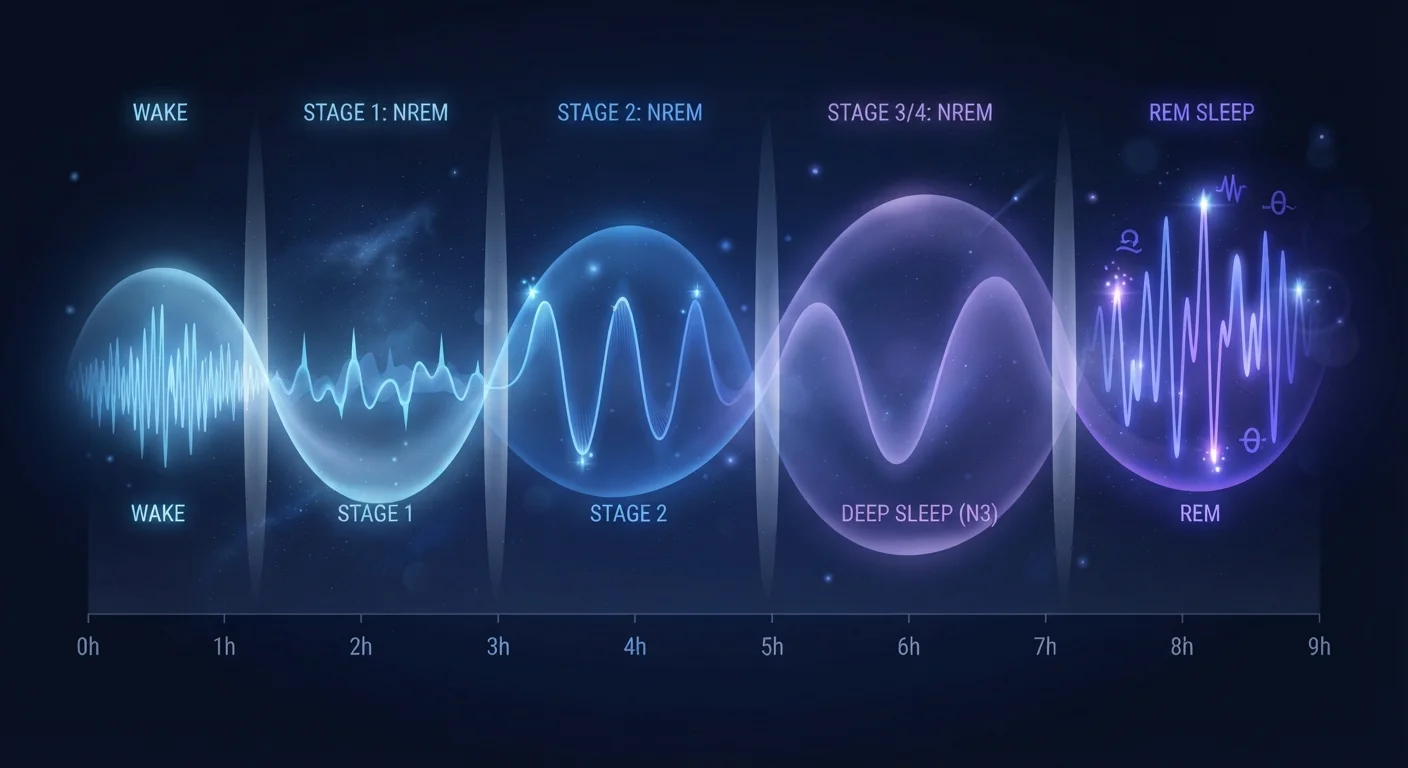
Key Takeaways
- Sleep is not a single uniform state — it cycles through four distinct stages all night.
- One complete sleep cycle lasts roughly 90 minutes; most adults complete four to six per night.
- Deep sleep dominates early in the night; REM sleep becomes longer in later cycles.
- Alcohol, irregular schedules, and sleep disorders can fragment or suppress critical stages.
- Understanding your sleep structure is a first step toward improving how rested you feel each morning.
Start here
What Sleep Architecture Actually Means
Next
The Four Stages at a Glance
Then
How Cycles Shift Across the Night
Apply it
Why Architecture Matters for How You Feel
Watch out for
Common Things That Disrupt Sleep Structure
What Sleep Architecture Actually Means
When researchers and clinicians talk about sleep architecture, they mean the internal organization of your sleep — the predictable sequence of stages your brain moves through from the moment you drift off until you wake. Far from being a passive, uniform shutdown, sleep is an active, structured process driven by shifts in brain activity, hormone release, and nervous system state.
The term comes from sleep science, where polysomnography (a lab-based test that records brain waves, eye movements, and muscle activity) first revealed that sleeping brains follow a remarkably consistent pattern. That pattern is made up of repeating sleep cycles, each roughly 90 minutes long, and within each cycle, several distinct stages unfold in sequence.
Understanding this structure is foundational to understanding why sleep quality matters — not just quantity. Part of our Sleep & Recovery hub explores exactly how rest habits connect to broader health outcomes.
Sleep architecture
The organized pattern of sleep stages that the brain cycles through during a night of sleep, including how long each stage lasts and the order in which they appear.
Sleep cycle
A single run through all sleep stages, lasting approximately 90 minutes. Most adults complete four to six cycles per night.
NREM sleep
Non-rapid eye movement sleep, which includes Stages 1, 2, and 3. It accounts for the majority of sleep time and is especially important for physical restoration.
REM sleep
Rapid eye movement sleep, a stage marked by vivid dreaming, increased brain activity, and temporary muscle paralysis. It plays a key role in memory and emotional processing.
Slow-wave sleep
Another name for Stage 3 deep sleep, characterized by large, slow brain wave patterns (delta waves). It is the most physically restorative stage of sleep.
Polysomnography
A comprehensive sleep study conducted in a clinical setting that records brain waves, eye movements, and other body signals to map sleep stages and detect disorders.
Sleep spindles
Brief bursts of rhythmic brain activity that appear during Stage 2 sleep. They are thought to play a role in protecting sleep and supporting memory consolidation.
Circadian rhythm
The body's internal 24-hour biological clock that regulates the timing of sleep, wakefulness, and many other physiological processes.
The Four Stages at a Glance
Modern sleep science recognizes four stages, organized into two broad categories: non-REM (NREM) sleep and REM sleep.
- Stage 1 (NREM 1): The transition from wakefulness to sleep — light, easily disrupted, lasting just a few minutes. Muscle activity slows and you may experience brief muscle twitches.
- Stage 2 (NREM 2): A deeper state of light sleep where heart rate slows and body temperature drops. Brain waves show distinctive patterns called sleep spindles and K-complexes. This stage accounts for roughly half of total sleep time in adults.
- Stage 3 (NREM 3 — Slow-Wave or Deep Sleep): The most physically restorative stage. Brain waves slow dramatically (called delta waves), making this the hardest stage to wake from. Growth hormone release peaks here, supporting tissue repair and immune function.
- REM Sleep (Rapid Eye Movement): Associated with vivid dreaming. Brain activity increases toward waking levels, while the body's major muscles are temporarily paralyzed — a safeguard against acting out dreams. REM is strongly linked to memory consolidation, learning, and emotional regulation.
For a deeper breakdown of what each stage does physiologically, see The Four Stages of Sleep, Decoded.
How Cycles Shift Across the Night
One of the most important — and often overlooked — aspects of sleep architecture is that cycles are not identical. The balance of stages shifts significantly between the first and last cycles of the night.
In the early cycles (roughly the first half of the night), Stage 3 deep sleep dominates. Your body prioritizes physical restoration early. In the later cycles (the second half of the night), deep sleep shrinks and REM periods grow longer and more intense — sometimes lasting 45 to 60 minutes in the final cycle before waking.
This timing is why cutting sleep short — even by an hour or two — disproportionately robs you of REM sleep. Waking up two hours early doesn't just mean less sleep; it means losing the most REM-rich portion of the night. Similarly, going to bed very late compresses early deep sleep into a shorter window.
To understand the full picture of what your body is doing during these cycles, Inside the Sleeping Brain offers a detailed look at the biological processes unfolding stage by stage.
Why Architecture Matters for How You Feel
Two people can sleep the same number of hours and wake up feeling very differently. Sleep architecture helps explain why. A night fragmented by frequent awakenings — even brief ones you don't remember — can prevent you from spending adequate time in deep or REM sleep, leaving you fatigued despite technically logging eight hours.
Research consistently links well-structured sleep to better cognitive performance, mood stability, physical recovery, and immune resilience. Disrupted architecture, on the other hand, is associated with daytime sleepiness, impaired memory, and reduced capacity for physical repair — even when total sleep time looks sufficient on paper.
It's also worth knowing that sleep architecture changes naturally across life. Children spend far more time in deep sleep than adults, and older adults often see less Stage 3 sleep and more fragmentation. How Sleep Changes From Infancy Through Old Age covers these normal developmental shifts in detail.
This article is for general informational purposes only and is not a substitute for professional medical advice, diagnosis, or treatment. If you have concerns about your sleep health, consult a qualified healthcare provider.
Common Things That Disrupt Sleep Structure
Many everyday factors can alter the normal cycling of sleep stages without the person realizing it. Awareness of these is a practical first step toward protecting sleep quality.
Protect Your Later Sleep Cycles
Because REM sleep is concentrated in the final hours of the night, even a single night of cutting sleep short can meaningfully reduce how much you get. If your schedule allows flexibility, prioritizing a consistent, full-length sleep window — rather than making up for lost sleep with naps — helps preserve the full cycle structure your brain needs.
- Alcohol: Suppresses REM sleep in the first half of the night and increases sleep fragmentation in the second half, even at moderate amounts.
- Irregular sleep timing: The body's circadian rhythm coordinates when each stage occurs. Shifting sleep timing — including on weekends — can misalign stages with their optimal biological windows.
- Caffeine consumed late in the day: Caffeine blocks adenosine, a chemical that builds sleep pressure. Consuming it too close to bedtime can delay sleep onset and reduce deep sleep.
- Sleep disorders: Conditions such as obstructive sleep apnea fragment sleep repeatedly throughout the night, preventing sustained time in deep or REM sleep. A healthcare provider or sleep specialist can assess and treat these conditions.
- Stress and anxiety: Elevated arousal keeps the nervous system alert, making it harder to reach and sustain deeper stages.
Understanding that sleep architecture is fragile — and that daily habits directly shape it — is one of the most useful insights you can take from sleep science. For a complementary look at what the stages each do for your body, see The Stages of Sleep and What Each One Actually Does for Your Body.