

| Number of sleep stages | 4 (NREM 1, NREM 2, NREM 3, REM) |
| Average cycle length | ~90 minutes (National Sleep Foundation) |
| Cycles per night | 4–6 complete cycles |
| Stage 2 share of total sleep | ~45–55% in adults |
| Deep sleep concentration | Mostly in first half of the night |
| REM sleep concentration | Increases in later cycles |
Why Sleep Stages Matter
Sleep isn't a single, uniform state of unconsciousness. It's a structured biological process made up of repeating cycles — typically four to six per night — each containing distinct stages with different purposes. Understanding what those stages do helps explain why cutting sleep short, or waking frequently, leaves you feeling less than restored even if the total hours seem adequate.
Sleep researchers divide a full night into two broad categories: NREM (non-rapid eye movement) sleep, which encompasses three stages, and REM (rapid eye movement) sleep. Together they form one complete cycle lasting roughly 90 minutes. See Sleep Science hub for a broader look at how sleep biology affects your health. For a comparison with conscious rest, learn what non-sleep rest actually does for your body and mind.
| Number of sleep stages | 4 (NREM 1, NREM 2, NREM 3, REM) |
| Average cycle length | ~90 minutes (National Sleep Foundation) |
| Cycles per night | 4–6 complete cycles |
| Stage 2 share of total sleep | ~45–55% in adults |
| Deep sleep concentration | Mostly in first half of the night |
| REM sleep concentration | Increases in later cycles |
The Four Sleep Stages, Explained
Stage 1 — Light Sleep (NREM 1)
This is the brief transition between wakefulness and sleep, typically lasting just one to seven minutes. Muscle activity slows, heart rate begins to drop, and the brain shifts from alert beta waves to slower alpha and theta waves. You can be easily roused here, and some people experience sudden muscle twitches — called hypnic jerks — as the body settles into sleep.
Stage 2 — Stable Light Sleep (NREM 2)
This stage makes up a large portion of total sleep time — roughly 45–55% in adults. Body temperature drops, eye movements stop, and the brain begins producing sleep spindles: short bursts of rhythmic neural activity thought to support memory consolidation and protect sleep from outside noise. Heart rate and breathing continue to slow. Stage 2 is important for cognitive function and motor skill learning.
Stage 3 — Deep Sleep (NREM 3)
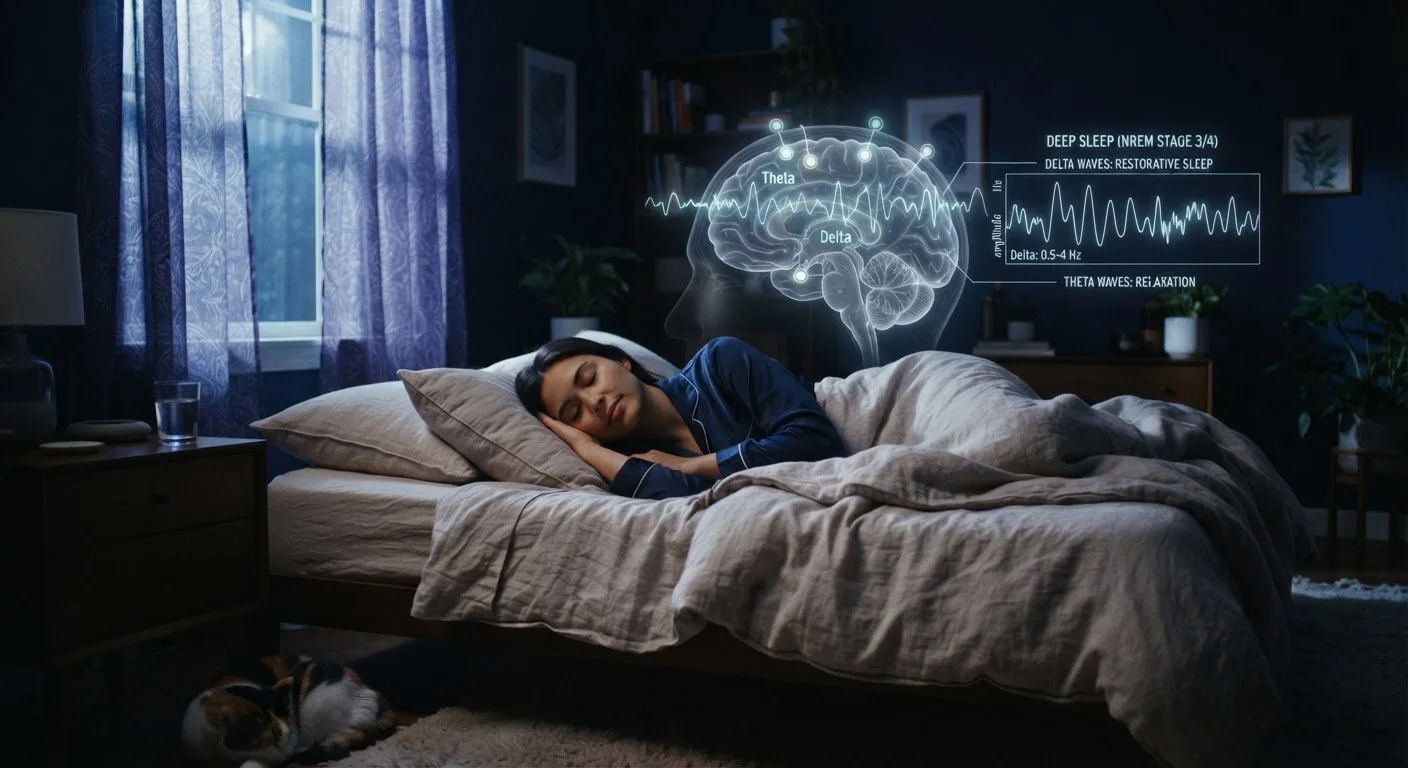
Often called slow-wave sleep due to its characteristic delta brain waves, this is the most physically restorative stage. Growth hormone is released, tissue repair occurs, and the immune system is reinforced. It's hardest to wake someone from deep sleep, and doing so often results in grogginess. Deep sleep is most abundant in the first half of the night. Sleep's critical role in physical recovery is closely tied to this stage.
Stage 4 — REM Sleep
REM sleep is when most vivid dreaming occurs. The brain becomes highly active — nearly as active as when awake — while the body's voluntary muscles are temporarily paralyzed. This stage supports emotional processing, memory consolidation, and learning. REM periods lengthen across the night, meaning the final hours of sleep are disproportionately rich in this stage. Cutting sleep short by even an hour or two can significantly reduce REM exposure. See a detailed breakdown of REM and deep sleep for more on their mental health roles.
How the Stages Work Together
No single stage is dispensable. Early cycles are weighted toward deep sleep; later cycles contain more REM. Disrupting any part of the cycle — whether through alarm clocks, alcohol, or inconsistent bedtimes — can shift this balance and shortchange specific stages without reducing total sleep time. For a complete picture of what unfolds neurologically across a full night, explore what your body is actually doing each night.
The Sleep & Recovery hub covers how stage-dependent sleep quality connects to mental clarity and emotional resilience. Healthy sleep habits — consistent timing, a cool and dark bedroom, limiting stimulants before bed — help preserve the natural architecture of these cycles.
This article is for informational purposes only and is not a substitute for professional medical advice. If you have concerns about your sleep quality or a sleep disorder, consult a qualified healthcare provider.