

Key Takeaways
- Calorie density measures how much energy a food provides per gram or serving.
- Nutrient density measures how many vitamins, minerals, and beneficial compounds come with those calories.
- High-calorie foods are not automatically unhealthy, and low-calorie foods are not automatically nutritious.
- Whole foods typically offer a stronger nutrient-to-calorie ratio than heavily processed alternatives.
- Understanding both concepts helps you make more informed food choices without eliminating entire food groups.
Our Verdict
Calorie density and nutrient density are two lenses for evaluating food, and neither tells the full story on its own. The most practical approach for everyday eating is to favor foods that deliver meaningful nutrition alongside their calories — without treating any single food as inherently off-limits.
| Best for | Recommended |
|---|---|
| Those managing total energy intake | Prioritizing low-calorie-density, high-nutrient-density foods |
| Those focused on micronutrient sufficiency | Emphasizing nutrient density across all meals |
| Those with higher energy needs (athletes, active individuals) | Balancing calorie-dense foods with nutrient-rich options |
| General healthy eating for most American adults | Using both concepts together as complementary guides |
Defining the Two Concepts
Calorie density refers to the number of calories (technically kilocalories) packed into a given weight or volume of food — typically expressed per 100 grams. Foods like oils, nuts, and refined grains are calorie-dense, meaning a small portion delivers a large amount of energy. Foods like leafy greens, cucumbers, and broth-based soups are low in calorie density because water and fiber make up most of their weight.
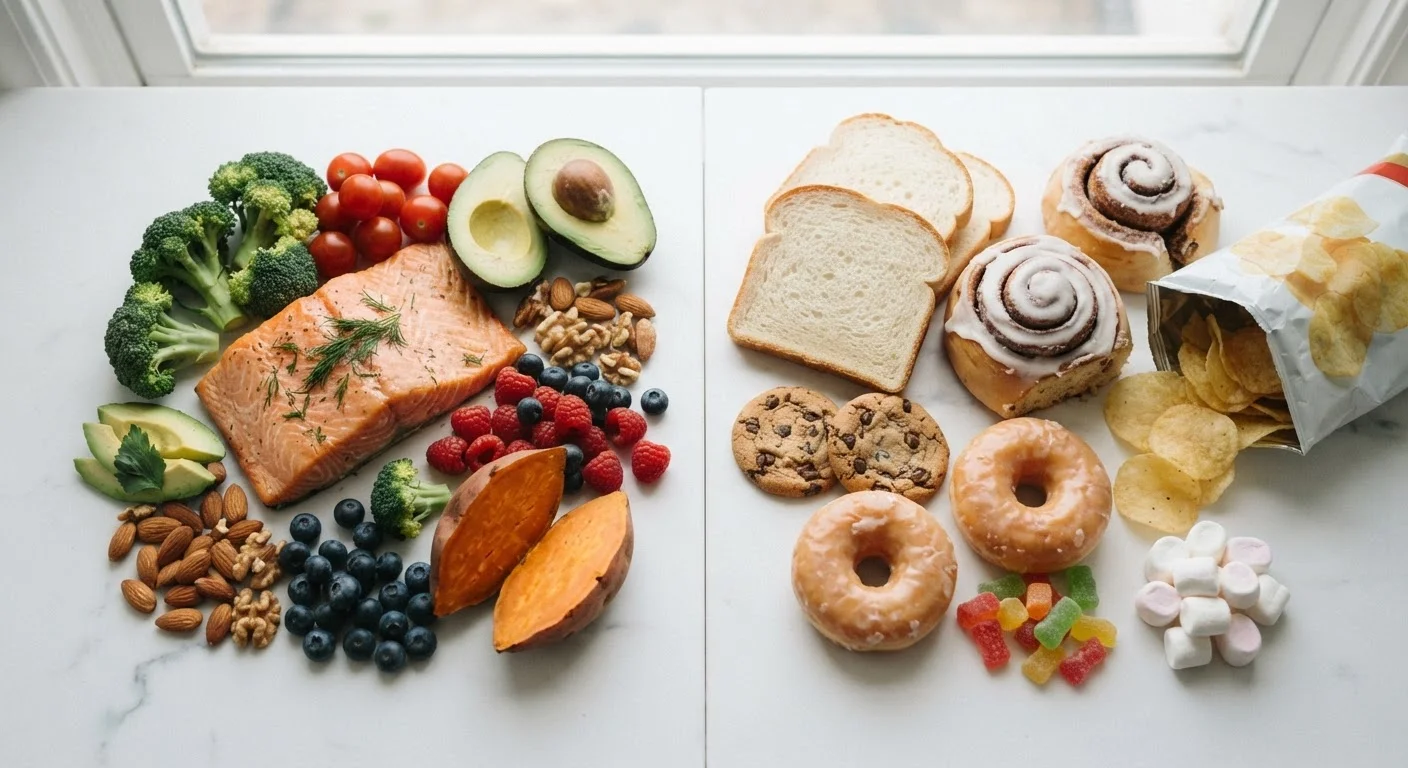
Nutrient density refers to how much nutritional value — vitamins, minerals, fiber, protein, and other beneficial compounds — a food provides relative to the calories it contains. A food can be high in calories and high in nutrients (avocado, salmon), or low in calories and low in nutrients (iceberg lettuce, diet soda). The two measures don't automatically move together.
To understand why this distinction matters for daily food choices, it helps to first understand what macronutrients are doing in the first place. See our plain-language breakdown of carbs, protein, and fat for the foundational context.
How Calorie Density Plays Out in Real Food
A tablespoon of olive oil contains roughly 120 calories in about 14 grams — that's high calorie density. A cup of raw spinach contains around 7 calories in 30 grams — that's extremely low calorie density. Neither is better by default; the question is what role each plays in your overall eating pattern.
High-calorie-density foods become a concern primarily when they crowd out more nutritious options or when portions are easy to underestimate. A handful of mixed nuts is genuinely nutritious, but the calories accumulate quickly in a way that a bowl of steamed vegetables simply does not. This is why calorie density matters for people trying to manage their overall energy intake without counting every gram.
| Calorie Density | Nutrient Density | |
|---|---|---|
| What it measures | Energy per gram of food | Nutrients per calorie of food |
| Primary use | Managing total energy intake | Ensuring nutritional adequacy |
| High example | Oils, nuts, refined grains | Leafy greens, legumes, salmon |
| Low example | Raw vegetables, broth soups | Diet soda, plain rice cakes |
| Can overlap? | Yes — nuts are high in both | Yes — greens are low in both |
| Practical takeaway | Watch portions of energy-rich foods | Choose foods that deliver real nutrition |
Low-calorie-density diets — built around foods with high water and fiber content — are associated with greater satiety at fewer calories, according to research summarized in the Dietary Guidelines for Americans. But eating only low-density foods without attention to nutritional content could still leave gaps in protein, healthy fats, or key micronutrients.
Why Nutrient Density Is the More Actionable Lens
For most everyday eaters, nutrient density is the more practical concept to build habits around. Rather than calculating calories per gram, you can ask a simpler question: What does this food actually deliver?
The USDA's Dietary Guidelines encourage Americans to focus on "nutrient-dense foods" — defined as foods that provide vitamins, minerals, and other health-promoting components with relatively little added sugars, saturated fat, or sodium. Think whole grains over refined ones, beans over chips, plain yogurt over heavily sweetened varieties.
This framework aligns well with how macronutrients influence body composition over time. As explored in how macronutrients affect lean mass and fat storage, the source of your calories — not just the number — matters for how your body partitions energy. Protein from whole food sources, for example, carries a different metabolic effect than the same number of calories from refined carbohydrates.
Applying Both Concepts Together
The most useful approach treats calorie density and nutrient density as complementary tools rather than competing priorities. Here's a practical way to think about it:
- Use nutrient density to choose what to eat. Prioritize foods that bring vitamins, minerals, fiber, and quality macronutrients to your plate.
- Use calorie density to manage how much. Be mindful that some nutritious foods are energy-rich and can contribute significantly to daily intake even in modest portions.
- Avoid equating low-calorie with healthy. Diet soda and plain rice cakes are low in calories but offer little nutritional value. A small serving of walnuts is calorie-dense but nutritionally meaningful.
Different eating patterns shift these balances in different ways — what common dietary patterns actually look like in real food terms can help you see how calorie and nutrient distribution vary across approaches like Mediterranean, low-carb, or plant-based diets.
If you track your food intake using nutrition labels, understanding where to find macronutrient data is essential. Reading a nutrition label for macros without the confusion walks through exactly what those numbers mean in context.
This article is for general informational and educational purposes only and does not constitute medical or dietary advice. Consult a registered dietitian or qualified healthcare professional for personalized nutrition guidance.