

| Newborn daily sleep need | 14–17 hours (National Sleep Foundation guidelines) |
| Teen recommended sleep | 8–10 hours per night (American Academy of Sleep Medicine) |
| Adult recommended sleep | 7–9 hours per night (National Sleep Foundation) |
| Sleep cycle length | ~90 minutes (Established sleep physiology consensus) |
| Age slow-wave sleep begins declining | Mid-30s onward (Sleep research literature) |
| REM sleep share in healthy adults | ~20–25% of total sleep (Established sleep physiology consensus) |
Sleep Architecture: A Brief Primer
Sleep is not a single, uniform state. Every night, the brain cycles through distinct stages — light non-REM sleep, deep slow-wave sleep, and REM (rapid eye movement) sleep — each serving different restorative functions. These cycles last roughly 90 minutes and repeat four to six times per night in healthy adults. What changes profoundly across a lifetime is how those stages are distributed, how long sleep lasts, and when in the 24-hour day it occurs.
| Newborn daily sleep need | 14–17 hours (National Sleep Foundation guidelines) |
| Teen recommended sleep | 8–10 hours per night (American Academy of Sleep Medicine) |
| Adult recommended sleep | 7–9 hours per night (National Sleep Foundation) |
| Sleep cycle length | ~90 minutes (Established sleep physiology consensus) |
| Age slow-wave sleep begins declining | Mid-30s onward (Sleep research literature) |
| REM sleep share in healthy adults | ~20–25% of total sleep (Established sleep physiology consensus) |
Understanding these shifts helps distinguish normal age-related changes from patterns worth discussing with a healthcare provider. For a broader look at the habits that support quality sleep at any age, see our complete guide to sleep hygiene.
Infancy and Early Childhood (0–5 Years)
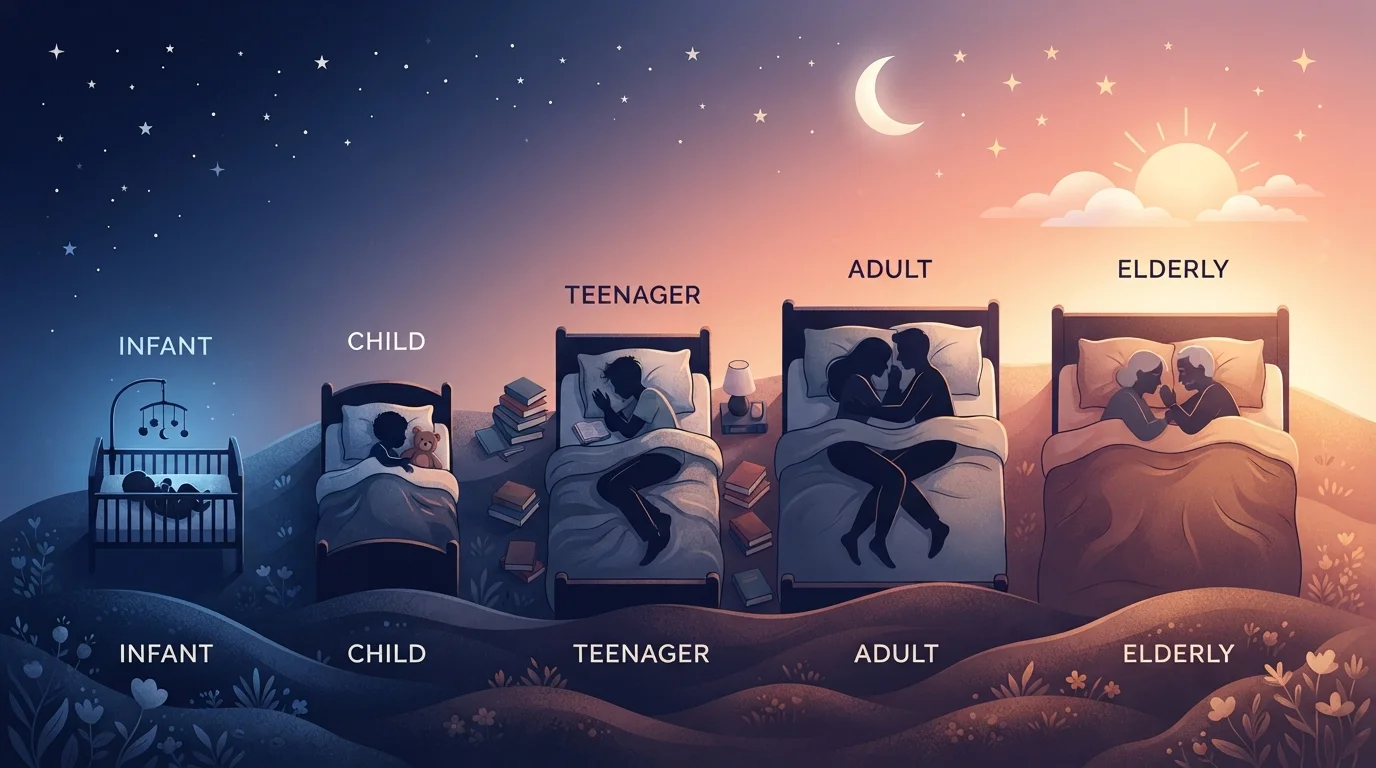
Newborns sleep 14–17 hours per day, but their sleep is radically different from adult sleep. Infants enter sleep directly through an active, REM-like state — a pattern that reverses in the first few months of life as the brain matures. Slow-wave deep sleep, which is critical for physical growth and early brain development, dominates infant sleep architecture.
By around three to six months, circadian rhythms begin consolidating, and nighttime sleep lengthens. Toddlers still require 11–14 hours, often split between nighttime sleep and one daytime nap. Napping tapers off between ages three and five as consolidated nocturnal sleep becomes sufficient.
REM Sleep
Rapid eye movement sleep is the stage associated with vivid dreaming, emotional memory consolidation, and brain restoration. It accounts for roughly 20–25% of total sleep in healthy adults.
Slow-Wave Sleep
Also called deep sleep or N3, this is the most restorative stage of non-REM sleep. It supports physical repair, immune function, and memory consolidation, and declines significantly with age.
Circadian Rhythm
The body's internal 24-hour biological clock that regulates sleep-wake timing, hormone release, and other physiological processes in response to light and darkness.
Sleep Architecture
The structural pattern of sleep stages — light non-REM, deep non-REM, and REM — and how they cycle and distribute across a night of sleep.
Circadian Phase Delay
A biological shift in the timing of the sleep-wake cycle toward later hours. It occurs naturally during puberty and causes adolescents to feel alert later at night and sleepy later in the morning.
School Age Through Adolescence (6–17 Years)
School-age children need 9–12 hours of sleep nightly. Their sleep is remarkably efficient — rich in slow-wave sleep that supports memory consolidation, immune function, and growth hormone secretion. Behavior and academic performance are closely tied to sleep quality at this stage.
Adolescence introduces one of the most significant biological sleep shifts: a delayed circadian phase. Puberty triggers a genuine neurological preference for later sleep and wake times — not simply a behavioral choice. This means teenagers' bodies are biologically primed to fall asleep later and wake later, which frequently conflicts with early school start times. Recommended sleep for teens is 8–10 hours per night. Learn more about how sleep architecture shifts across the full lifespan.
Adulthood (18–64 Years)
Adults generally function best with 7–9 hours of sleep. Sleep architecture stabilizes in early adulthood but begins a gradual shift around the mid-30s: slow-wave sleep starts to decline, and the proportion of lighter sleep stages increases. REM sleep remains relatively preserved into middle age.
Stress, shift work, parenting demands, and lifestyle factors frequently fragment sleep during these decades — making consistent sleep practices especially important. The Sleep & Recovery hub offers guidance on building sustainable rest habits throughout working adulthood.
Older Adulthood (65 and Beyond)
Aging brings well-documented changes to sleep that are distinct from sleep disorders. Older adults experience less slow-wave sleep, more frequent nighttime awakenings, and an advance in circadian timing — an earlier natural bedtime and wake time. Total sleep time may shorten modestly, though sleep need does not meaningfully decrease.
Conditions common in older age — chronic pain, sleep apnea, medication effects, and reduced light exposure — can further disrupt sleep architecture. Many of these factors are addressable with appropriate clinical support. Research increasingly links sustained poor sleep in later life to cognitive and cardiovascular health outcomes, a topic explored in depth in our article on sleep and longevity.
This article is for general informational purposes only and does not constitute medical advice. Consult a qualified healthcare professional for concerns about your sleep or health.