

| Number of Sleep Stages | 4 (NREM Stages 1–3 + REM) (American Academy of Sleep Medicine) |
| Average Cycle Length | ~90 minutes (National Sleep Foundation) |
| Cycles Per Night | 4–6 complete cycles (National Institutes of Health) |
| Stage With Most Time | Stage 2 (~45–55% of total sleep) (Sleep Medicine Reviews) |
| Most Physically Restorative Stage | Stage 3 (slow-wave / deep sleep) (National Institutes of Health) |
| REM Sleep Proportion | ~20–25% of total sleep in adults (American Academy of Sleep Medicine) |
How Sleep Is Structured
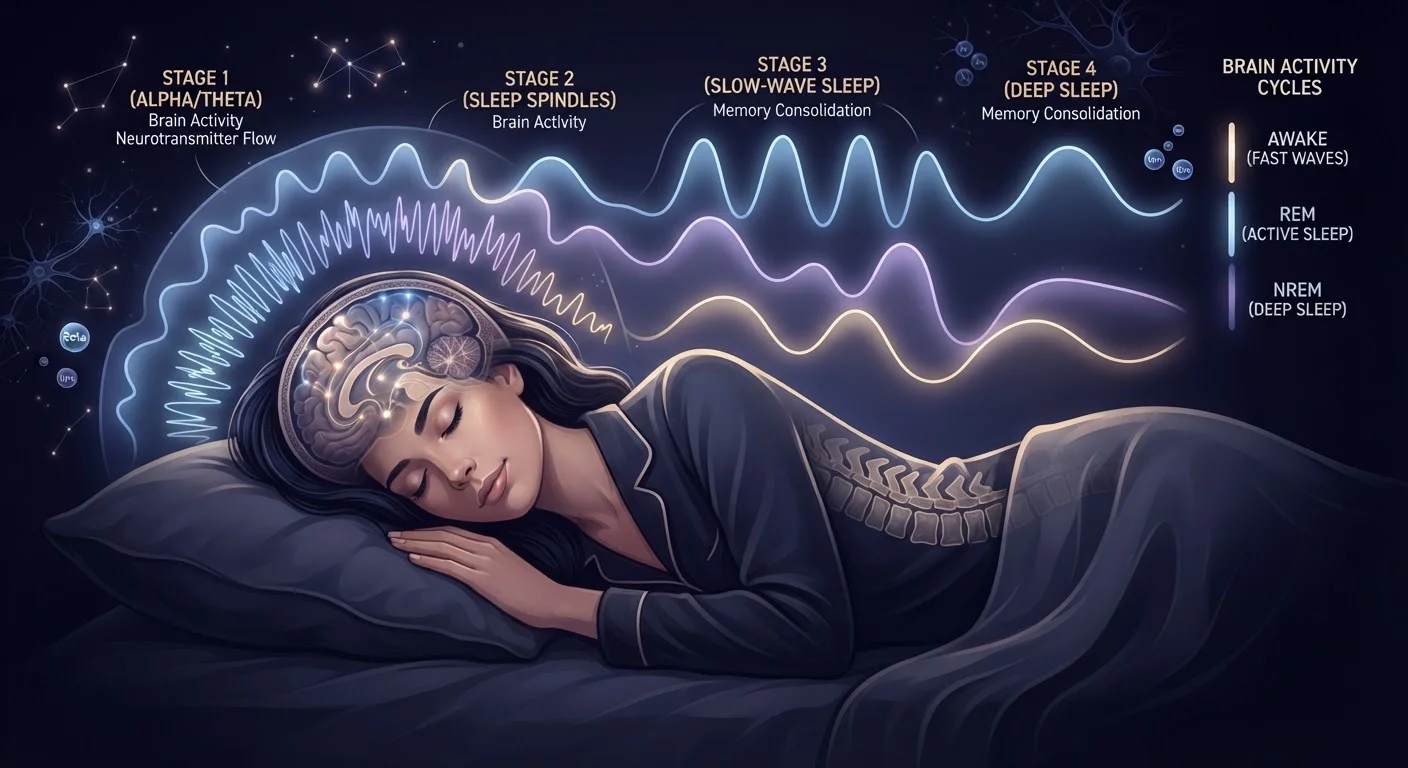
Sleep is not a uniform state of unconsciousness. Each night, your brain and body cycle through four distinct stages, organized into roughly 90-minute blocks that repeat four to six times. Understanding what happens in each stage explains why a full night's sleep — not just enough hours, but enough cycles — is essential for waking up restored.
The four stages fall into two broad categories: non-REM (NREM) sleep, which includes Stages 1, 2, and 3, and REM (rapid eye movement) sleep, which makes up Stage 4. Each plays a non-interchangeable role in physical repair, memory, and emotional health. For a deeper look at how these stages relate to overall well-being, see the Sleep & Recovery hub or the full breakdown of what each stage does for your body.
| Number of Sleep Stages | 4 (NREM Stages 1–3 + REM) (American Academy of Sleep Medicine) |
| Average Cycle Length | ~90 minutes (National Sleep Foundation) |
| Cycles Per Night | 4–6 complete cycles (National Institutes of Health) |
| Stage With Most Time | Stage 2 (~45–55% of total sleep) (Sleep Medicine Reviews) |
| Most Physically Restorative Stage | Stage 3 (slow-wave / deep sleep) (National Institutes of Health) |
| REM Sleep Proportion | ~20–25% of total sleep in adults (American Academy of Sleep Medicine) |
The Four Stages, One by One
Stage 1 — Light NREM Sleep
Stage 1 is the transition between wakefulness and sleep, typically lasting just one to seven minutes. Muscle activity slows, eye movements become rolling and slow, and the brain shifts from alpha to theta waves. You're easy to wake at this point, and you may experience hypnic jerks — those sudden muscle twitches common as you drift off.
Stage 2 — Consolidated NREM Sleep
Stage 2 accounts for roughly 45–55% of total sleep time in adults, making it the most prevalent stage across the night. Brain activity slows further but is punctuated by two defining features: sleep spindles (brief bursts of rhythmic activity linked to memory consolidation) and K-complexes (large, slow waves thought to suppress arousal and protect sleep continuity). Core body temperature drops and heart rate slows during this stage.
Stage 3 — Deep (Slow-Wave) NREM Sleep
Stage 3 is the most physically restorative stage. Also called slow-wave sleep, it's dominated by high-amplitude delta waves and is when the body prioritizes tissue repair, immune function, and the release of growth hormone. It is hardest to be woken from this stage, and waking from it typically produces grogginess. Deep sleep is most abundant in the first half of the night and diminishes with age. For a detailed look at the repair work that happens here, see Sleep's Role in Physical Recovery.
Stage 4 — REM Sleep
REM sleep emerges approximately 90 minutes after sleep onset and grows longer with each successive cycle — the final REM period can last up to an hour. The brain is highly active, close to waking levels, while voluntary muscles are temporarily paralyzed. Dreams are most vivid here. REM is central to emotional regulation, creative thinking, and the consolidation of procedural and emotional memories. REM sleep does far more than generate dreams — it's a cornerstone of mental and emotional resilience.
NREM Sleep
Non-rapid eye movement sleep encompasses Stages 1, 2, and 3. It is characterized by progressively slower brain waves and is essential for physical restoration and memory processing.
REM Sleep
Rapid eye movement sleep is Stage 4, marked by high brain activity, temporary muscle paralysis, and vivid dreaming. It plays a critical role in emotional regulation and memory consolidation.
Sleep Spindles
Brief bursts of oscillating brain activity seen in Stage 2 sleep. They are associated with the brain's ability to consolidate newly acquired memories and filter out external stimuli.
Slow-Wave Sleep
Another name for Stage 3 (deep NREM) sleep, defined by high-amplitude delta brain waves. It is the most physically restorative phase, supporting tissue repair and immune function.
Sleep Architecture
The overall pattern and sequence of sleep stages across a night. Healthy sleep architecture means cycling through all four stages multiple times in proper proportion.
Delta Waves
The slowest, highest-amplitude brain waves, predominant during Stage 3 deep sleep. Their presence signals the deepest, most restorative phase of the sleep cycle.
Why All Four Stages Matter
Cutting sleep short — even by one or two hours — disproportionately reduces REM sleep, since REM periods lengthen across the night. Alcohol, certain medications, and irregular schedules can suppress deep sleep or REM independently, leaving the body and mind under-restored even after what feels like a full night. For a plain-language look at what REM and deep sleep actually do for mental clarity, each stage has its own irreplaceable contribution to how you think, feel, and function.
The practical takeaway: optimizing sleep is not just about duration. Protecting sleep architecture — allowing uninterrupted cycles to complete — is what determines whether sleep is genuinely restorative. If you consistently wake unrefreshed, consult a healthcare professional, as disrupted sleep architecture can be a sign of underlying conditions like sleep apnea or insomnia.
This article is for general informational and educational purposes only and does not constitute medical advice. Consult a qualified healthcare professional for concerns about your sleep health or any related symptoms.