

Key Takeaways
- Muscle tissue burns more calories at rest than fat tissue, making lean mass a key driver of metabolic rate.
- Higher body fat - especially visceral fat - is linked to metabolic inefficiency and chronic disease risk.
- Metabolic rate naturally declines with age, largely due to gradual muscle loss (sarcopenia).
- Resistance training and adequate protein intake are among the most evidence-supported strategies for preserving lean mass.
- Body weight alone doesn't reflect these dynamics - body composition is the more meaningful measure.
Metabolic Rate & Body Composition
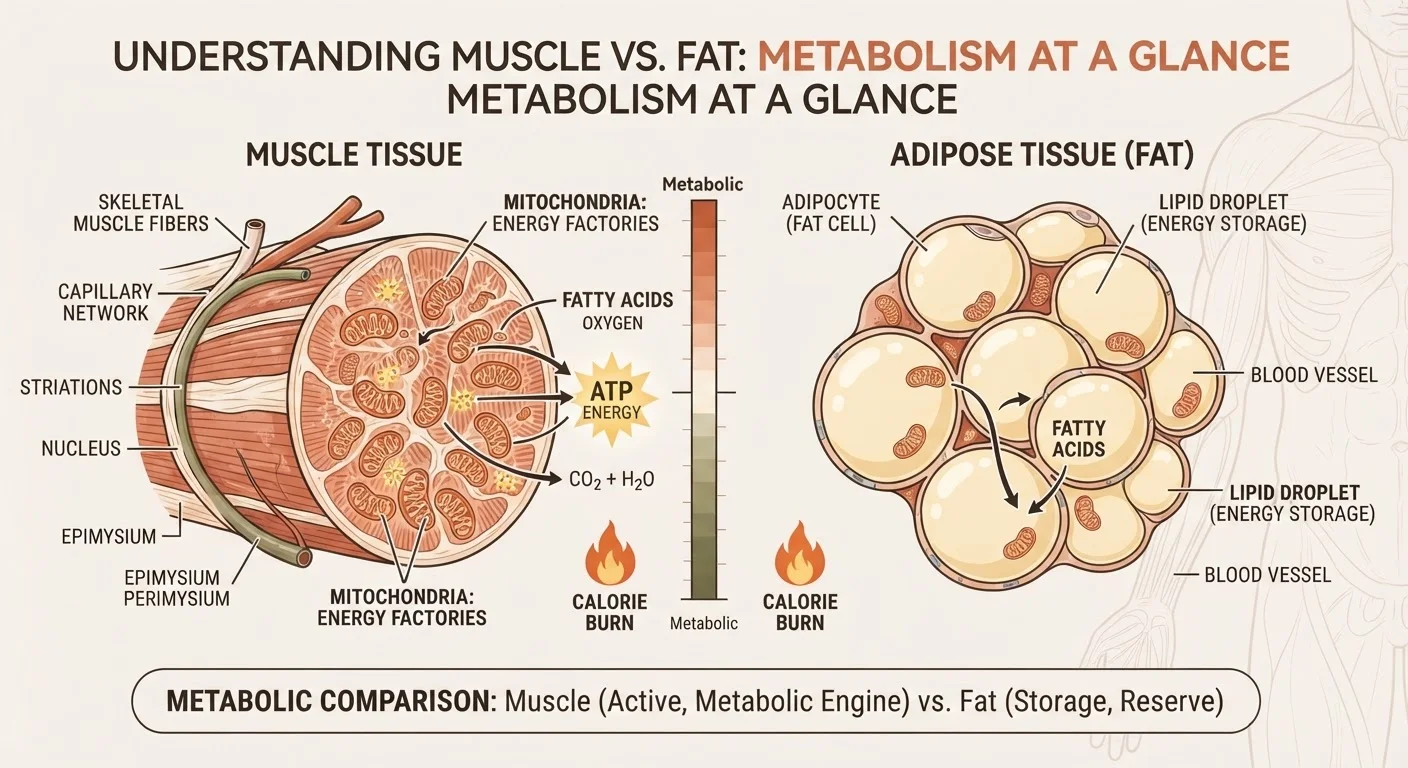
Your metabolic rate is the speed at which your body burns calories to sustain itself. Body composition - the ratio of muscle to fat - directly influences this rate, because muscle tissue is more metabolically active than fat tissue. Together, these two factors shape how efficiently your body uses and stores energy throughout your life.
Resting metabolic rate (RMR) accounts for roughly 60-70% of total daily energy expenditure in most adults, and lean mass is its strongest predictor among controllable variables.
Why Muscle and Fat Are Not Metabolically Equal
When most people think about body weight, they picture a single number. But that number tells you almost nothing about what the body is actually made of - or how it functions. Muscle and fat are chemically and metabolically distinct tissues, and understanding that difference is foundational to understanding energy and long-term health.
Skeletal muscle is energetically expensive to maintain. Even at rest, muscle fibers consume oxygen and fuel to sustain cellular processes. Fat tissue, by contrast, is primarily a storage depot and requires comparatively little ongoing energy. This metabolic gap means that two people with identical body weights can have meaningfully different resting calorie needs depending on their muscle-to-fat ratio.
See why the scale doesn't capture this distinction for a broader look at what body composition actually measures.
~20-30%
More calories burned by muscle vs. fat at rest
Skeletal muscle burns roughly 6 calories per pound per day at rest, compared to approximately 2 calories for fat tissue, according to exercise physiology research.
3-8%
Muscle mass lost per decade after age 30
Research published in the Journal of Gerontology estimates adults lose 3-8% of muscle mass per decade without active countermeasures, accelerating after age 60.
60-70%
Of daily energy use attributed to resting metabolic rate
Resting metabolic rate accounts for the majority of total daily energy expenditure in most adults, with lean mass being one of its strongest modifiable predictors.
How Body Fat Distribution Affects Metabolic Health
Not all fat is stored equally. Subcutaneous fat sits just beneath the skin and, while it contributes to overall fat mass, carries a different metabolic risk profile than visceral fat - the fat that accumulates around the abdominal organs.
Visceral fat is metabolically active in a problematic way: it secretes inflammatory molecules and contributes to insulin resistance, a condition in which cells become less responsive to insulin's signal to absorb glucose from the blood. Over time, elevated visceral fat is associated with increased risk of type 2 diabetes, cardiovascular disease, and other chronic conditions. Research also suggests that visceral fat tends to expand more readily when overall energy balance is chronically disrupted.
Understanding your fat distribution - not just your total body fat percentage - is why healthcare providers often look beyond BMI. Learn more about how body fat percentage and BMI differ as health metrics.
The Metabolic Consequences of Losing Muscle Over Time
Starting in the mid-30s, most adults begin losing a small but measurable amount of muscle mass each decade - a process called sarcopenia. Without deliberate effort to counteract it, this loss accelerates with age. The metabolic consequence is a gradual reduction in resting energy expenditure, which means the body needs fewer calories to maintain basic functions.
This shift is significant not just for energy balance, but for functional health. Muscle tissue supports blood glucose regulation by acting as a primary site for glucose uptake. A reduction in muscle mass can impair this function, increasing metabolic vulnerability over time.
Body composition changes across a lifetime in predictable ways - but understanding those patterns can help you make informed choices earlier.
What the Evidence Says About Supporting Lean Mass
The most consistently supported strategies for maintaining or building lean muscle involve two things: resistance-based physical activity and adequate protein intake. These two levers work synergistically - resistance training stimulates muscle protein synthesis, and dietary protein provides the amino acid building blocks that process requires.
Beyond structured exercise, everyday movement also plays a role. The energy burned through daily non-exercise activity - walking, standing, light tasks - contributes meaningfully to overall metabolism and body composition over time. This is explored in depth in our article on Non-Exercise Activity Thermogenesis (NEAT).
It's also worth noting the role of macronutrient balance. How protein, carbohydrates, and dietary fat are distributed in the diet influences both muscle retention and fat storage patterns. Macronutrients and body composition are closely intertwined, and understanding that relationship doesn't require turning food into a numbers game.
Practical Starting Points for Lean Mass
You don't need to overhaul your life to support better body composition. Adding two resistance-based sessions per week - even bodyweight exercises - alongside ensuring protein is present at most meals is a reasonable, evidence-informed starting point. Small, consistent changes accumulate meaningfully over months and years. Talk with your healthcare provider about what's appropriate for your individual health status.
This article is for general informational purposes only and does not constitute medical advice. Consult a qualified healthcare provider before making changes to your exercise routine, diet, or health management plan.