

Key Takeaways
- Muscle mass naturally begins declining around age 30 and accelerates significantly after 60.
- Fat tends to redistribute toward the abdomen with age, even when total body weight stays stable.
- Hormonal changes - especially drops in estrogen, testosterone, and growth hormone - drive many of these shifts.
- Resistance training is one of the most evidence-supported strategies for slowing muscle loss at any age.
- Body composition is a more meaningful health marker than body weight or BMI alone.
- Lifestyle habits - movement, protein intake, and sleep quality - influence how quickly these shifts occur.
Body Composition Across a Lifetime
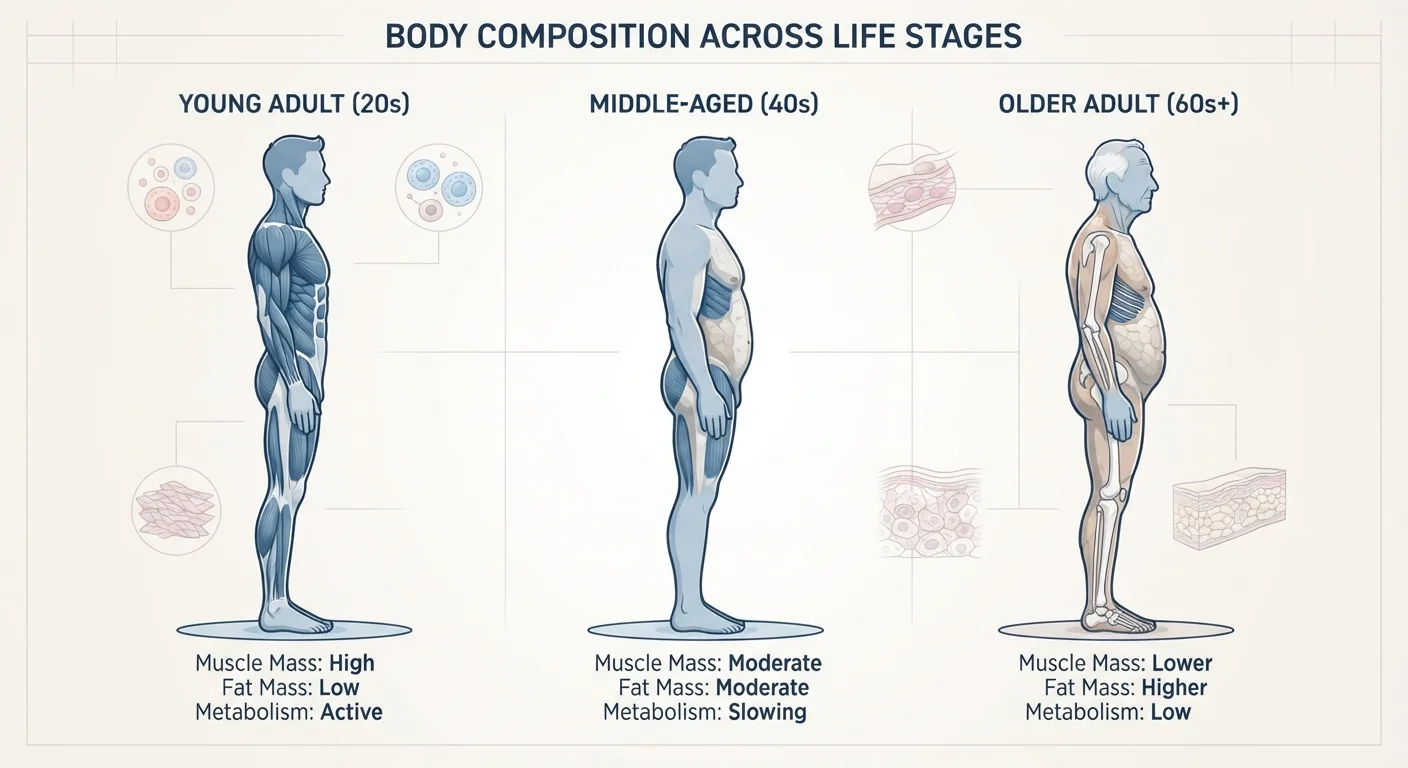
Body composition refers to the proportion of muscle, fat, bone, and water that makes up your total body weight. Over a lifetime, these proportions shift in predictable ways - muscle mass tends to decline while fat mass, particularly around the abdomen, tends to increase. These changes are driven by hormonal shifts, reduced physical activity, and aging biology, but they are not entirely fixed.
The gradual loss of skeletal muscle mass with age is clinically termed sarcopenia, typically defined as muscle loss of 3-8% per decade after age 30, accelerating after 60.
The Predictable Arc of Body Composition Change
Your body is not static. Even without dramatic changes in diet or lifestyle, its internal composition shifts steadily across every decade of life. Understanding this arc - rather than being surprised or alarmed by it - puts you in a far better position to work with your body rather than against it.
As body composition fundamentals explain, the scale captures only total weight, not the far more meaningful ratio of muscle to fat. That ratio is where the real health story lives - and it changes in ways that are largely predictable but not entirely inevitable.
The primary drivers of lifetime compositional change include hormonal shifts, reduced anabolic signaling, declining physical activity levels, and changes in protein metabolism efficiency. Each decade adds a new layer to this picture.
Decade by Decade: What the Research Shows
20s and 30s: Peak muscle mass typically occurs somewhere in the late 20s to early 30s for most people. After that, even without obvious lifestyle changes, skeletal muscle begins a slow decline. Fat mass may remain stable during this period, but visceral fat - the metabolically active fat surrounding abdominal organs - can begin accumulating quietly, especially with sedentary habits.
40s and 50s: Hormonal changes accelerate compositional shifts. In women, perimenopause and menopause bring declining estrogen, which promotes fat redistribution toward the abdomen and accelerates bone density loss. In men, testosterone levels decline gradually, reducing anabolic drive. Both sexes typically see more pronounced muscle loss and fat gain during this window, even with consistent effort. This is a critical period to prioritize resistance training - research explored in the article on strength training after 50 addresses exactly this stage.
60s and beyond: Muscle loss accelerates more sharply. Sarcopenia - clinically significant muscle loss - becomes a genuine functional concern, affecting mobility, balance, and metabolic health. Fat mass may plateau or decline, but lean mass losses can be substantial if no countermeasures are in place. Recovery from exertion also takes longer, as discussed in the overview of recovery across the lifespan.
3-8%
Muscle mass lost per decade after age 30
According to published research in journals including Age and Ageing, sarcopenic muscle loss averages 3-8% per decade, accelerating after age 60.
~30%
Muscle mass reduction by age 80 vs. peak
Studies estimate that by the eighth decade of life, average individuals may have lost close to 30% of their peak skeletal muscle mass compared to young adulthood.
2x faster
Rate of muscle loss after age 60 vs. 30s
Research suggests the rate of muscle decline roughly doubles after age 60 compared to earlier adulthood, making the sixth decade a critical window for intervention.
What Is - and Isn't - Within Your Control
Age-related body composition change is real and universal, but the rate and severity are not fixed. Lifestyle factors exert a substantial influence on how quickly muscle declines and fat accumulates.
Resistance training is the most robustly supported intervention. Decades of research show it preserves and builds lean mass across every age group - including adults over 70. Even modest training frequency produces measurable benefits. For a closer look at what these changes actually look like in practice, the effect of strength training on body composition is worth exploring.
Protein intake plays a supporting role. Older adults have reduced anabolic sensitivity to protein, meaning they generally need adequate - often somewhat higher - protein intake to support the same degree of muscle protein synthesis as younger adults. A registered dietitian can help tailor this to individual needs.
Sleep and stress management matter more than most people realize. Elevated cortisol from chronic stress promotes fat storage; poor sleep disrupts growth hormone secretion, which supports tissue repair and muscle maintenance.
If you are new to thinking about these markers, an introductory guide to body composition offers a practical starting point for understanding what to measure and why.
Start Resistance Training Before You Feel You Need It
The best time to begin building and preserving lean mass is before noticeable decline sets in. Starting resistance training in your 30s or 40s creates a higher muscle baseline to draw from as aging progresses. If you are already in your 50s, 60s, or beyond, current evidence supports meaningful benefit regardless of when you begin - so starting now still matters.
This article is for general informational purposes and does not constitute medical advice. Consult a qualified healthcare professional before making changes to your exercise routine, diet, or health management plan - especially if you have a chronic condition or are in a special population group such as pregnancy or older adulthood.