

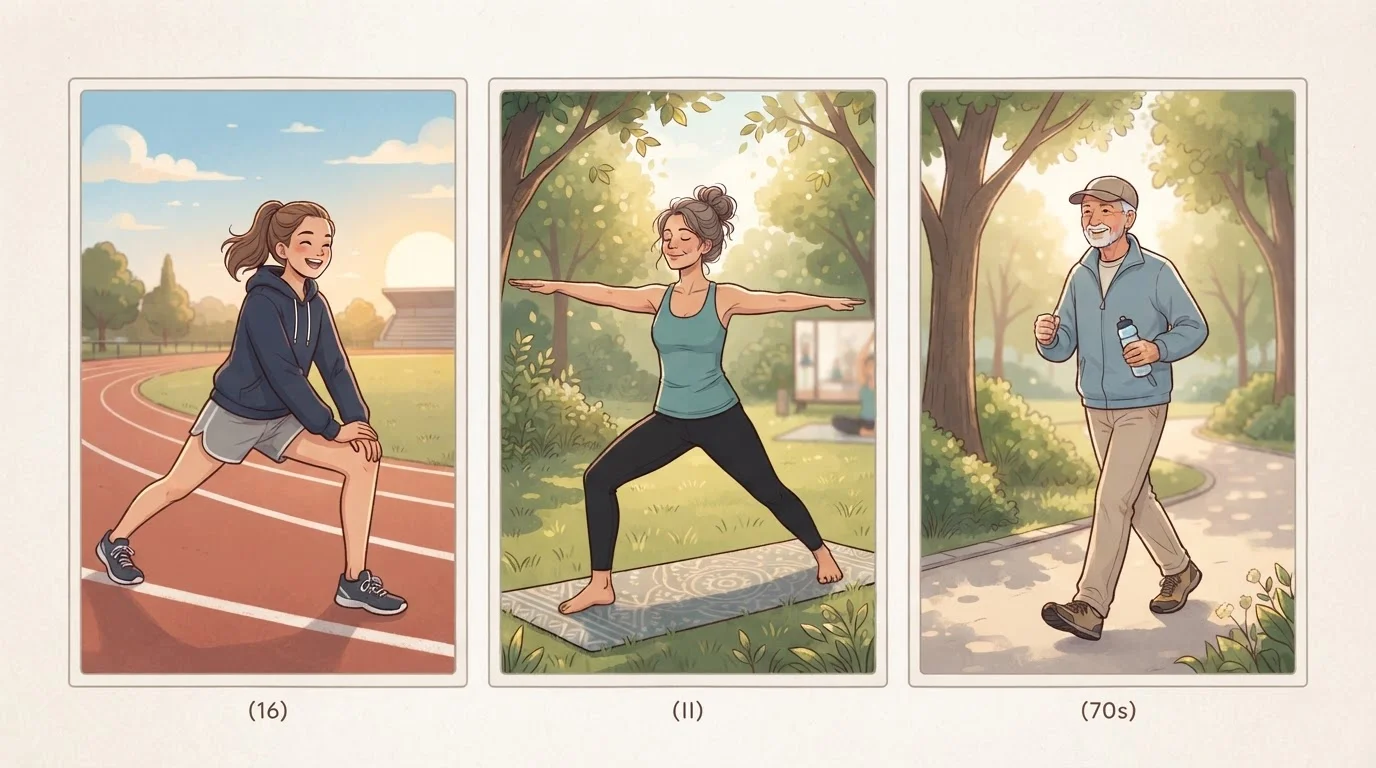
Key Takeaways
- Recovery speed naturally slows with age due to changes in hormones, inflammation, and cellular repair capacity.
- Teenagers need more total sleep and may recover quickly from intensity but are vulnerable to overuse injuries.
- Adults in their 30s and 40s benefit from deliberate rest days and attention to sleep quality.
- Older adults typically require longer recovery windows and gain the most from consistent, moderate-intensity training.
- Rest is not the opposite of fitness - it is a core component of any effective training plan at any age.
Age-Specific Recovery
Age-specific recovery refers to how the body's ability to repair muscle tissue, replenish energy, and reduce inflammation changes across the lifespan. Teenagers, adults in their prime, and older exercisers all experience measurable differences in recovery speed, hormonal support, and vulnerability to overtraining. Matching your rest strategy to your life stage is just as important as matching your workout to your fitness goal.
Key physiological drivers include growth hormone secretion patterns, satellite cell activity (responsible for muscle repair), and the body's inflammatory response kinetics - all of which shift significantly with age.
Why Recovery Isn't One-Size-Fits-All
Most fitness conversations focus on what you do in the gym - the sets, the reps, the miles. Far less attention goes to what happens after. Recovery is where training adaptations actually occur: muscle fibers rebuild stronger, energy stores replenish, and the nervous system recalibrates. The problem is that many people apply the same recovery logic across decades of life, ignoring a well-established biological reality - the body's repair machinery changes substantially with age.
Understanding the phases of physical recovery helps explain why this matters. The biological processes behind inflammation, tissue remodeling, and glycogen restoration are influenced by hormones, cell behavior, and immune function - all of which shift as we move through different life stages. What works at 17 won't automatically serve you at 47 or 67.
Recovery Is Individual, Not Just Age-Based
While age-related trends are well-supported by research, individual variation is significant. Fitness history, training volume, sleep habits, nutrition, stress levels, and genetics all influence how quickly any person recovers. The age-based framework here is a starting point - your personal experience and, where appropriate, professional guidance should shape your actual plan.
Teenagers: High Output, High Stakes
Adolescent athletes often seem to bounce back from hard workouts overnight - and in many ways, they do. Elevated growth hormone levels, robust satellite cell activity (the cells that repair and grow muscle tissue), and high sleep drive all accelerate recovery during the teenage years. This can create a false sense of invincibility.
The real risk for teens isn't insufficient recovery speed - it's overuse injury. Growing bones and connective tissue are vulnerable to repetitive stress, and a culture that prizes specialization and year-round training amplifies that risk. Teens benefit from genuine rest days, seasonal sport variation, and - critically - enough sleep. Research consistently shows that adolescents need more sleep than adults, yet school schedules and screen habits routinely cut this short.
Parents and coaches should treat rest as a training tool, not a sign of weakness. Building recovery habits early also sets a sustainable foundation for decades of activity ahead.
Adults in Their 30s and 40s: The Inflection Point
For many people, the 30s mark the beginning of a noticeable shift. Growth hormone output starts to decline gradually, and the body's inflammatory response after exercise tends to last longer. Muscle protein synthesis - the process of rebuilding muscle tissue - begins to slow, though it remains highly responsive to training stimulus and adequate protein intake.
Practically, this means that the recovery window between hard sessions often needs to extend. A 25-year-old might tolerate back-to-back intense workouts with minimal consequence; a 40-year-old doing the same may find performance dipping and soreness accumulating. This is a feature of biology, not a failure of fitness.
Sleep quality becomes particularly important during this stage. As sleep architecture shifts with age, adults tend to spend less time in deep slow-wave sleep - the stage most associated with physical restoration. Prioritizing sleep hygiene, managing stress, and including deliberate rest days are the most evidence-supported strategies for this group.
~1% per year
Rate of muscle mass loss starting in your 30s
Research published in sports medicine literature suggests adults may begin losing lean muscle mass at roughly 1% per year from their 30s onward without resistance training - a process called sarcopenia.
8-10 hours
Recommended nightly sleep for teenagers
The American Academy of Sleep Medicine recommends 8-10 hours of sleep per night for adolescents aged 13-18 to support health and physical development.
48-72 hours
Typical muscle repair window for adults
Exercise science research generally identifies 48 to 72 hours as the standard recovery window for the same muscle group after resistance training - a window that may extend further for older adults.
Older Adults (60+): Slower Repair, Smarter Training
After 60, recovery slows more noticeably. Satellite cell activity declines, testosterone and growth hormone levels drop further, and the anabolic response to exercise - the body's ability to convert training stimulus into muscle growth - becomes less sensitive. Body composition also shifts, with lean muscle mass tending to decrease over time; see our resource on body composition shifts across a lifetime for more detail.
None of this means older adults should exercise less - quite the opposite. Research consistently supports regular resistance and aerobic training as among the most powerful tools for healthy aging. The adjustment is in how training is structured: longer gaps between high-intensity sessions, a higher ratio of moderate-intensity work, and closer attention to nutrition - particularly protein intake - around workouts.
For older adults managing chronic conditions, joint concerns, or post-rehabilitation needs, working with a qualified healthcare provider or physical therapist before changing a training routine is strongly recommended. The body's recovery and repair processes remain responsive to the right inputs; they simply require more deliberate support.
The Common Thread: Rest as Active Strategy
Across every life stage, the principle holds: recovery is not passive absence of effort - it is an active physiological process that deserves planning. That means scheduling rest days intentionally, treating sleep as a performance variable, adjusting training load when signals of under-recovery appear, and recognizing that nutrition plays a supporting role at every age. Our overview of body recovery covers how muscles, joints, and systems repair themselves in more depth.
Whether you're 16 or 66, the goal is the same: build a recovery strategy that matches your body's current biology so that the training you put in can actually stick.
This article is for general informational and educational purposes only and does not constitute medical advice. Always consult a qualified healthcare professional before making changes to your exercise or health routine, particularly if you have an existing medical condition or injury.