

| Most accessible home method | Circumference measurements (tape measure) |
| Most accurate clinical method | DEXA scan (Widely cited in sports science and clinical nutrition literature) |
| Key limitation of consumer BIA scales | Results vary significantly with hydration levels |
| Waist circumference risk threshold (general) | >35 in (women) / >40 in (men) associated with elevated metabolic risk (National Institutes of Health guidelines) |
| DEXA radiation exposure | Very low - comparable to a transatlantic flight |
| Best method for long-term home tracking | Consistent BIA scale use under standardized conditions |
Why Measurement Method Matters
The number on a bathroom scale tells you one thing: how much total mass your body contains at a given moment. It says nothing about how much of that mass is muscle, fat, bone, or water. Body composition goes well beyond what the scale captures, which is why the method you use to measure it genuinely matters.
Different assessment tools vary widely in accuracy, cost, convenience, and what they actually measure. No single method is perfect for every situation. Knowing the strengths and limitations of each helps you choose one that fits your goals and gives you data worth acting on.
| Most accessible home method | Circumference measurements (tape measure) |
| Most accurate clinical method | DEXA scan (Widely cited in sports science and clinical nutrition literature) |
| Key limitation of consumer BIA scales | Results vary significantly with hydration levels |
| Waist circumference risk threshold (general) | >35 in (women) / >40 in (men) associated with elevated metabolic risk (National Institutes of Health guidelines) |
| DEXA radiation exposure | Very low - comparable to a transatlantic flight |
| Best method for long-term home tracking | Consistent BIA scale use under standardized conditions |
Home-Based and Low-Cost Methods
Skinfold calipers measure subcutaneous fat (the fat just beneath the skin) at specific body sites. A trained practitioner pinches the skin and records thickness at several locations, then uses a validated formula to estimate overall body fat percentage. Accuracy depends heavily on the tester's skill and consistency. When performed correctly by the same person each time, calipers are a reasonable tracking tool, though absolute accuracy can vary.
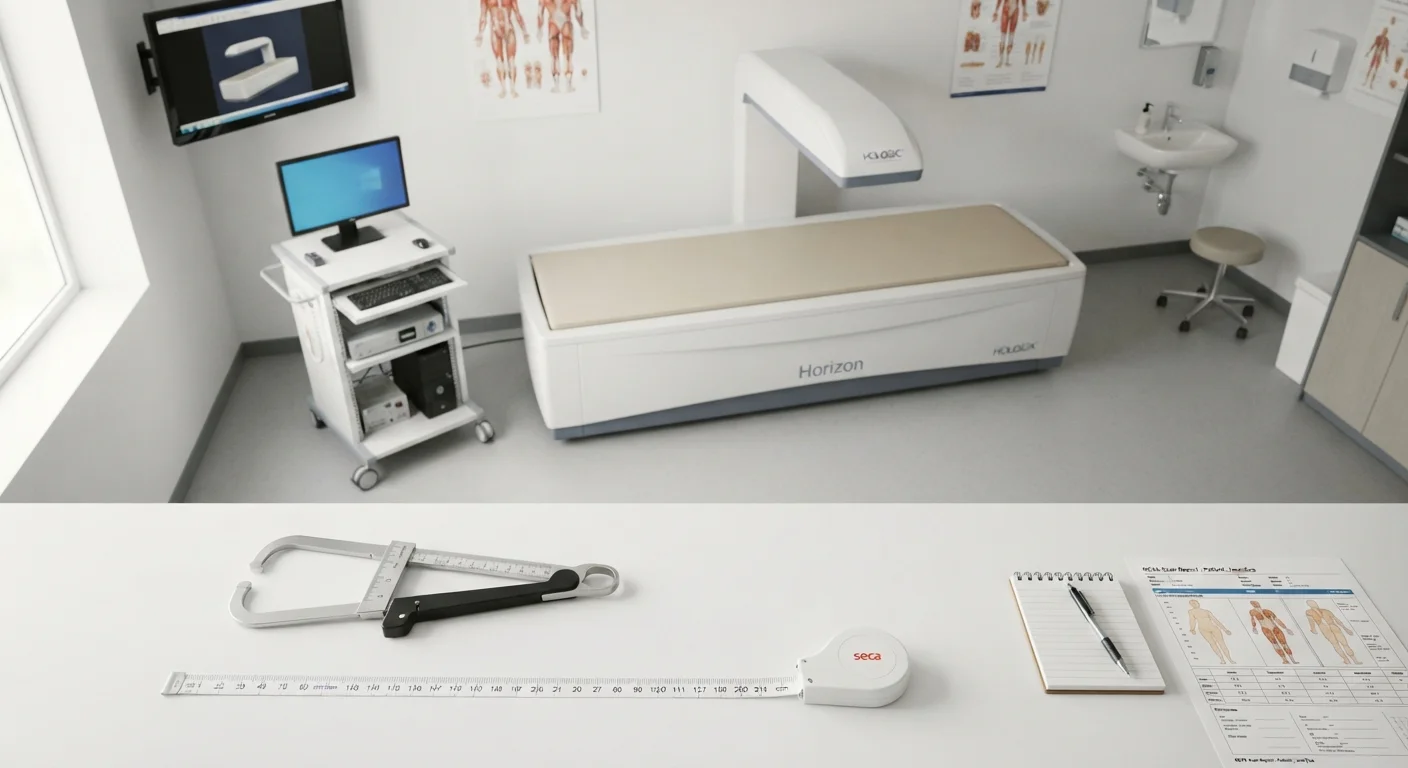
Circumference measurements - waist, hip, neck, and limb - are inexpensive, reproducible, and accessible to anyone with a flexible measuring tape. Waist circumference in particular has well-established associations with metabolic health risk. These measurements don't estimate body fat directly, but they track meaningful changes over time.
Consumer bioelectrical impedance scales send a low electrical current through the body to estimate fat and lean mass based on how tissues resist the current. Results are highly sensitive to hydration, time of day, and recent food or exercise, making them inconsistent for day-to-day comparison. They are more useful for observing long-term trends when conditions are standardized - same time of day, same hydration state - than for single-point accuracy.
If you're new to tracking your health, circumference measurements are often the most practical starting point.
Clinical and Higher-Accuracy Methods
DEXA (Dual-Energy X-ray Absorptiometry) is widely considered one of the most accurate body composition methods available outside a research lab. It uses two low-dose X-ray beams to distinguish bone mineral, fat mass, and lean soft tissue with high precision. DEXA also provides regional breakdowns - showing fat distribution in the arms, legs, trunk, and android (abdominal) region - which adds clinically relevant detail. It requires a clinic visit and involves a small amount of radiation exposure, though the dose is very low.
Hydrostatic (underwater) weighing estimates body density by comparing a person's weight on land to their weight while submerged. Because fat is less dense than lean tissue, the difference reveals body composition. This method is highly accurate but logistically demanding and rarely available outside research or sports science settings.
Air displacement plethysmography (commonly known as the Bod Pod) uses the same density principle as hydrostatic weighing but replaces water with air. The subject sits inside a sealed chamber while air pressure changes are measured. It is more accessible than underwater weighing and comparably accurate, though equipment availability is still limited.
Medical-grade bioelectrical impedance analysis (BIA) devices - such as multi-frequency segmental analyzers used in clinical and sports settings - are considerably more precise than consumer scales. They provide segmental data and are less sensitive to hydration fluctuations than single-frequency home units.
Once you have results, understanding how to interpret those numbers in context is just as important as the measurement itself.
Choosing the Right Method for Your Situation
For most people tracking general health and fitness progress, a combination of circumference measurements and a consistent bioimpedance scale - used under standardized conditions - offers a practical, low-cost approach. For those who want a more detailed baseline or are managing a health condition, a DEXA scan provides actionable data that consumer tools cannot match.
Consistency across measurements matters more than which single method you choose. A less precise tool used in identical conditions at regular intervals often reveals more useful trends than a highly accurate one-time assessment.
It's also worth noting that body fat percentage and BMI measure fundamentally different things, and neither alone is a complete picture of health. Always interpret body composition data alongside other health markers and in consultation with a qualified healthcare professional.
This article is for general informational purposes only and does not constitute medical advice. Consult a qualified healthcare provider for guidance specific to your health situation.