

Key Takeaways
- Aging is driven by multiple biological mechanisms, not a single cause.
- Telomere shortening limits how many times most cells can divide safely.
- Senescent cells accumulate with age and promote low-grade inflammation.
- Mitochondrial dysfunction reduces cellular energy and increases oxidative stress.
- Lifestyle factors like exercise and sleep influence the pace of biological aging.
- Researchers have identified at least nine distinct hallmarks of aging at the cellular level.
Cellular Aging (Senescence)
Cellular aging refers to the gradual biological changes that accumulate in your cells over time, reducing their ability to function, divide, and repair themselves. These changes are driven by multiple interconnected processes - including DNA damage, telomere shortening, and the buildup of dysfunctional proteins. Together, they contribute to the physical and physiological changes we associate with getting older.
The scientific field studying these mechanisms is geroscience, which distinguishes between chronological age (years lived) and biological age (the body's functional aging state), recognizing they can diverge significantly.
The Cellular Clock: An Overview of Biological Aging
Aging isn't a single event - it's a slow-motion accumulation of biological changes that begin at the molecular level and eventually manifest as the physical and functional shifts we recognize as getting older. To understand aging, you need to look inside the cell, where several distinct but interconnected processes are constantly unfolding.
Scientists have catalogued these processes into what researchers now call the hallmarks of aging - a framework originally proposed in a landmark 2013 paper in the journal Cell and updated since. If you want a structured breakdown of all nine, see our reference guide to the nine hallmarks of aging.
Here, we focus on the most fundamental mechanisms: what they are, why they matter, and what the current evidence suggests about slowing their progression.
Telomere Shortening: The Cellular Countdown
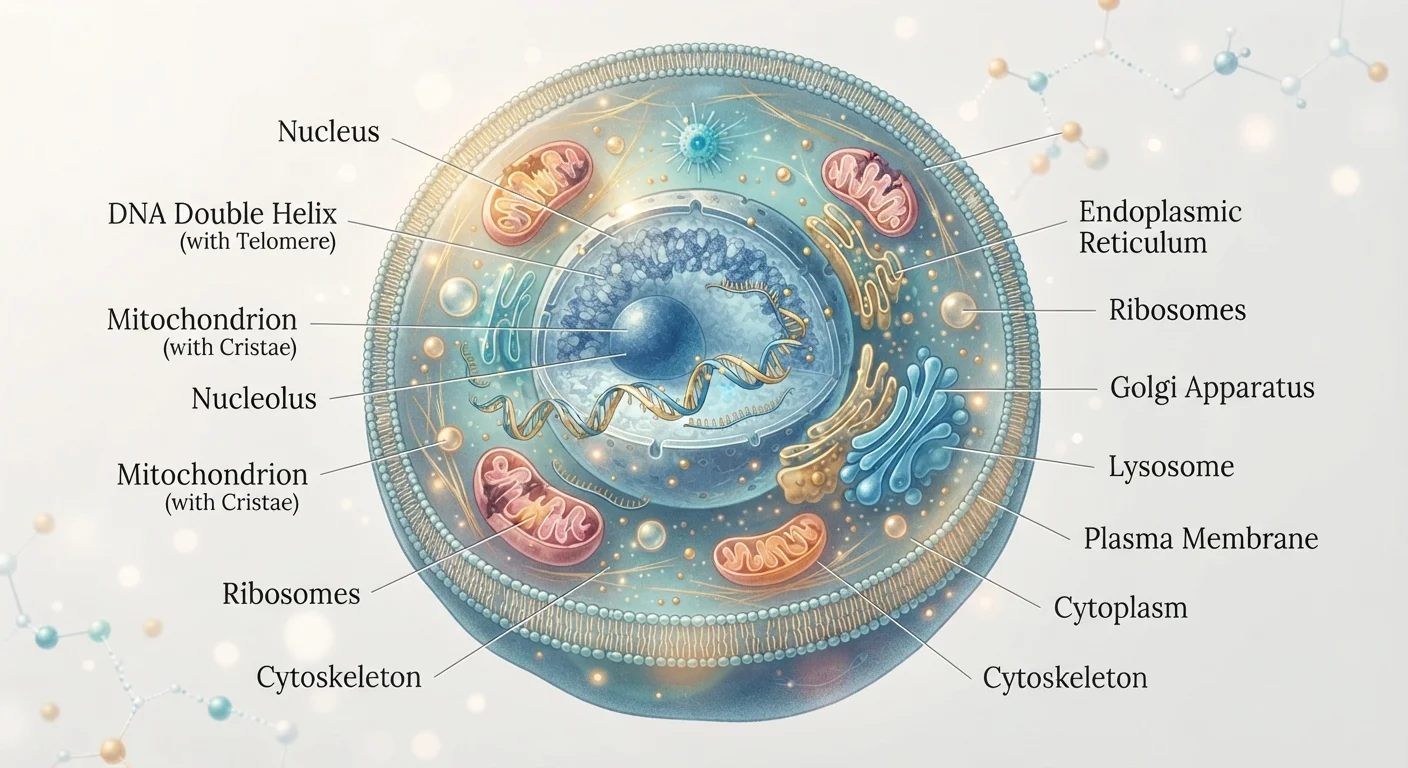
Inside every cell nucleus, your DNA is organized into 46 chromosomes. At the tip of each chromosome sits a telomere - a repetitive sequence of DNA that acts as a protective buffer, similar to the plastic cap on a shoelace. Each time a cell divides to repair or regenerate tissue, the copying machinery can't quite replicate the very end of the chromosome, so the telomere shortens slightly.
After enough divisions, telomeres become critically short. At that point, the cell interprets this as DNA damage and activates protective pathways - either triggering programmed cell death (apoptosis) or halting division permanently. This second outcome is called cellular senescence.
Telomere length is influenced by both genetics and lifestyle. Chronic psychological stress, smoking, physical inactivity, and poor sleep quality have all been associated with shorter telomeres in population studies, though causality is complex and not fully established.
~50
Maximum divisions most human cells can undergo
Known as the Hayflick limit, this ceiling on cell division - established through laboratory research by Leonard Hayflick in the 1960s - reflects the biological constraint imposed by telomere shortening.
~30%
Muscle mass decline from age 50 to 70
Research estimates adults can lose roughly 3-5% of muscle mass per decade after 30, with the rate accelerating after 60, partly due to mitochondrial decline and reduced cellular repair capacity.
9
Recognized hallmarks of cellular aging
A widely cited framework published in the journal Cell (Lopez-Otin et al., 2013, updated 2023) identifies nine interconnected biological hallmarks that collectively drive the aging process.
Cellular Senescence: When Cells Refuse to Die
Senescent cells don't simply stop working quietly. They actively secrete a mixture of inflammatory proteins, enzymes, and growth factors - a pattern researchers call the SASP (Senescence-Associated Secretory Phenotype). In small numbers, senescent cells serve useful purposes, such as limiting tumor growth and aiding wound healing. But as they accumulate with age, their inflammatory output begins to damage surrounding healthy tissue.
This persistent, low-grade inflammation driven partly by senescent cells is increasingly linked to a wide range of age-associated conditions. Our companion article on why chronic inflammation accelerates aging explores this connection in depth.
Researchers are actively investigating so-called senolytics - compounds that selectively clear senescent cells - but this science is still largely in early clinical stages and has not been validated for routine human use.
Mitochondrial Decline and Oxidative Stress
Mitochondria - the organelles responsible for generating most of a cell's usable energy (ATP) - accumulate damage over time. Mitochondrial DNA is particularly vulnerable because it lacks some of the repair mechanisms that protect nuclear DNA. As mitochondria become less efficient, cells produce more reactive oxygen species (ROS) - chemically unstable molecules that can damage proteins, lipids, and DNA in a process called oxidative stress.
This creates a feedback loop: damaged mitochondria generate more ROS, which causes more damage. Over decades, this contributes to reduced muscle mass, slower metabolic function, and declining organ performance.
Regular aerobic exercise is one of the best-studied interventions for maintaining mitochondrial health. It stimulates a process called mitophagy - the selective removal of damaged mitochondria - and promotes the formation of new, functional ones. See what the research says about exercise and healthy aging for a fuller picture of the evidence.
Epigenetic Drift and Protein Maintenance Failures
Beyond telomeres and mitochondria, two additional mechanisms deserve attention. First, epigenetic drift: your genome carries chemical tags (methylation patterns, among others) that regulate which genes are switched on or off. With age, these patterns become increasingly disordered - genes that should stay silent become active, and vice versa. Researchers have used epigenetic patterns to develop biological age clocks that can estimate how fast someone is aging independent of their birth year. Learn how scientists use these tools in our article on biological age vs. chronological age.
Second, proteostasis (protein homeostasis) - the cell's system for folding, maintaining, and clearing proteins - degrades with age. Misfolded proteins accumulate and can form aggregates that impair cellular function. This is a central feature of several neurodegenerative diseases and is considered a hallmark of aging in its own right.
This article is for general informational and educational purposes only and does not constitute medical advice. Always consult a qualified healthcare professional for guidance specific to your health situation.