
Biological Age vs. Chronological Age: How Researchers Try to Measure the Difference

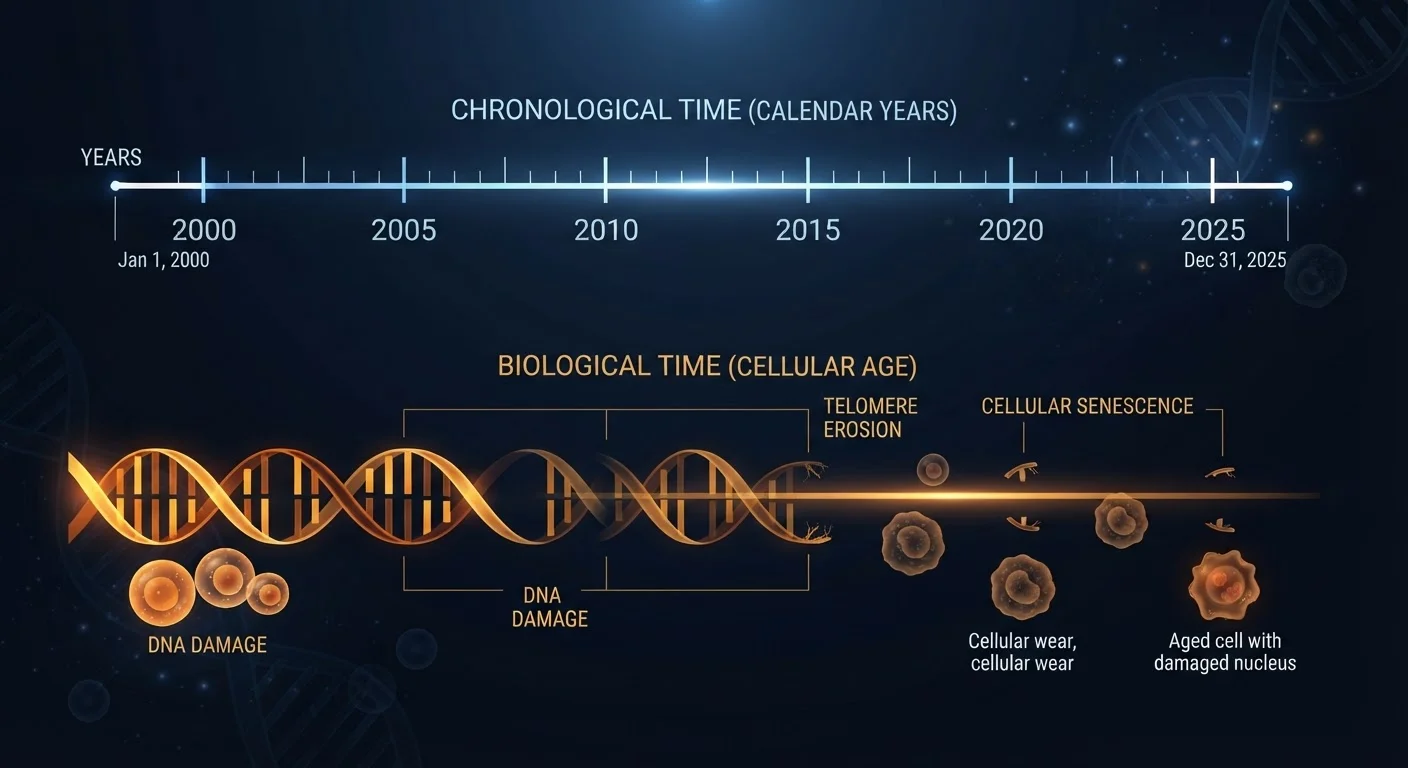
Key Takeaways
- Chronological age simply counts years lived; biological age estimates the actual functional state of your body's tissues and systems.
- Researchers use multiple tools - including epigenetic clocks, telomere length, and composite biomarker panels - to approximate biological age.
- No single biological age test is perfectly validated or universally standardized for clinical use.
- Lifestyle factors such as sleep, physical activity, diet quality, and chronic stress are consistently linked to biological aging pace.
- Biological age measurements are research tools first; consult a healthcare professional before drawing personal medical conclusions from them.
Option A
Chronological Age
The simple, universal count of time since birth.
Best for: Administrative purposes, population-level health guidelines, and baseline medical screening thresholds.
Option B
Biological Age
A science-based estimate of how fast your body is actually aging.
Best for: Researchers and clinicians seeking a deeper measure of an individual's physiological aging pace and long-term health risk.
If you want a reliable benchmark for standard medical care
Chronological Age
Clinical guidelines, screening schedules, and risk calculators are built around chronological age, making it the practical and universally comparable standard.
If you are a researcher studying aging interventions
Biological Age
Biological age metrics - especially epigenetic clocks - provide a more sensitive readout of physiological change than birth year alone.
If you want to understand the factors influencing your personal aging trajectory
Biological Age
Biological age frameworks highlight the modifiable lifestyle and metabolic factors that science links to faster or slower physiological aging.
If you need a quick, zero-cost health reference point
Chronological Age
You always know your birth year, and age-adjusted population data makes it immediately useful without any testing.
What Each Concept Actually Means
Chronological age is the number of years, months, and days since you were born - straightforward, objective, and identical for everyone born on the same day. It is the age recorded on your driver's license, used to set Medicare eligibility, and baked into every population health guideline you have ever received.
Biological age is an estimate of where your body sits on the aging spectrum relative to that calendar number. Two people who are both 55 chronologically may have very different cardiovascular resilience, cellular repair capacity, and immune function. Biological age attempts to quantify that gap using measurable physiological markers rather than a birth certificate.
Understanding this distinction matters because aging is not a uniform process. Genetics, cumulative lifestyle exposures, chronic disease burden, and even socioeconomic stress all leave marks at the molecular level - marks that chronological age alone cannot capture. Longevity researchers increasingly focus on this gap, a theme explored in depth in our piece on healthspan vs. lifespan.
How Researchers Measure Biological Age
Because biological age is a concept rather than a single observable fact, scientists have developed several distinct measurement approaches, each with its own strengths and limitations.
Epigenetic Clocks
The most widely cited tools in aging research are epigenetic clocks - algorithms trained on DNA methylation patterns, which are chemical tags on the genome that shift predictably with age. The Horvath clock, published in 2013, demonstrated that methylation data from multiple tissue types could estimate chronological age with striking accuracy. Subsequent clocks, such as GrimAge and PhenoAge, were trained not just on age but on health outcomes, making them stronger predictors of mortality and disease risk. These clocks are primarily research instruments; commercial versions exist but are not yet standardized clinical tools.
Telomere Length
Telomeres are protective caps on the ends of chromosomes that shorten each time a cell divides. Shorter average telomere length is associated with older biological age and higher risk for several age-related conditions, though the relationship is probabilistic rather than deterministic. Telomere measurement is useful at the population level but has significant variability at the individual level.
Composite Biomarker Panels
Some researchers calculate biological age from panels of blood-based markers - including inflammation indicators like C-reactive protein, metabolic markers, and organ-function tests - combined into a single score. These composite approaches are appealing because they draw on routine clinical labs, but the specific markers and weightings vary across different scoring systems, limiting direct comparisons.
For context on the underlying cellular processes these tools try to capture, see our reference guide to the nine hallmarks of aging.
| Criterion | Chronological Age | Biological Age |
|---|---|---|
| Definition | Years elapsed since birth | Estimated physiological aging state |
| How it's measured | Birth certificate / calendar | Biomarkers, epigenetic clocks, or panels |
| Standardization | Universal and objective | Varies by method and laboratory |
| Clinical use | Widely embedded in guidelines | Primarily a research tool |
| Modifiable by lifestyle? | No | Partially, per current evidence |
| Individual variability captured | None - same for all born same day | High - reflects personal biology |
| Cost to measure | Free | Moderate to high (testing required) |
What Influences Biological Aging Pace
Research consistently identifies a cluster of modifiable factors associated with faster or slower biological aging, even when chronological age is held constant.
- Physical activity: Regular moderate-to-vigorous exercise is among the most robustly supported lifestyle factors for favorable epigenetic and telomere profiles.
- Sleep quality and duration: Chronic short sleep and disrupted sleep architecture are linked to accelerated biological aging markers. Recovery processes that occur during sleep - including cellular repair - are explored further in our article on why recovery slows with age.
- Dietary patterns: Diets rich in whole plant foods and low in ultra-processed foods are associated with more favorable aging biomarkers in multiple cohort studies.
- Chronic inflammation: Low-grade systemic inflammation - sometimes called inflammaging - is both a driver and a marker of accelerated biological aging. Our coverage of chronic inflammation and aging goes deeper on this mechanism.
- Stress and social connection: Chronic psychological stress and social isolation correlate with shorter telomeres and less favorable epigenetic profiles in observational data.
13+ years
Biological age gap seen within same chronological cohorts
Research using epigenetic clocks has documented biological age differences of more than a decade among people of the same chronological age in population studies.
~25-40%
Heritability of biological aging pace
Twin studies estimate that genetic factors explain roughly a quarter to two-fifths of the variance in biological aging markers, with environment accounting for the rest.
353
CpG sites in the original Horvath epigenetic clock
Steve Horvath's landmark 2013 clock used methylation data from 353 specific genomic sites to estimate age across multiple human tissue types.
Importantly, none of these factors operates in isolation, and effect sizes vary considerably across studies. Heritability still accounts for a meaningful portion of biological aging variance - estimated at roughly 25-40% in twin studies - meaning lifestyle alone does not fully determine the picture.
This article is for general informational and educational purposes only and does not constitute medical advice. Consult a qualified healthcare professional before making any decisions about health testing, treatment, or changes to your health regimen.