
Healthspan vs. Lifespan: Why the Years You Feel Well Matter More Than Total Years Lived

Key Takeaways
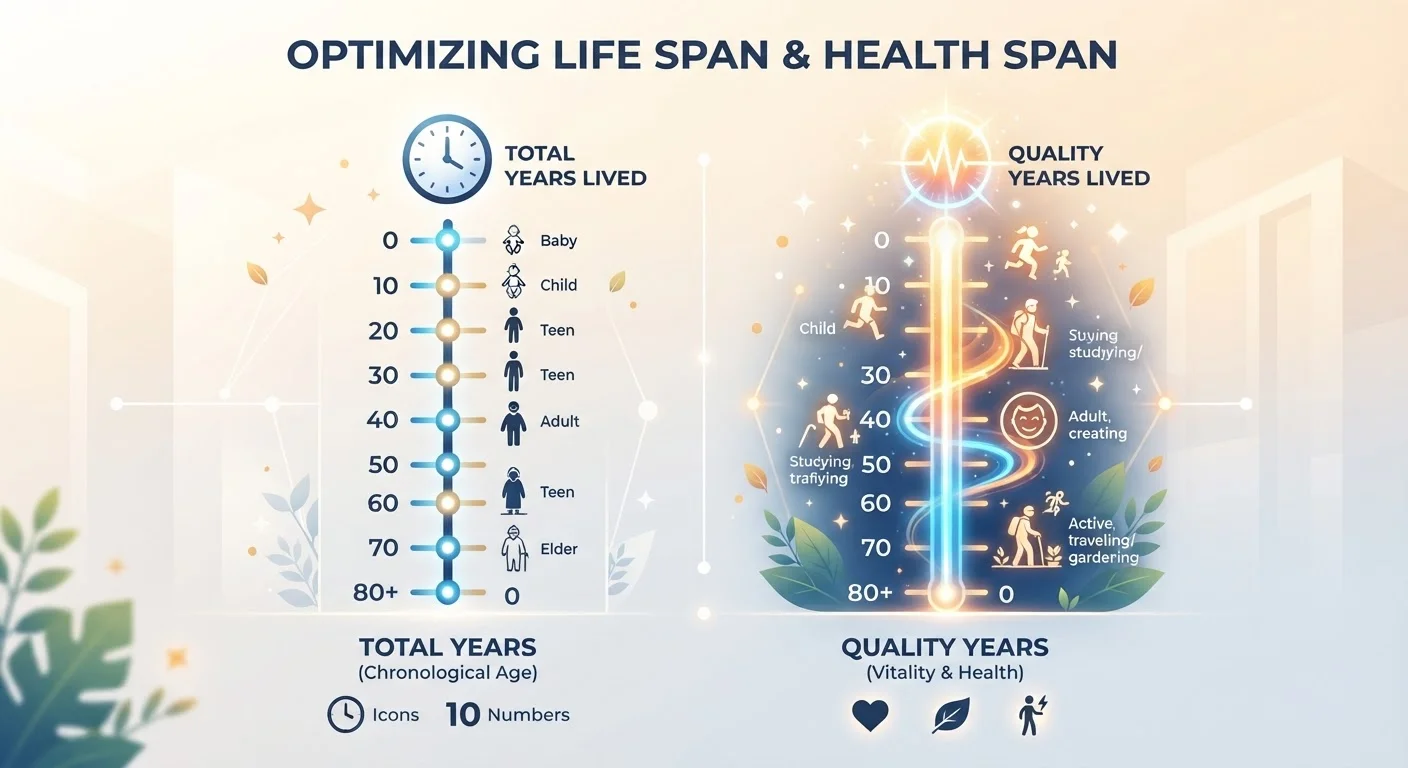
- Lifespan measures total years lived; healthspan measures years free of significant disease or disability.
- Many Americans spend roughly a decade at the end of life managing serious chronic conditions.
- Longevity researchers increasingly treat expanding healthspan - not just lifespan - as the primary goal.
- Lifestyle factors including exercise, sleep, and diet have documented effects on healthspan.
- The gap between lifespan and healthspan can be meaningfully influenced by everyday habits and decisions.
Option A
Lifespan
The total count of years from birth to death.
Best for: Tracking population-level mortality trends and life expectancy statistics across demographics.
Option B
Healthspan
The years lived in genuine physical and cognitive vitality.
Best for: Guiding individual and public health strategies aimed at reducing years spent in disability or chronic disease.
If you want to understand population aging and mortality statistics
Lifespan
Lifespan data is the standard metric used in public health research and epidemiology to track how long people live across populations and time periods.
If you want to guide personal health and wellness decisions
Healthspan
Healthspan focuses on the quality and function of the years you live, making it the more actionable and personally meaningful metric for everyday choices.
If you are interested in cutting-edge longevity research
Healthspan
Most current aging science - from senolytics to epigenetic clocks - targets the compression of morbidity and extension of healthy years, not simply adding years at any cost.
Two Numbers, Two Very Different Stories
When a news headline announces that average life expectancy has risen, it tells you something real but incomplete. It tells you how long, on average, people survive - not how those years are spent. That distinction is at the heart of one of the most important shifts in modern longevity science.
Lifespan is simple to measure: it is the total number of years from birth to death. Healthspan is more nuanced - it refers to the portion of life spent in good health, free from serious chronic disease, significant disability, or substantial cognitive decline. The two numbers can, and frequently do, diverge considerably.
In the United States, average life expectancy at birth has increased dramatically over the 20th century, largely due to improvements in sanitation, vaccines, and acute care medicine. But a substantial portion of those added years are often marked by the management of conditions such as heart disease, type 2 diabetes, arthritis, and dementia. Research published in journals like The Lancet and JAMA has documented that while people are living longer, a meaningful share of later life involves functional limitations. Understanding this gap is foundational - for a deeper primer, see our plain-language introduction to longevity science.
How Researchers Think About the Gap
Geroscientists - researchers who study the biology of aging - increasingly frame their work around a concept called compression of morbidity. The idea, influential since physician James Fries articulated it in the 1980s, is that the period of significant illness and disability at the end of life might be compressed into a shorter window, even if total lifespan stays roughly constant or increases modestly. The goal is not simply to add years, but to shift the curve so that more of life is spent well.
| Criterion | Lifespan | Healthspan |
|---|---|---|
| Definition | Total years from birth to death | Years lived free of serious disease or disability |
| Primary use | Population mortality statistics | Quality of life and functional aging research |
| How it's measured | Death records and actuarial data | Disability-free life years, functional assessments |
| Influenced by lifestyle? | Partially, but genetics play a large role | Substantially, per current evidence |
| Research focus | Declining, as a standalone goal | Growing priority in geroscience |
| Actionability for individuals | Limited - hard to change directly | High - responsive to daily habits |
This reframing has practical consequences for research priorities. Rather than focusing solely on what kills people, scientists are asking what keeps people functionally capable - walking, thinking, socializing, working - into their seventh, eighth, and ninth decades. Measuring biological aging, rather than just chronological age, is one active area; biological age versus chronological age explores how researchers are attempting to quantify that difference in living individuals.
What Actually Influences Healthspan
Unlike lifespan, which is partly shaped by factors largely outside individual control - genetics, accidents, infectious disease - healthspan appears meaningfully responsive to modifiable behaviors. The evidence base here is substantial, though it is important to note that research shows associations and risk reduction, not guarantees.
Physical activity stands out consistently across decades of epidemiological data. Regular movement is associated with reduced risk of cardiovascular disease, type 2 diabetes, cognitive decline, and all-cause mortality. What the research actually says about exercise and healthy aging breaks down which types of movement show the strongest evidence.
Sleep quality and duration are increasingly recognized as a pillar of biological resilience. Poor sleep is linked in research to accelerated cellular aging markers, impaired immune function, and elevated risk of several chronic conditions. Sleep and longevity examines the mechanisms and what the evidence actually supports.
Patterns observed in long-lived communities around the world add texture to this picture, though caution is warranted when interpreting them. Blue Zones under the microscope looks at what independent researchers say those communities genuinely teach us.
Healthspan Is Not One Single Measure
Researchers use several overlapping metrics to approximate healthspan, including disability-adjusted life years (DALYs), health-adjusted life expectancy (HALE), and disease-free survival intervals. None captures it perfectly, and definitions can vary between studies. When you encounter healthspan claims in media coverage, it's worth checking which specific measure was used and in which population.
This article is for general informational and educational purposes only and does not constitute medical advice. Consult a qualified healthcare professional before making changes to your health routine, particularly if you have existing health conditions.