

| Study type | Overnight in-lab polysomnography (PSG) |
| Signals recorded | Brain activity (EEG), eye movements, muscle tone, breathing, SpO₂, heart rate, limb movements (American Academy of Sleep Medicine) |
| Normal AHI (adults) | Fewer than 5 events per hour (AASM Scoring Manual) |
| Clinically significant PLMI | Greater than 15 movements per hour (AASM diagnostic criteria) |
| Report scored by | Registered polysomnographic technologist, interpreted by board-certified sleep physician |
| Consumer tracker comparison | Wearables estimate sleep stages; PSG directly measures brain and physiological signals |
What Is a Polysomnography Report?
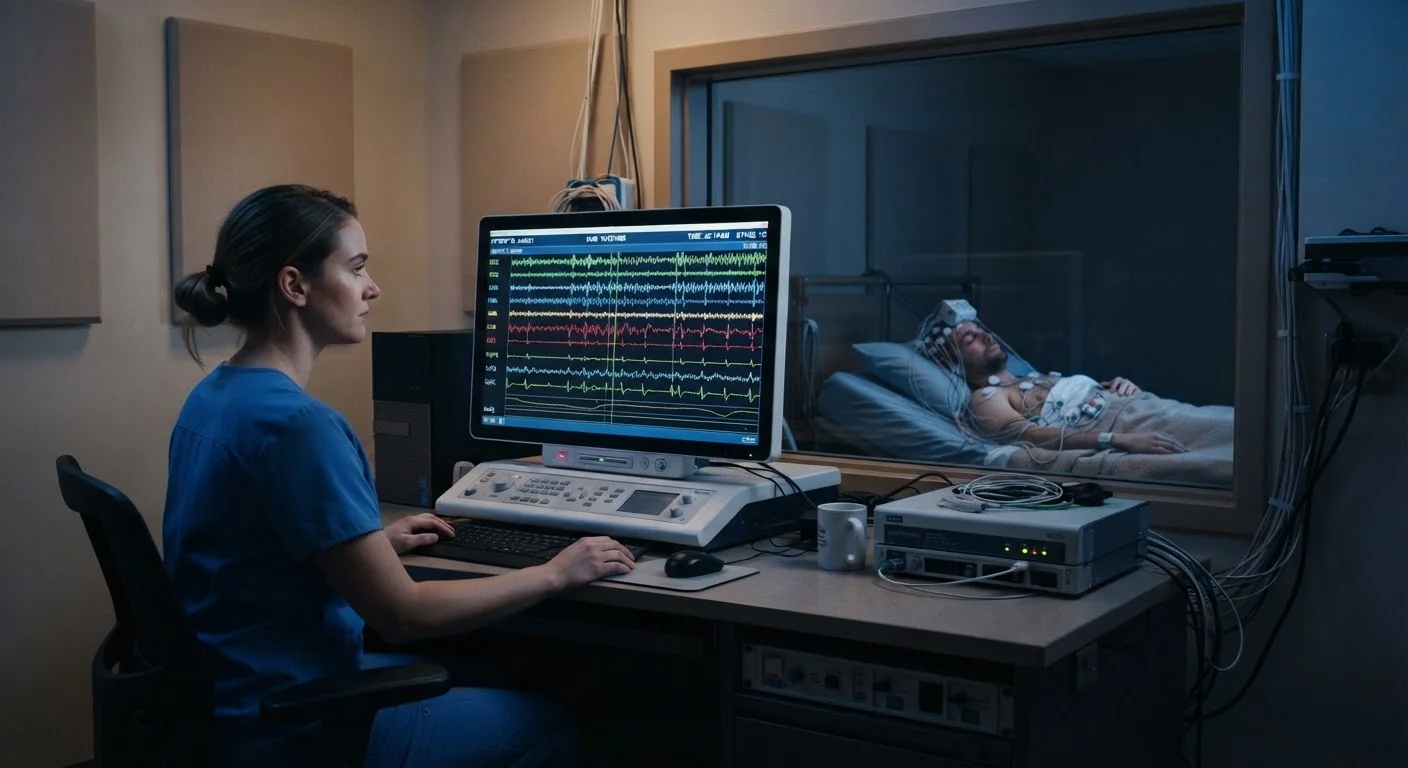
If a clinician has referred you for a sleep study — or you've already had one — you may have received a multi-page report filled with abbreviations, numbers, and waveform descriptions that aren't immediately self-explanatory. Polysomnography (PSG) is the gold-standard clinical assessment of sleep. It simultaneously records brain electrical activity, eye movements, muscle tone, breathing patterns, blood oxygen levels, heart rate, and limb movements across an entire night.
The resulting report is not a pass/fail document. It is a quantitative snapshot of how your body cycles through sleep, used by sleep medicine specialists to identify disruptions, diagnose disorders, and guide treatment decisions. This reference guide explains what the most common metrics mean — in plain language.
This article is for general educational purposes only and is not a substitute for medical advice. Always discuss your specific results with your treating clinician.
| Study type | Overnight in-lab polysomnography (PSG) |
| Signals recorded | Brain activity (EEG), eye movements, muscle tone, breathing, SpO₂, heart rate, limb movements (American Academy of Sleep Medicine) |
| Normal AHI (adults) | Fewer than 5 events per hour (AASM Scoring Manual) |
| Clinically significant PLMI | Greater than 15 movements per hour (AASM diagnostic criteria) |
| Report scored by | Registered polysomnographic technologist, interpreted by board-certified sleep physician |
| Consumer tracker comparison | Wearables estimate sleep stages; PSG directly measures brain and physiological signals |
Key Metrics Explained
Sleep Architecture
Sleep architecture describes how your night is distributed across the four main sleep stages. A PSG report will typically express each stage as both total minutes and a percentage of total sleep time. Understanding what each stage contributes is important context — see our breakdown of REM and deep sleep for a detailed explanation of what happens in each phase.
Apnea–Hypopnea Index (AHI)
The AHI is one of the most clinically significant numbers in a sleep study report. It counts the average number of breathing interruptions — full pauses (apneas) and partial reductions in airflow (hypopneas) — per hour of sleep. Clinicians generally use the following severity thresholds: fewer than 5 events per hour is considered normal in adults; 5–14 is mild; 15–29 is moderate; 30 or more is severe. These categories help guide decisions about treatment options such as positive airway pressure therapy.
Oxygen Desaturation Index (ODI) and SpO₂
The oxygen desaturation index records how often blood oxygen saturation drops by a defined threshold (commonly 3–4%) per hour. Baseline and nadir (lowest recorded) SpO₂ values are also reported. Sustained or frequent drops below approximately 90% are clinically notable and may indicate that breathing disruptions are affecting oxygenation during sleep.
Arousal Index
An arousal is a brief shift toward lighter sleep detected by EEG, often too short to wake the sleeper consciously. The arousal index — arousals per hour — indicates how fragmented sleep is. High arousal indices can explain daytime fatigue even when total sleep time appears adequate on paper.
Periodic Limb Movement Index (PLMI)
Surface electrodes on the legs record repetitive limb movements during sleep. A PLMI above 15 movements per hour is generally considered clinically significant, particularly if movements are associated with arousals. This finding may point to periodic limb movement disorder or restless legs syndrome.
For broader context on how sleep structure supports recovery, our article on what each sleep stage does for your body is a useful companion read.
Polysomnography (PSG)
A comprehensive sleep study that simultaneously records brain activity, eye movements, muscle tone, respiration, blood oxygen, and limb movements across a full night. It is the clinical standard for diagnosing sleep disorders.
Apnea
A complete cessation of airflow lasting at least 10 seconds during sleep. Apneas can be obstructive (airway physically blocked), central (brain fails to signal breathing), or mixed.
Hypopnea
A partial reduction in airflow during sleep, typically defined as a drop of 30% or more accompanied by oxygen desaturation or an arousal. Hypopneas are counted alongside apneas in the AHI.
Sleep Architecture
The pattern and proportion of time spent in each sleep stage (N1, N2, N3, and REM) across a night. PSG allows precise measurement of how sleep is structured and whether the expected cycling pattern is disrupted.
Arousal Index
The number of EEG-detected arousals per hour of sleep. Arousals are brief shifts toward wakefulness that fragment sleep quality even when the sleeper is not fully conscious of waking.
SpO₂
Peripheral oxygen saturation — the percentage of hemoglobin in arterial blood carrying oxygen. Measured continuously during PSG via a finger or earlobe sensor to detect drops linked to breathing events.
PLMI (Periodic Limb Movement Index)
The average number of repetitive leg movements per hour of sleep recorded by surface EMG electrodes. Elevated PLMI may indicate periodic limb movement disorder when associated with arousals.
Total Sleep Time (TST)
The actual minutes of sleep recorded during a PSG study, excluding time spent awake after lights-out. TST is used as the denominator when calculating per-hour indices like AHI.
How PSG Differs From Consumer Sleep Trackers
It is worth understanding that the precision of polysomnography is categorically different from what consumer wearables provide. Wristband trackers and smartwatches estimate sleep stages using movement and heart rate algorithms — they do not measure brain activity directly. Our editorial team has examined what consumer sleep trackers can and cannot measure, and the limitations are meaningful for anyone trying to self-monitor a suspected sleep disorder.
PSG data is collected in a standardized clinical environment, scored by trained technologists using established criteria (most commonly the American Academy of Sleep Medicine scoring rules), and interpreted by a board-certified sleep physician. If your PSG report raises questions, your sleep specialist is the appropriate person to walk through the findings with you — both in terms of what the numbers mean and what, if any, next steps are recommended for your specific situation.
Always consult a qualified healthcare professional before making any changes to your treatment or care based on sleep study results.