

Key Takeaways
- Morning light exposure is the strongest signal for anchoring your sleep-wake cycle to a consistent schedule.
- Blue-wavelength light from screens suppresses melatonin and can delay the onset of sleep.
- Even dim indoor lighting in the evening can meaningfully shift your internal clock.
- Darkness is not just the absence of light — it is an active biological signal that triggers melatonin release.
- Consistent daily light-dark patterns reinforce circadian stability and sleep quality over time.
Circadian Photoentrainment
Circadian photoentrainment is the process by which light resets your body's internal 24-hour clock each day. Specialized cells in your eyes detect light and send signals to a region of the brain called the suprachiasmatic nucleus (SCN), which coordinates when you feel alert, sleepy, hungry, and more. This daily light-based reset keeps your biology synchronized with the external world.
The primary light-detecting cells involved are intrinsically photosensitive retinal ganglion cells (ipRGCs), which are especially sensitive to short-wavelength blue light around 480 nanometers.
The Brain's Master Clock and Its Light Sensor
Deep inside the hypothalamus sits a tiny structure called the suprachiasmatic nucleus (SCN) — roughly 20,000 neurons that function as the brain's master circadian pacemaker. Left entirely isolated from external cues, the SCN runs on a cycle slightly longer than 24 hours. What keeps it precisely calibrated to Earth's actual day is light.
Specialized cells lining the retina — intrinsically photosensitive retinal ganglion cells, or ipRGCs — are distinct from the rods and cones used for vision. They contain a photopigment called melanopsin, which is most sensitive to short-wavelength blue light. When stimulated, ipRGCs transmit signals directly to the SCN via the retinohypothalamic tract, triggering a cascade that resets timing across virtually every organ system in the body.
This system is why circadian rhythm operates so reliably under natural light conditions — and why disrupting the light signal has such wide-ranging effects on health and performance.
Morning Light: The Most Powerful Timing Signal
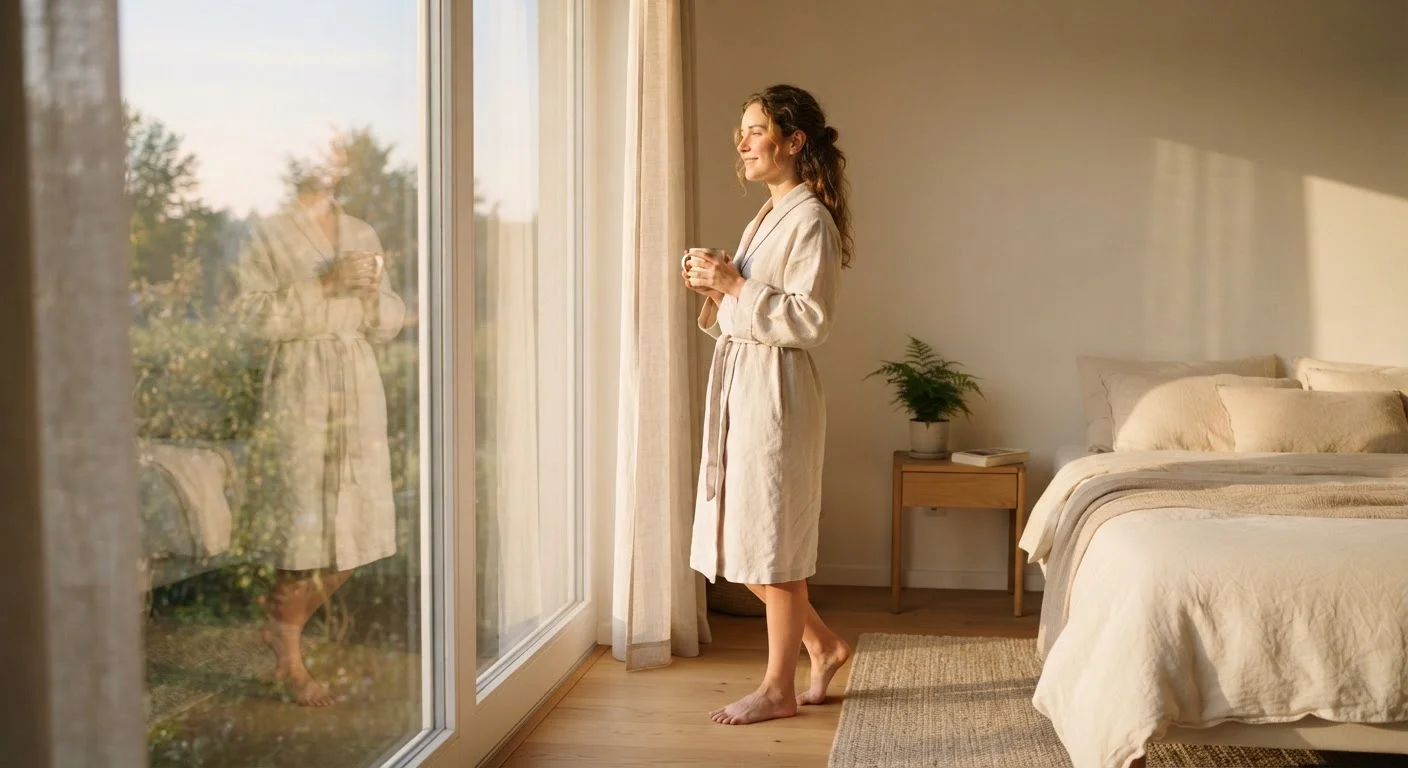
Light exposure in the early morning is the single most potent external cue for anchoring your sleep-wake cycle. When bright light reaches the retina shortly after waking, the SCN interprets this as a confirmation of morning and shifts alertness-promoting signals into high gear — suppressing melatonin, elevating cortisol, and advancing the timing of every downstream process tied to the circadian clock.
Outdoor morning light — even under cloud cover — delivers far more photons than typical indoor environments. This intensity difference is not trivial: the SCN responds to light in a dose-dependent manner. A few minutes outside can provide the kind of robust signal that hours of indoor ambient light cannot replicate.
10–50×
More light outdoors versus typical indoor settings
Even overcast outdoor environments commonly deliver 1,000–10,000 lux, compared to 100–500 lux in most indoor spaces, according to published photometry research.
~50%
Melatonin suppression from moderate evening light
Studies published in sleep research journals have found that even room-level lighting of around 200 lux can suppress melatonin by approximately 50% relative to dim-light conditions in the evening.
~2 hrs
Potential circadian delay from late-night screen exposure
Research on evening blue-light exposure has documented delays of up to two hours in melatonin onset timing when bright screens are used close to habitual bedtime.
The practical implication is straightforward: consistent morning light exposure helps stabilize the timing of when you feel sleepy at night. This is also why morning routines that begin with outdoor exposure tend to have downstream effects on energy and mood throughout the day.
Evening Light, Screens, and Melatonin Suppression
Just as morning light advances the clock, evening light delays it. When the SCN detects bright or blue-enriched light after sunset, it interprets the signal as daytime continuing — and suppresses melatonin, the hormone that signals darkness to the body's tissues.
Melatonin doesn't cause sleep directly, but it is a key timing signal that prepares the body for rest. As the actual role of melatonin in sleep biology makes clear, disrupting this signal delays the cascade of physiological changes that precede sleep — including the drop in core body temperature and the shift in brain activity patterns.
Smartphones, tablets, and televisions emit light in the wavelengths most disruptive to melatonin. But brightness matters alongside wavelength: even warm-toned light at high intensity can suppress melatonin meaningfully. Dimming all light sources in the one to two hours before bed — not just swapping to a night mode — is the more comprehensive strategy supported by evidence. For a fuller picture of what evening habits actually influence sleep onset, see what behavioral science says about pre-sleep habits.
Darkness as an Active Biological Signal
It's tempting to think of darkness as simply the absence of light — a neutral state. Biologically, it is anything but. Darkness is an active signal that the SCN uses to initiate the transition toward sleep. When light falls below a threshold detectable by ipRGCs, the pineal gland is released from SCN inhibition and begins secreting melatonin into the bloodstream, typically starting one to two hours before habitual sleep onset.
Even low-level light during sleep — a streetlamp through thin curtains, a standby indicator on electronics — can fragment this signaling. Research has found associations between nighttime light exposure during sleep and disrupted sleep architecture, though individual sensitivity varies.
Your pre-bed environment — including how dark your room becomes — is one of the underappreciated levers of sleep quality. Blackout curtains, covered indicator lights, and consistent dim lighting in the hour before bed all reduce the light signal reaching the SCN when darkness is needed most.
This article is for general informational and educational purposes only and is not a substitute for professional medical advice. If you have concerns about your sleep or health, consult a qualified healthcare provider.