
Circadian Rhythm vs. Sleep Pressure: Two Forces That Control When You Fall Asleep

Key Takeaways
- Circadian rhythm is a 24-hour internal clock driven primarily by light exposure and runs continuously regardless of sleep.
- Sleep pressure is a chemical buildup — primarily adenosine — that increases the longer you stay awake and dissipates during sleep.
- Both systems work together; falling asleep easily requires them to align, not just one to activate.
- Disrupting either system — through shift work, jet lag, or sleep deprivation — affects alertness, mood, and physical recovery.
- Understanding both forces can help you make smarter decisions about sleep timing, napping, and daily light exposure.
Option A
Circadian Rhythm
Your body's internal 24-hour clock.
Best for: Timing when you feel alert or sleepy across the day based on environmental cues like light and darkness.
Option B
Sleep Pressure (Homeostatic Sleep Drive)
The accumulating biological urge to sleep.
Best for: Signaling how much sleep your body currently needs based on how long you've been awake.
If you want to understand why you feel a mid-afternoon slump
Circadian Rhythm
The post-lunch dip in alertness is driven by a natural trough in your circadian cycle, not just food intake. Your clock dips in the early afternoon regardless of when you ate.
If you're trying to understand why all-nighters feel progressively worse
Sleep Pressure (Homeostatic Sleep Drive)
Adenosine accumulates continuously while you're awake. The longer you stay up, the greater the chemical debt your brain is carrying, independent of clock time.
If you're planning a nap strategically
Sleep Pressure (Homeostatic Sleep Drive)
Short naps temporarily reduce adenosine buildup, relieving sleep pressure without significantly disrupting nighttime sleep if timed well within your circadian window.
If you're recovering from jet lag or shift work disruption
Circadian Rhythm
Jet lag and shift schedules create a mismatch between your internal clock and the external environment — resetting the circadian signal through light exposure is the primary mechanism for recovery.
Two Separate Systems, One Experience of Tiredness
When you feel tired at night or wide awake in the morning, it rarely feels like science — it just feels like your body. But behind that experience are two distinct biological mechanisms working in parallel, each contributing to when and how deeply you sleep.
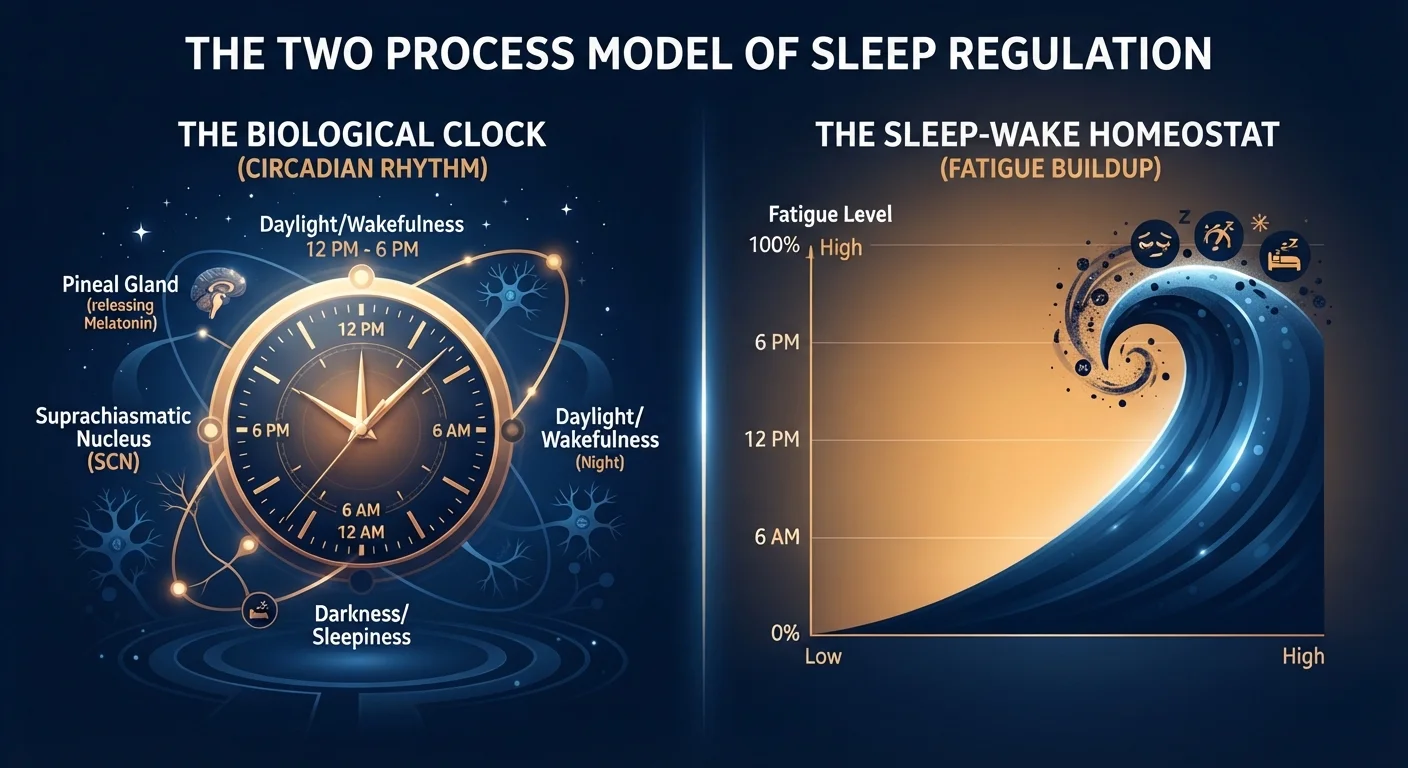
The first is your circadian rhythm: a roughly 24-hour internal clock encoded in nearly every cell of your body, coordinated by a small brain region called the suprachiasmatic nucleus (SCN). The second is sleep pressure, also called homeostatic sleep drive: a chemical signal that accumulates the longer you're awake and clears during sleep. Neither system alone explains your full sleep experience — you need to understand both, and how they interact.
For a broader look at how these forces fit into whole-body health, see our comprehensive sleep overview.
Circadian Rhythm: Your Internal 24-Hour Clock
Your circadian rhythm operates on an approximately 24-hour cycle and regulates far more than just sleep — it governs body temperature, hormone secretion, metabolism, and immune function. The master clock in the SCN is reset daily by environmental cues, the most powerful of which is light.
In the morning, light exposure suppresses the hormone melatonin and increases cortisol, signaling wakefulness. As evening approaches and light dims, the SCN triggers melatonin release from the pineal gland, priming the body for sleep. This rhythm runs continuously — even if you haven't slept at all, your circadian clock still cycles through its programmed peaks and valleys of alertness.
This explains phenomena like the early-afternoon alertness dip (a genuine circadian trough unrelated to lunch) and the "second wind" some people experience in the late evening when the clock briefly promotes wakefulness before the melatonin rise takes over. Light exposure is the primary tool for resetting this clock, which is why managing morning sunlight and evening screen use has real physiological consequences.
| Criterion | Circadian Rhythm | Sleep Pressure |
|---|---|---|
| Primary driver | Light/dark environmental cues | Duration of wakefulness |
| Key biological signal | Melatonin & cortisol cycles | Adenosine accumulation |
| Cycle length | ~24 hours (continuous) | Resets with each sleep episode |
| Cleared by | Light exposure & consistent timing | Sleep (any stage) |
| Disrupted by | Jet lag, shift work, irregular light | Sleep deprivation, long naps |
| Effect of caffeine | Minimal direct effect | Temporarily masks the signal |
| Governed by | Suprachiasmatic nucleus (SCN) | Diffuse neural adenosine receptors |
Sleep Pressure: The Chemistry of Feeling Tired
Sleep pressure operates on a completely different principle. From the moment you wake up, your brain begins producing adenosine — a byproduct of neural activity that accumulates in brain tissue as a kind of metabolic debt. The longer you stay awake, the higher the adenosine concentration, and the stronger the drive to sleep becomes.
During sleep, the brain clears adenosine efficiently, which is why even a few hours of rest can meaningfully reduce the subjective sense of exhaustion. This is also precisely how caffeine works: it temporarily blocks adenosine receptors, masking the signal without actually reducing the underlying chemical buildup. When caffeine wears off, the adenosine is still waiting.
Learn more about adenosine and how sleep pressure builds at the molecular level. This system helps explain why a short nap can restore alertness — but also why napping late in the day may blunt sleep pressure enough to delay nighttime sleep onset. See how naps compare to nighttime sleep for practical context.
~24.2 hrs
Average intrinsic human circadian period
Research published in sleep science literature shows the human circadian clock runs slightly longer than 24 hours and requires daily light cues to stay synchronized.
16 hrs
Typical wakefulness before peak sleep pressure
After approximately 16 hours of continuous wakefulness, adenosine-driven sleep pressure reaches levels that strongly promote sleep onset in most adults.
~90 min
Nap length that significantly reduces sleep pressure
Sleep researchers note that naps exceeding 90 minutes enter deep slow-wave sleep, where substantial adenosine clearance occurs and nighttime sleep may be delayed.
How the Two Systems Interact — and When They Conflict
Optimal sleep occurs when both systems align: circadian timing promotes sleep at the same moment that sleep pressure is high enough to initiate and sustain it. For most people on a consistent schedule, this happens naturally in the late evening after a full day of wakefulness.
Conflict between the two systems is where sleep problems often originate. A night-shift worker may have high sleep pressure but a circadian rhythm actively promoting wakefulness during the day — making restorative daytime sleep difficult regardless of how tired they feel. Someone with jet lag may have a strong sleep drive aligned to their home time zone while their new environment's clock is out of phase. In both cases, the mismatch — not personal weakness — is the root cause of poor sleep quality.
Understanding this two-process model also clarifies why simply "trying harder" to sleep rarely works. If either system isn't ready, initiating sleep is physiologically difficult. Practices that respect both systems — consistent wake times to anchor the circadian clock, avoiding excessive napping to preserve sleep pressure, and managing light to support melatonin timing — work with your biology rather than against it.
This article is for informational purposes only and is not a substitute for professional medical advice. If you have concerns about your sleep patterns or a sleep disorder, please consult a qualified healthcare provider.