

Key Takeaways
- Muscle soreness after exercise is caused by microscopic fiber damage and the resulting inflammation, not lactic acid buildup.
- The repair process — not the workout itself — is what makes muscles stronger and more resilient over time.
- Protein synthesis peaks in the hours after exercise but continues for up to 48–72 hours post-workout.
- Sleep is when much of the hormonal signaling for muscle repair occurs, making it an essential recovery tool.
- Skipping recovery time between hard sessions can impair adaptation and increase injury risk.
Muscle Repair After Exercise
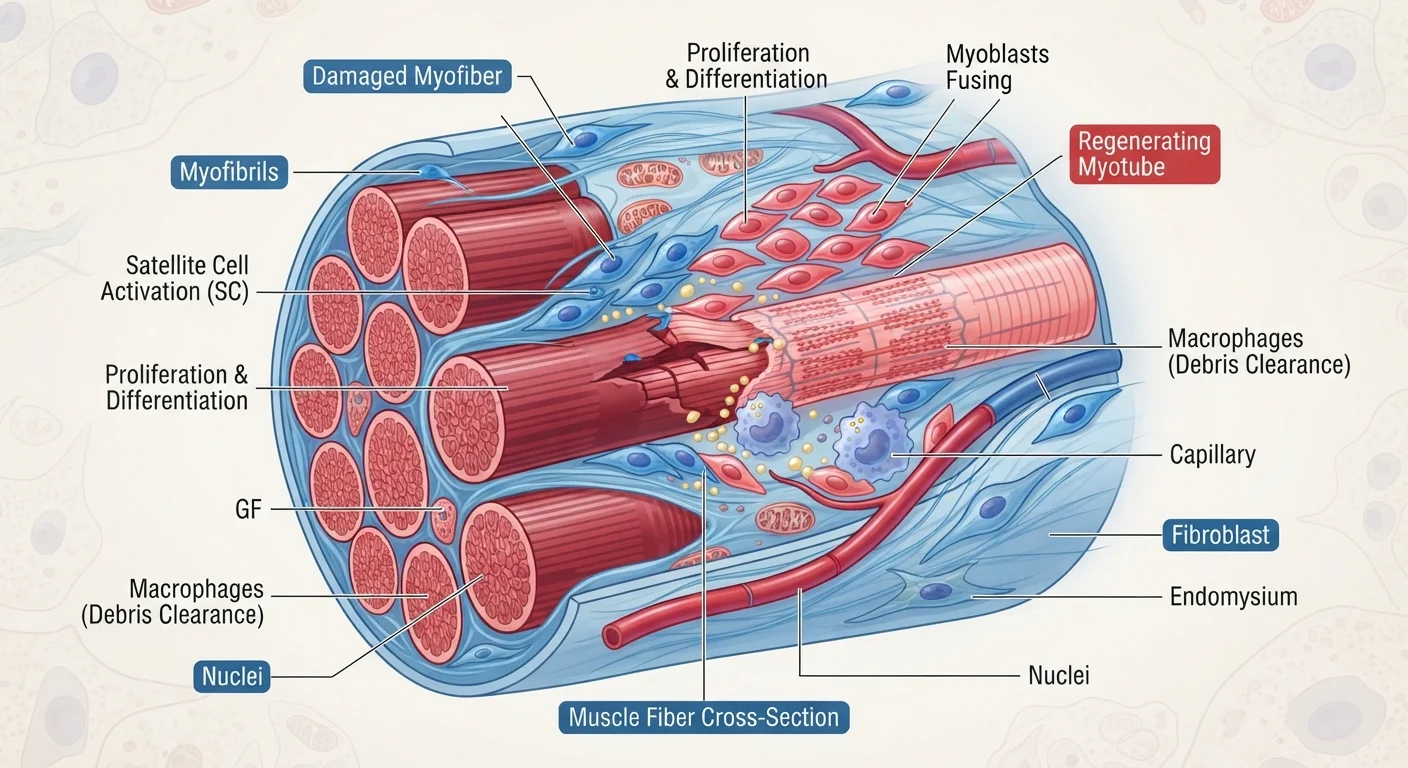
When you exercise intensely, your muscle fibers sustain microscopic damage. Your body responds by triggering an inflammatory repair process that rebuilds those fibers slightly stronger than before. This cycle of damage and repair is the fundamental mechanism behind muscle adaptation and growth.
The process involves satellite cell activation, myofibril remodeling, and upregulated muscle protein synthesis (MPS) — collectively regulated by signaling pathways including mTOR and IGF-1.
The Micro-Damage That Drives Adaptation
Every time you push your muscles hard — whether through lifting, sprinting, or sustained endurance effort — you create microscopic damage within the muscle fibers themselves. These tiny tears, called micro-tears or myofibrillar disruptions, are not a sign that something went wrong. They are the intended stimulus for adaptation.
Eccentric contractions — the phase where a muscle lengthens under load, such as lowering a dumbbell or descending stairs — produce the greatest degree of micro-damage. This is why new or unusually intense exercise sessions tend to produce the most soreness.
Within hours of exercise, your immune system dispatches inflammatory signals to the damaged area. White blood cells, particularly neutrophils and macrophages, move in to clear cellular debris and initiate tissue repair. This inflammatory phase is essential; attempts to suppress it entirely with anti-inflammatory drugs may actually blunt long-term muscle adaptation, according to some research lines — though the science here is still evolving.
For a broader look at how the body manages this process from head to toe, see the complete overview of physical recovery from exercise.
Protein Synthesis: How Muscle Rebuilds Itself
Once the initial inflammatory phase is underway, the body shifts into a rebuilding mode driven by muscle protein synthesis (MPS) — the cellular process of assembling new proteins to repair and reinforce damaged muscle fibers. Satellite cells, a type of muscle stem cell, activate and fuse with existing fibers to support this repair.
MPS is elevated above baseline for up to 48–72 hours following intense resistance exercise, meaning the recovery window extends well beyond the workout itself. The amino acids required for this process must come from dietary protein, which is why nutrition in the hours and days after exercise matters for recovery outcomes.
48–72 hrs
Duration of elevated muscle protein synthesis post-exercise
Research in exercise physiology indicates MPS remains above baseline for up to 72 hours after a single resistance training session.
~7–9 hrs
Recommended nightly sleep for adults
The American Academy of Sleep Medicine recommends 7–9 hours of sleep per night for adults to support health, including physical recovery.
24–48 hrs
Typical DOMS onset window
Delayed-onset muscle soreness generally peaks between 24 and 48 hours after a challenging workout, according to established exercise science literature.
Hormones also play a central role. Testosterone, growth hormone, and insulin-like growth factor-1 (IGF-1) all peak in response to exercise and contribute to anabolic signaling — the cascade of instructions that tells muscle tissue to repair and grow. Importantly, growth hormone secretion surges primarily during deep sleep, linking quality rest directly to physical recovery.
To understand exactly how what you eat supports this process, the guide on protein, carbs, and hydration for recovery explains the mechanisms in practical terms.
Why Sleep and Rest Are Non-Negotiable
Training creates the stimulus for adaptation. Recovery — particularly sleep — is where that adaptation actually occurs. During slow-wave (deep) sleep, the pituitary gland releases the largest pulse of growth hormone your body produces in a 24-hour period. This hormonal environment is critical for protein synthesis, tissue repair, and cellular restoration.
Sleep deprivation disrupts this hormonal signaling, reduces the body's anabolic response to exercise, and impairs glycogen resynthesis — the process of restoring muscle fuel stores. Research consistently shows that athletes who sleep fewer than seven hours per night show slower recovery and greater risk of overuse injury than those who prioritize adequate rest.
Rest between sessions matters just as much. Returning to high-intensity training before muscles have completed the repair cycle can interrupt adaptation and, over time, contribute to overtraining syndrome — a state of accumulated fatigue where performance and recovery both decline.
It's also worth noting that muscles are not the only structures that need time to heal. Connective tissues like tendons, ligaments, and fascia recover more slowly than muscle fibers and are often overlooked in standard recovery conversations.
This article is for general informational and educational purposes only and does not constitute medical advice. Consult a qualified healthcare professional with questions about your health, symptoms, or training program.