

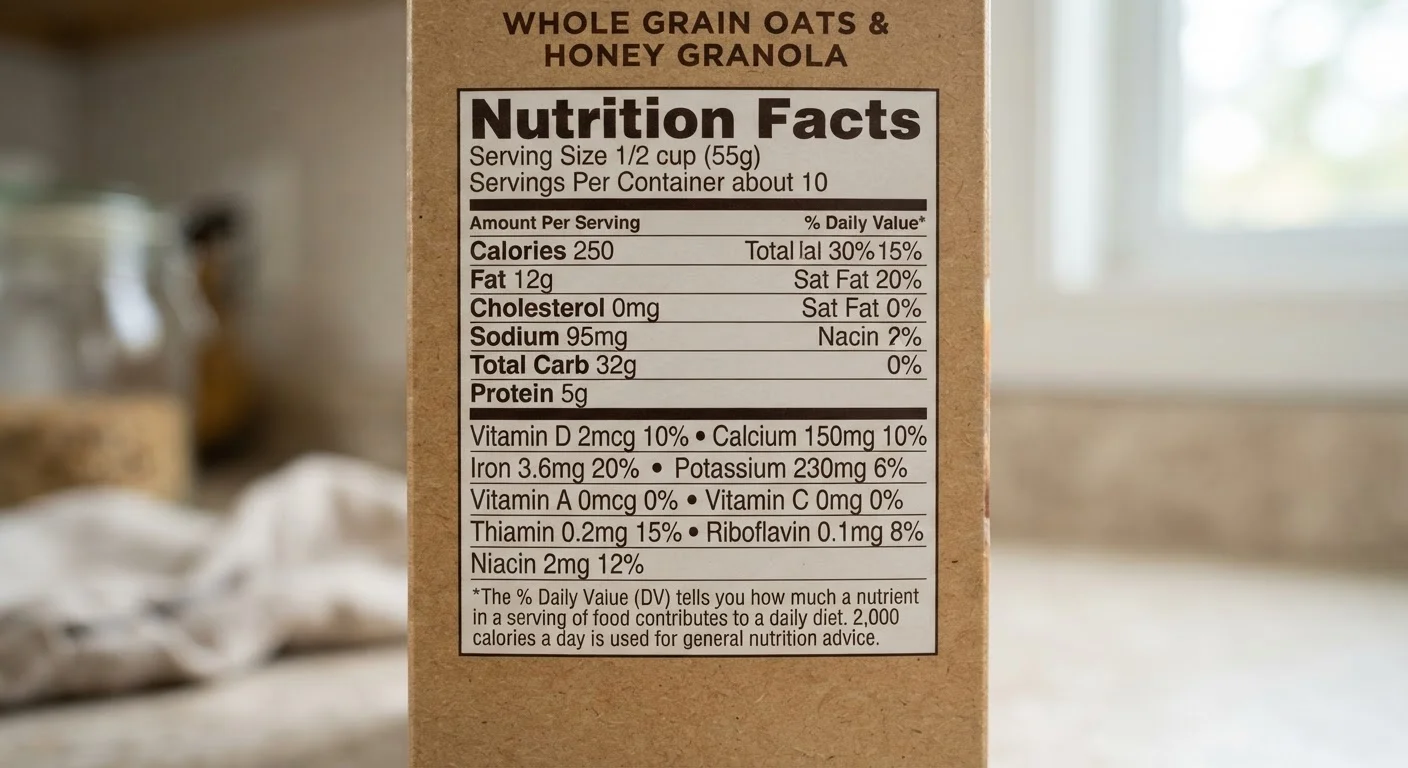
Key Takeaways
- Percent Daily Value (%DV) tells you how much one serving contributes toward a standard daily nutrient target.
- 5% DV or less is low; 20% DV or more is high for any listed micronutrient.
- Only four micronutrients are federally required on every U.S. label: Vitamin D, Calcium, Iron, and Potassium.
- Manufacturers may voluntarily list additional vitamins and minerals beyond the required four.
- Labels use a 2,000-calorie reference diet — your actual needs may vary by age, sex, and health status.
What you will need
Why the Micronutrient Section Deserves More Attention
Most Americans scan a nutrition label for calories, fat, or sodium — and stop there. The micronutrient section at the bottom of the panel tends to get overlooked, yet it carries practical information about vitamins and minerals that directly support bone health, immune function, oxygen transport, and more.
If you're newer to reading labels, our full Nutrition Facts panel walkthrough covers every section top to bottom. This guide focuses specifically on the vitamin and mineral rows. To understand why these nutrients matter biologically, see our primer on how vitamins and minerals differ.
The Label Reflects a Reference Diet, Not Yours
The %DV figures on any label are calculated against a 2,000-calorie-per-day reference intake established by the FDA. Your personal nutrient needs may be higher or lower based on your age, sex, activity level, or health conditions. Use %DV as a general guide, not a personal prescription.
What You'll Need Before You Start
No special equipment is required. All you need is a packaged food item with a standard U.S. Nutrition Facts panel and a basic understanding of serving sizes. Having a second product on hand for comparison is helpful but optional.
What you will need
Step-by-Step: Reading the Micronutrient Rows
Follow these steps each time you pick up a packaged food and want to evaluate its micronutrient contribution.
Confirm the serving size before reading anything else
All numbers on a Nutrition Facts panel — including micronutrient percentages — apply to one serving, not the entire package. Find the serving size at the very top of the label (e.g., "1 cup (240 mL)") and note how many servings the package contains. If you eat two servings, every %DV figure doubles.
Locate the micronutrient rows near the bottom of the panel
After the sodium row, you'll find a horizontal rule followed by rows listing individual vitamins and minerals. Under FDA rules updated in 2020, every compliant U.S. label must display four nutrients in this section:
- Vitamin D
- Calcium
- Iron
- Potassium
These four were prioritized because Americans commonly fall short of them. Additional micronutrients — such as Vitamin A, Vitamin C, or Magnesium — may appear if the manufacturer chooses to list them or if a nutrient content claim is made about them.
Read the Percent Daily Value (%DV) for each nutrient
Each micronutrient row shows a name, an amount (in milligrams or micrograms), and a %DV. The %DV tells you what fraction of a standardized daily reference amount that one serving provides. The FDA uses a 2,000-calorie daily diet as its reference point. Use this quick benchmark:
- 5% DV or less = low in that nutrient
- 10–19% DV = a moderate source
- 20% DV or more = high in that nutrient
Note the unit of measurement for context
Vitamins and minerals are listed in either milligrams (mg) or micrograms (mcg or µg). One milligram equals 1,000 micrograms — so nutrients listed in micrograms are needed in much smaller absolute quantities. This context helps when comparing products or researching a specific nutrient. For example, Vitamin D is listed in micrograms, while Calcium is in milligrams.
Compare products or meals to spot nutritional gaps
Once you can read one label, use the same approach across multiple foods. Look for patterns: Are most of your daily foods low in Vitamin D? Is Iron consistently near 0% DV? This practice helps you identify gaps your overall diet may have — and informs smarter food choices without requiring supplements. Our beginner's guide to micronutrients can help you understand which nutrients your body prioritizes and why.
Putting It Into Practice
Reading labels is most useful when it informs real purchasing and meal decisions. A single food rarely needs to supply every vitamin or mineral you need — the goal is overall dietary diversity across the day. If one product is high in Calcium but low in Iron, that's not a flaw; it's useful information about what to pair it with.
For a deeper look at building meals around micronutrient density without specialty products, see our guide on building a micronutrient-rich diet from everyday grocery store foods. And if you're also tracking carbohydrates, protein, and fat, the label walkthrough for macronutrients is a natural companion read.
High %DV Isn't Always Better
While higher %DV is desirable for nutrients like Calcium and Iron, some nutrients can accumulate to harmful levels if consumed in excess — particularly fat-soluble vitamins such as Vitamin D and Vitamin A. If you also take dietary supplements, the amounts from food and supplements add together. Speak with a healthcare provider or registered dietitian before significantly increasing intake of any single nutrient.
This article is for general informational purposes only and is not a substitute for personalized medical or dietary advice. Consult a registered dietitian or qualified healthcare provider for guidance specific to your health needs.