

Key Takeaways
- Dietary fat is an essential macronutrient the body cannot function without.
- Not all fats are equal — unsaturated fats support heart health, while industrially produced trans fats pose real risks.
- Eating fat does not directly cause body fat gain; overall calorie balance and food quality matter most.
- Fat enables absorption of fat-soluble vitamins A, D, E, and K.
- Low-fat diets often replace fat with refined carbohydrates, which can worsen metabolic health.
How Fat Got a Bad Reputation
For much of the late 20th century, dietary fat was cast as the primary villain behind heart disease and weight gain. Government guidelines issued in the 1980s urged Americans to cut fat dramatically, and food manufacturers responded with a wave of "fat-free" and "low-fat" products. What those products often contained instead — refined sugars and starches — went largely unquestioned at the time.
The science has since moved forward considerably. Fat is one of three macronutrients the body needs in meaningful quantities every day. To understand what fat actually does, see our overview of all three macronutrients. The short version: cutting fat wholesale was never the clean solution it was marketed as.
Common Myths About Dietary Fat — Corrected
Several stubborn misconceptions about fat continue to shape how people eat. The myth-and-fact pairs below address each one directly, drawing on established nutritional research.
Myth
Eating fat makes you fat.
Fact
Body fat accumulation is driven by overall calorie surplus, not by dietary fat alone.
Weight change is determined by the relationship between calories consumed and calories expended. Fat is calorie-dense (9 calories per gram), so large portions can contribute to a surplus — but the same is true of any macronutrient in excess. Research consistently shows that diets moderate to high in fat do not inherently cause greater weight gain than lower-fat diets when total calories are matched. Dietary fat also promotes satiety, meaning it can help people feel full and eat less overall.
Myth
All fat is bad for your heart.
Fact
Unsaturated fats are associated with improved cardiovascular risk markers, not increased risk.
The relationship between fat and heart health depends heavily on fat type. Monounsaturated and polyunsaturated fats — found in olive oil, nuts, seeds, and fatty fish — have been shown in multiple large studies to support healthy cholesterol profiles and reduce markers of cardiovascular risk. Trans fats, on the other hand, are strongly linked to increased LDL (low-density lipoprotein, often called "bad" cholesterol) and decreased HDL (high-density lipoprotein). Treating all fats as interchangeable ignores meaningful biological differences between them.
Myth
Low-fat foods are automatically healthier.
Fact
Many low-fat products compensate with added sugar or refined starches, which may worsen metabolic outcomes.
When fat is removed from a processed food, something has to replace its role in texture and palatability. Manufacturers frequently use sugar, high-fructose corn syrup, or refined flours. These substitutions can raise blood glucose more sharply than the fat they replaced and contribute to energy spikes and crashes. Reading ingredient labels rather than relying on front-of-package claims gives a clearer picture of a food's actual nutritional value.
Myth
You should avoid fat if you're trying to eat heart-healthy.
Fact
Heart-healthy dietary patterns — such as a Mediterranean-style diet — are notably rich in fat from whole-food sources.
The Mediterranean dietary pattern, which research has repeatedly linked to reduced cardiovascular disease risk, is not a low-fat diet. It derives a substantial portion of calories from fat — primarily olive oil, fish, and nuts. The quality and source of fat matters more than the quantity alone. Replacing saturated fat with refined carbohydrates, as low-fat diet messaging often implied, has not shown clear heart-health benefits in research.
Myth
Fat has no role in a healthy diet — it's just stored energy.
Fact
Fat is essential for hormone synthesis, nerve function, and absorption of fat-soluble vitamins.
The body cannot produce certain fatty acids on its own — omega-3 and omega-6 fatty acids are termed "essential" precisely because they must come from food. Beyond energy storage, fat forms the structural backbone of cell membranes throughout the body, insulates nerve fibers, and is required to produce steroid hormones including estrogen and testosterone. Without adequate dietary fat, fat-soluble vitamins (A, D, E, and K) pass through the digestive tract without being absorbed, even if the diet is otherwise nutrient-rich.
What Fat Actually Does in the Body
Fat serves functions no other macronutrient can replicate. It is the primary structural component of every cell membrane in the body. The brain — roughly 60% fat by dry weight — depends on fatty acids for development and ongoing function. Fat also acts as the transport vehicle for fat-soluble vitamins: A, D, E, and K cannot be absorbed without it. A meal of leafy greens or orange vegetables delivers far less nutritional benefit when eaten with zero fat than when paired with even a small amount.
Beyond absorption, fat provides a dense, stable energy source (9 calories per gram, compared to 4 for carbohydrates and protein) and plays a central role in hormone production, including reproductive hormones and cortisol. These are not optional processes — they are foundational to health.
For a closer look at how fat interacts with the other macronutrients to affect body composition, see how macronutrients influence body composition.
Choosing Fat Wisely in Everyday Eating
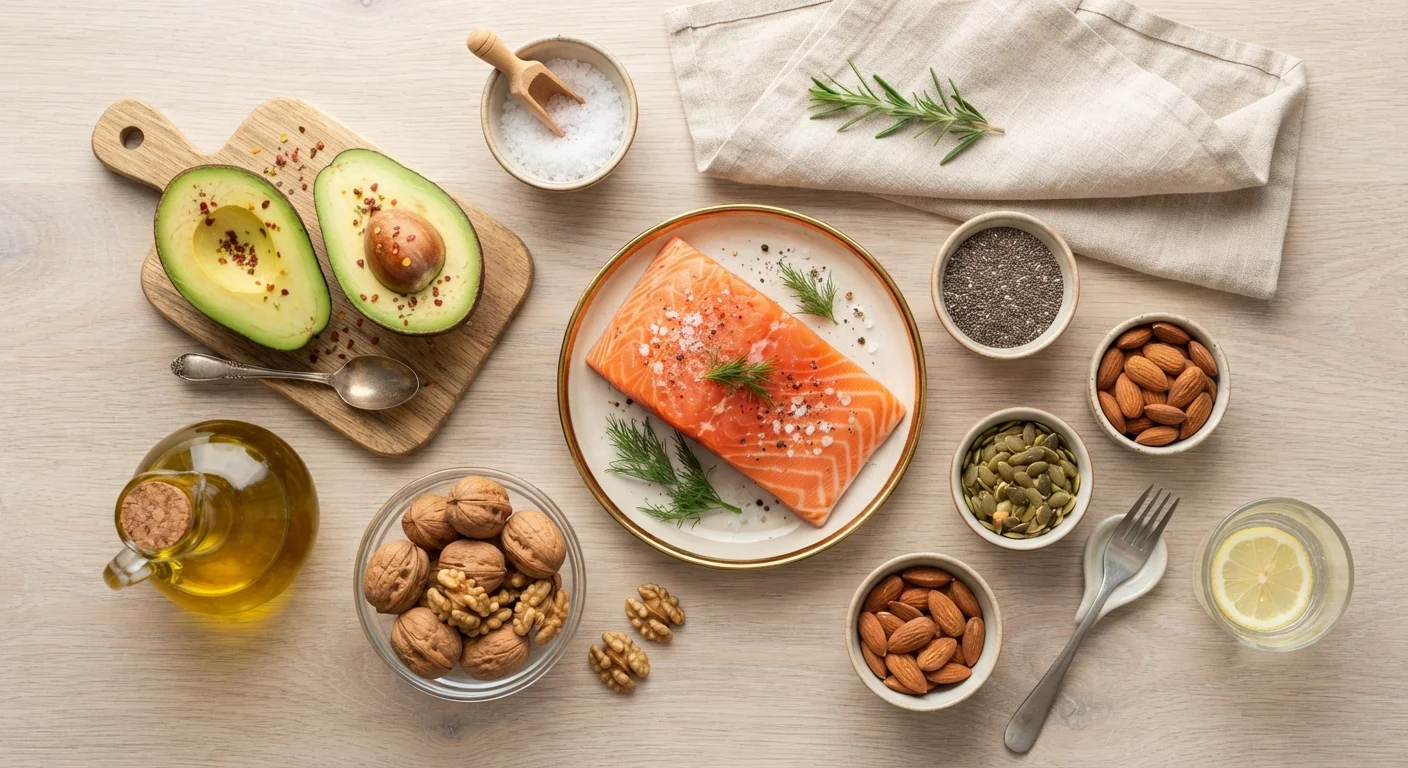
No single food delivers only one type of fat — most contain a mix. That said, the balance matters. Diets that emphasize unsaturated fats (found in olive oil, avocados, nuts, and fatty fish) are consistently associated with better cardiovascular outcomes in large-scale research. Saturated fats, found primarily in animal products and tropical oils, are an active area of ongoing research; current evidence generally supports moderation rather than total avoidance. Industrially produced trans fats, largely removed from the U.S. food supply following FDA action, remain the fat type most clearly linked to harm.
For clear definitions of each fat type and where they appear in real foods, the no-jargon fat-type reference is a useful companion to this article.
Practical guidance: prioritize whole-food fat sources over heavily processed ones, include a source of fat at most meals to support nutrient absorption, and resist the reflex to reach for low-fat versions of foods when the alternative ingredients are less favorable. If you have specific cardiovascular or metabolic conditions, work with a registered dietitian or physician to determine what fat intake is appropriate for you.
This article is for general informational and educational purposes only and is not a substitute for professional medical or dietary advice. Always consult a qualified healthcare provider before making significant changes to your diet, especially if you have an existing health condition.