

Key Takeaways
- Processed food exists on a spectrum — not all processing is nutritionally harmful.
- Ultra-processed foods are the most strongly linked to poor health outcomes in research.
- Whole foods deliver fiber, micronutrients, and phytonutrients that processing can reduce.
- Frozen and canned vegetables are minimally processed and nutritionally comparable to fresh.
- Reading ingredient lists helps identify where a product falls on the processing spectrum.
- A realistic, balanced diet can include some processed foods without compromising overall health.
Option A
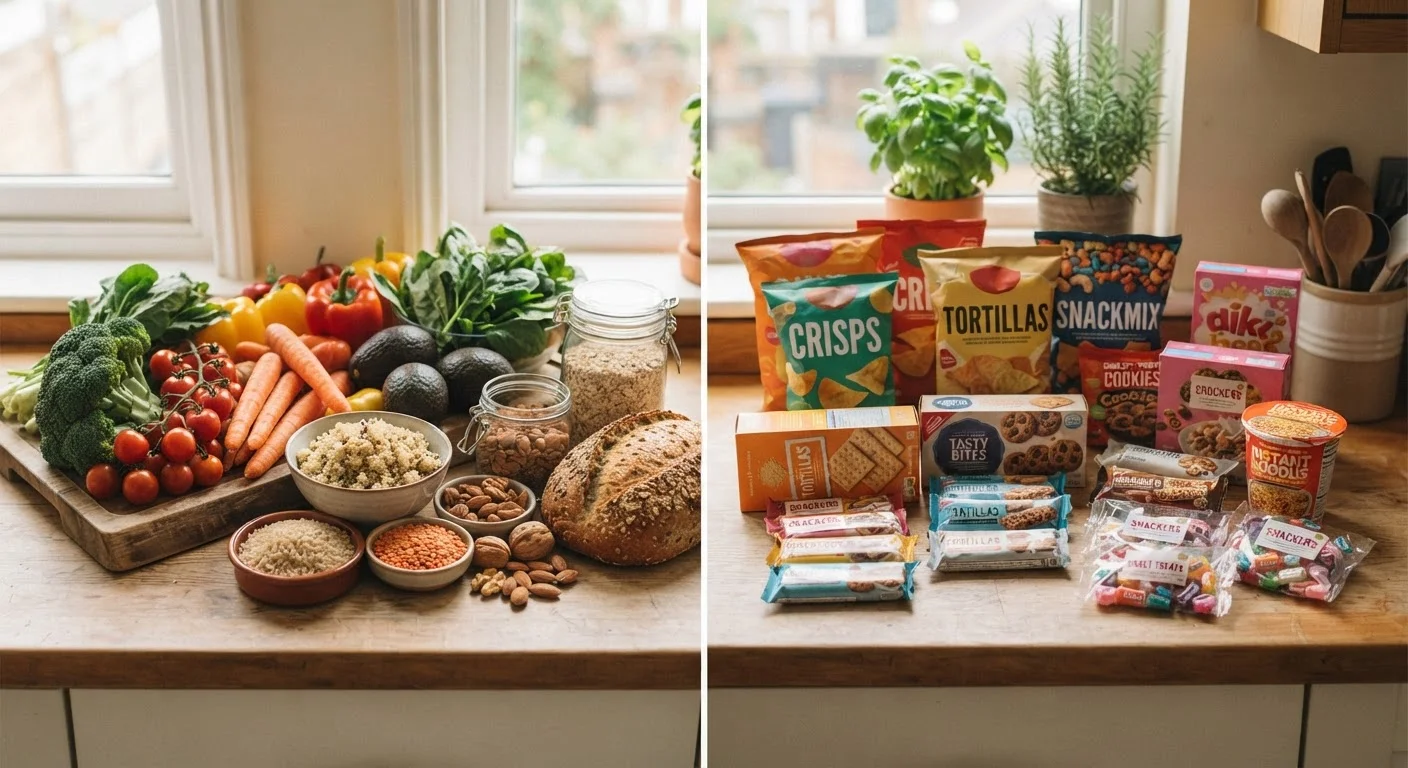
Whole Foods
The minimally altered, nutrient-dense foundation of a balanced diet.
Best for: People prioritizing maximum nutrient density and minimal additives in their daily eating.
Option B
Processed Foods
A broad spectrum from lightly modified to heavily engineered products.
Best for: Anyone navigating convenience and affordability without abandoning nutrition goals.
If you want to maximize nutrient density at every meal
Whole Foods
Whole foods retain the full matrix of fiber, vitamins, minerals, and phytonutrients that processing can reduce or remove.
If your priority is convenience and affordability on a busy schedule
Processed Foods
Minimally processed options like canned beans, frozen vegetables, and plain oats offer solid nutrition with significantly less prep time and cost.
If you are trying to reduce sodium, added sugar, and refined carbohydrates
Whole Foods
Whole foods naturally contain little to no added sodium or sugar, making them the clearest path to reducing these nutrients without careful label-reading.
If you want a sustainable long-term eating pattern without strict restriction
Processed Foods
Strategically chosen minimally processed foods help fill practical gaps, making a largely whole-food diet easier to maintain in real American households.
What We Actually Mean by 'Processed'
The word processed gets used as a catch-all term for anything deemed unhealthy, but that framing misses important nuance. By the technical definition used by food scientists and public health researchers, nearly every food Americans eat has undergone some form of processing — washing, cutting, cooking, fermenting, or freezing all count.
A more useful framework is the NOVA classification system, developed by researchers at the University of São Paulo. NOVA divides foods into four groups based on the nature and extent of industrial processing:
- Group 1 — Unprocessed or minimally processed foods: Fresh fruits, vegetables, plain meats, eggs, plain milk, and dried legumes. These are whole foods in the most precise sense.
- Group 2 — Processed culinary ingredients: Oils, flours, salt, and sugars — substances extracted from whole foods and used in home cooking.
- Group 3 — Processed foods: Products like canned tomatoes, jarred nut butters, smoked fish, and aged cheeses. These are whole foods with minimal added ingredients to preserve them or enhance flavor.
- Group 4 — Ultra-processed foods (UPF): Industrially formulated products made largely from substances extracted from foods, with little or no whole food remaining — think packaged snacks, sugary cereals, reconstituted meat products, and soft drinks.
Understanding this spectrum changes the conversation. A can of plain black beans is processed. So is a bag of cheese-flavored puffs. Treating them identically is nutritionally inaccurate.
How Whole Foods and Ultra-Processed Foods Compare
When nutritional science compares these ends of the spectrum, consistent patterns emerge. Whole foods tend to deliver higher amounts of dietary fiber, essential vitamins, minerals, and phytonutrients — bioactive plant compounds that research associates with reduced disease risk. Ultra-processed foods, by contrast, are typically higher in added sugars, sodium, refined starches, and industrial fats, while being lower in fiber and micronutrients.
| Criterion | Whole Foods | Ultra-Processed Foods |
|---|---|---|
| Fiber content | Naturally high | Typically low |
| Added sugars | None | Often high |
| Sodium | Naturally low | Often high |
| Micronutrient density | High; full food matrix intact | Lower; nutrients often lost in processing |
| Ingredient list | One ingredient or very few | Long; many additives and artificial ingredients |
| Convenience | Requires more prep time | Ready-to-eat or quick to prepare |
| Cost | Variable; fresh produce can cost more | Often lower cost per serving |
| Satiety | Higher; fiber and protein promote fullness | Lower; engineered to encourage overeating |
Epidemiological research, including large cohort studies published in journals such as The BMJ and JAMA Internal Medicine, has found associations between high ultra-processed food consumption and increased risks of cardiovascular disease, type 2 diabetes, obesity, and certain cancers. It is important to note these are observational associations — they show correlation, not direct cause and effect — but the consistency across multiple studies and populations lends them scientific weight.
On the practical side, ultra-processed foods are engineered to be hyper-palatable, meaning they are formulated to encourage continued eating beyond fullness. This is a meaningful behavioral factor when thinking about daily food choices.
For a deeper look at interpreting what's on a food package, see our guide to reading a nutrition label.
Where Minimally Processed Foods Fit In Real Life
For most American households, a diet built exclusively on unprocessed whole foods is neither realistic nor necessary. The evidence does not demand perfection — it points toward patterns. Minimally processed foods in NOVA Group 3 can be nutritional allies:
- Frozen vegetables: Flash-frozen shortly after harvest, these often retain comparable vitamin levels to fresh produce. They require no prep and reduce food waste.
- Canned legumes: Beans and lentils canned in water or brine provide protein, fiber, and iron at low cost. Rinsing reduces sodium content significantly.
- Plain rolled oats: A whole grain with minimal processing that delivers soluble fiber, particularly beta-glucan, associated with heart health benefits.
- Plain yogurt: Minimally processed dairy that provides protein, calcium, and live cultures.
The strategy that evidence supports is straightforward: build meals around Group 1 and Group 3 foods, use Group 2 ingredients (oils, herbs, salt) in reasonable amounts, and treat Group 4 ultra-processed foods as occasional rather than habitual.
Whole foods also deliver nutrients in a food matrix — the physical structure of the food — that affects how nutrients are absorbed and how satisfied you feel. This is one reason why whole food sources of vitamins and minerals often differ functionally from isolated supplements. For more on that distinction, see micronutrients from whole foods vs. supplements.
If you're ready to put this into practice, building a micronutrient-rich diet from everyday grocery store foods offers concrete strategies using standard supermarket staples.
This article is for general informational and educational purposes only and is not a substitute for professional medical or dietary advice. Consult a qualified healthcare provider or registered dietitian for guidance specific to your health needs.