

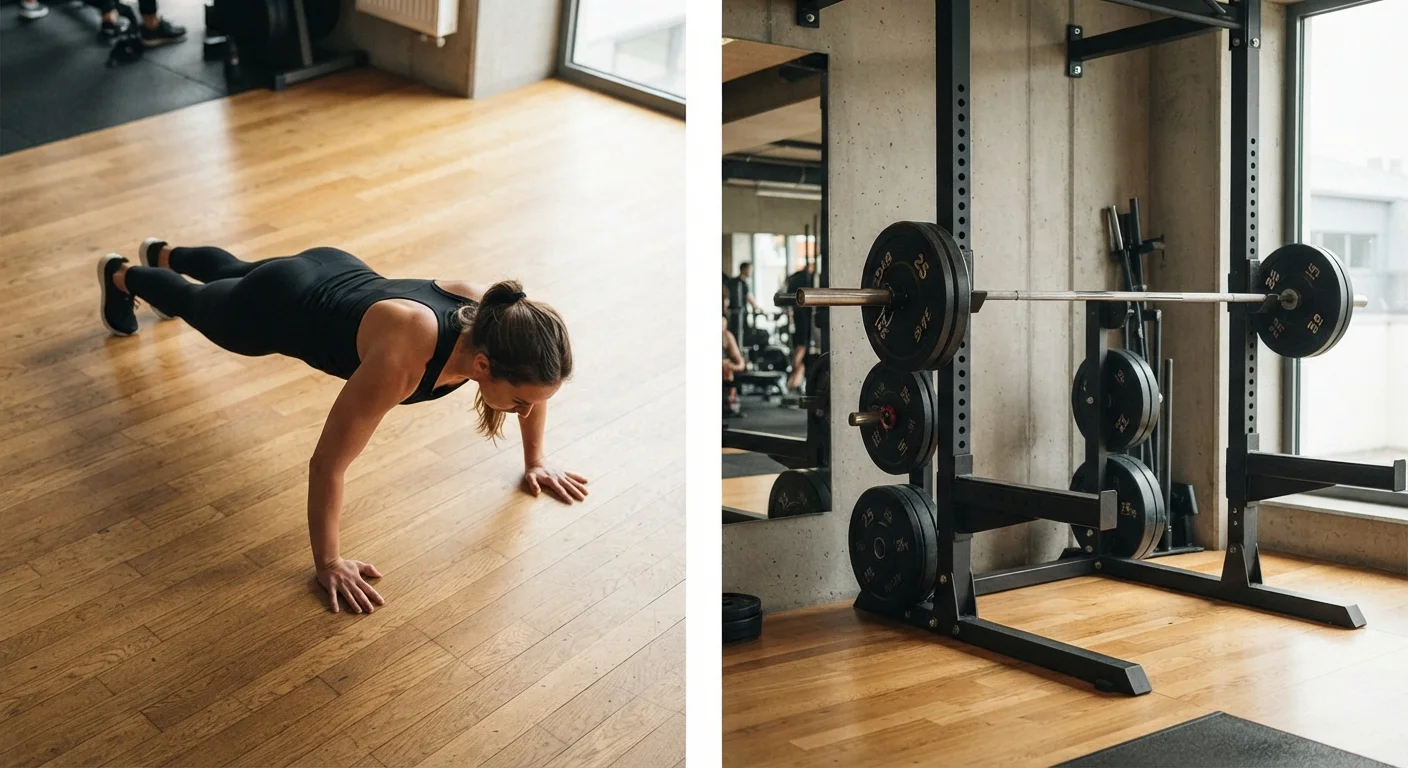
Key Takeaways
- Both bodyweight training and free weights are effective for building strength and improving body composition.
- Bodyweight exercises are limited in easy load progression but excel at teaching coordination and control.
- Free weights allow precise, incremental load increases — a key driver of long-term strength adaptation.
- Beginners often benefit from bodyweight fundamentals before adding external load.
- Neither approach is universally superior — the best choice depends on goals, access, and training stage.
- Combining both methods is a practical strategy for most everyday exercisers.
Option A
Bodyweight Training
The portable, skill-rich foundation of human movement.
Best for: Anyone building movement patterns from scratch, training without equipment, or developing body control and relative strength.
Option B
Free Weights
The precise, load-scalable tool for progressive overload.
Best for: Anyone ready to systematically increase external resistance and track measurable strength gains over time.
If you're a complete beginner with no equipment access
Bodyweight Training
Learning to control your own body through fundamental movement patterns builds the coordination and joint stability that makes any future training safer and more effective.
If your primary goal is measurable, long-term strength development
Free Weights
The ability to add small, precise increments of load makes progressive overload more systematic, which is the central driver of continued strength adaptation.
If you travel frequently or prefer training at home
Bodyweight Training
Zero equipment is required, and exercise difficulty can be scaled through leverage, tempo, and range of motion without a gym membership.
If you want to maximize muscle hypertrophy efficiently
Free Weights
Loading muscles through their full range of motion with controlled, progressive resistance is among the most well-supported methods for stimulating muscle growth.
If you want a sustainable long-term approach that adapts with you
Bodyweight Training and Free Weights combined
Using bodyweight moves for warm-ups, skill work, and recovery days alongside free-weight sessions gives you the benefits of both systems across different training contexts.
How Each Method Delivers Resistance
At the core of any strength training method is one question: how does the exercise load the muscle? Understanding that answers most of the bodyweight-vs-free-weights debate before it starts.
Bodyweight training uses your body's own mass as the resistance. The challenge can be scaled by changing your leverage — elevating your feet for push-ups, for example, shifts more load onto the chest and shoulders. But the upper ceiling is fixed: once a standard push-up feels easy, you're limited in how precisely you can add more resistance without changing the movement entirely (think archer push-ups or one-arm progressions).
Free weights — dumbbells, barbells, and kettlebells — apply an external load that is independent of your bodyweight. That means you can add 2.5 lb to a dumbbell bench press without changing the movement pattern at all. This makes progressive overload (the gradual increase of training stimulus over time) more straightforward to track and apply. As explored in how resistance training reshapes body composition, consistent overload is a primary driver of long-term muscle and strength development.
| Criterion | Bodyweight Training | Free Weights |
|---|---|---|
| Resistance source | Body mass and leverage | External load (dumbbells, barbells) |
| Load progression | Leverage and variation changes | Incremental weight increases |
| Equipment needed | None | Weights or gym access |
| Skill/technique demand | Body control and proprioception | Stabilization under external load |
| Injury risk profile | Lower with poor form | Higher if form breaks under load |
| Best for beginners | Strong foundation builder | Better after basics are learned |
| Long-term strength ceiling | Limited without advanced progressions | High — load can scale continuously |
| Portability | Fully portable | Gym-dependent or costly at home |
Skill Demand, Stability, and Movement Quality
Both methods require good movement quality — but they develop it differently.
Bodyweight exercises are inherently closed-chain movements, meaning your hands or feet are fixed against a surface. This typically produces higher demands on joint stability and proprioception (your sense of body position in space). A well-executed pull-up, for instance, simultaneously trains grip strength, shoulder stability, and core tension — it's a full-system effort.
Free weights introduce an element of load management: you must stabilize the weight through space while also producing force. A dumbbell overhead press, for example, challenges shoulder girdle stability in a way a bodyweight pike push-up doesn't fully replicate. However, free weights also introduce a higher injury risk when technique breaks down under fatigue or excessive load. This is why form should always precede added load — a principle that applies to both modalities but is especially critical with external weights.
For newer exercisers, mastering bodyweight movement patterns first builds the neuromuscular foundation that makes free-weight training more productive and safer later on.
Accessibility, Cost, and Practical Fit
The practical realities of your life matter as much as exercise science does.
Bodyweight training requires no equipment and minimal space. A floor, a doorframe, and your own bodyweight can cover push/pull/squat/hinge patterns effectively. This makes it genuinely accessible for home training, travel, or anyone not ready to join a gym.
Free weights require some investment — either a gym membership or purchasing your own equipment. The payoff is a wider loading range and a cleaner progression path. For those focused on improving body composition rather than just body weight, the ability to systematically load muscles over months and years is a meaningful practical advantage.
2–3×
Frequency needed for strength adaptations
Exercise science literature generally supports training each muscle group at least two to three times per week to drive consistent strength and hypertrophy gains, regardless of training modality.
~48 hrs
Typical muscle recovery window between sessions
Most established resistance training guidelines recommend allowing roughly 48 hours of recovery between sessions targeting the same muscle groups to support repair and adaptation.
8–12 reps
Rep range associated with hypertrophy
Research in exercise physiology consistently identifies moderate rep ranges (roughly 6–15) as effective for muscle growth, applicable to both bodyweight and free-weight exercises when performed near muscular failure.
Neither approach demands the other be abandoned. Many experienced exercisers use bodyweight movements for warm-up, skill work, or active recovery days — and free weights for primary strength sessions. That integration is often the most sustainable long-term strategy.
This article is for general informational and educational purposes only and is not a substitute for professional medical or fitness advice. If you have any health conditions or are new to exercise, consult a qualified healthcare provider or certified fitness professional before beginning a new training program.