

Key Takeaways
- Even modest sleep loss — as little as one to two hours — measurably impairs attention, reaction time, and working memory.
- Sleep-deprived people frequently underestimate their own level of cognitive impairment.
- Memory consolidation, particularly for newly learned information, depends heavily on adequate sleep duration.
- Decision-making under uncertainty becomes riskier and less accurate with accumulated sleep debt.
- These cognitive deficits are distinct from — but related to — the long-term body-wide effects of chronic sleep deprivation.
- No evidence supports the idea that the brain fully adapts to persistent short sleep over time.
Cognitive Cost of Sleep Loss
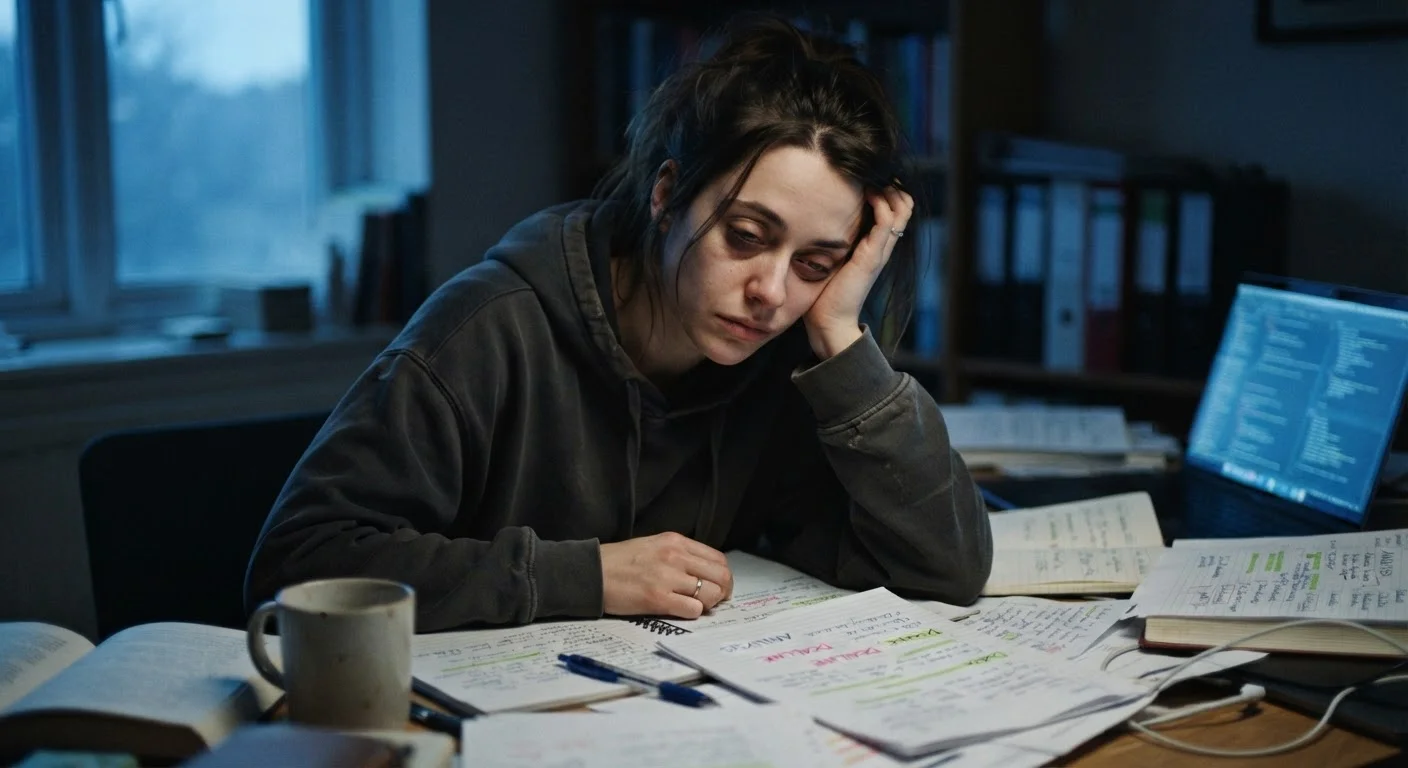
The cognitive cost of sleep loss refers to the measurable decline in mental performance — including memory, attention, and decision-making — that occurs when a person gets less sleep than their brain needs. Research shows these impairments can appear after as little as one shortened night. The effects are often underestimated because sleep-deprived individuals commonly misjudge how impaired they actually are.
Neuroscientists describe sleep deprivation's cognitive effects in terms of reduced prefrontal cortex activity, disrupted synaptic consolidation during NREM sleep, and impaired adenosine clearance — all of which contribute to observable deficits in executive function and alertness.
What Sleep Does for the Brain
Sleep is not cognitive downtime — it is an active period of neural maintenance. During non-REM (NREM) sleep, the brain replays and consolidates newly encoded memories, transferring information from short-term to longer-term storage. During REM sleep, it integrates experiences, processes emotional content, and supports creative problem-solving. The glymphatic system — the brain's waste-clearance network — is also most active during sleep, flushing metabolic byproducts that accumulate during waking hours.
Disrupting this process has immediate, measurable consequences. The brain does not simply pause its cognitive work and resume it unchanged when sleep is cut short. It starts the next day already behind.
For a broader view of how these processes connect to overall health, the Sleep & Recovery hub covers the relationship between rest habits and well-being in depth.
What Research Shows: Attention, Memory, and Decision-Making
Laboratory studies using standardized cognitive tests consistently show that sleep restriction degrades performance across multiple mental domains. Sustained attention — the ability to remain vigilant on a repetitive task — is one of the most sensitive measures. Studies using the Psychomotor Vigilance Task (PVT) have demonstrated that restricting sleep to six hours per night for two weeks produces impairments equivalent to 24 hours of total sleep deprivation, yet participants rated themselves as only slightly sleepy.
Memory encoding and consolidation are also reliably disrupted. Research has shown that people who sleep after learning new material retain it significantly better than those who remain awake for an equivalent period. Missing sleep in the period after learning — even if sleep is restored later — results in measurable memory gaps that cannot be fully recovered.
Decision-making deteriorates in a specific pattern under sleep loss: individuals tend to take greater risks, rely more heavily on habitual or automatic responses, and show reduced sensitivity to negative feedback. This is thought to reflect reduced activity in the prefrontal cortex, the region most responsible for deliberate, flexible thinking.
~2 weeks
Time for 6-hour sleep restriction to mimic total deprivation
Laboratory studies, including work by David Dinges at the University of Pennsylvania, show that two weeks of six-hour nights produces performance deficits equivalent to 24–48 hours without sleep.
70%
Memory retention advantage after sleep versus wakefulness
Multiple controlled studies have found that sleep in the period following learning produces meaningfully better retention of declarative memory compared to an equivalent wake period.
1–2 hours
Sleep reduction sufficient to impair performance
Research indicates that even modest reductions below an individual's sleep need — as little as one to two hours — can produce measurable deficits in attention and reaction time.
The Problem of Impaired Self-Assessment
One of the most practically significant findings in sleep deprivation research is that people are poor judges of their own cognitive state. As sleep debt accumulates over days, subjective sleepiness tends to plateau — individuals feel moderately tired rather than increasingly impaired — while objective performance continues to worsen. This dissociation between how a person feels and how they are actually functioning is well-documented and carries real-world implications, particularly in contexts like driving, high-stakes professional decisions, and medical care.
Research by sleep scientist David Dinges and colleagues has consistently demonstrated this pattern using multi-day restriction protocols. The takeaway is not alarmist but worth stating plainly: self-reported alertness is an unreliable proxy for actual cognitive capacity when sleep has been restricted.
What Remains Uncertain
The science of sleep and cognition is robust in its broad findings, but several important questions remain open. Individual variability in vulnerability to sleep loss is substantial and appears to have a genetic component — some people show sharp performance drops after one night of poor sleep while others are considerably more resilient. The mechanisms behind this variability are still being mapped.
Whether chronic short sleep causes permanent structural changes to the brain — beyond recoverable performance deficits — is another area of active investigation. Some neuroimaging studies suggest structural differences in chronically sleep-deprived individuals, but causality and reversibility have not been established. This connects to broader questions explored in research on sleep and healthy aging.
It is also worth noting that most controlled research uses total or partial sleep deprivation in laboratory settings. Real-world sleep loss — fragmented, irregular, and combined with other stressors — may produce different patterns of impairment that are harder to study rigorously.
For readers interested in tracking their own sleep patterns, it helps to understand what consumer sleep trackers can and cannot measure before drawing conclusions from the data they collect.
This article is for general informational and educational purposes only and does not constitute medical advice. If you have concerns about sleep disorders or cognitive symptoms, consult a qualified healthcare professional.