

Key Takeaways
- Slow-wave sleep is when the body releases the majority of its daily growth hormone.
- Immune cells are more active during deep sleep, strengthening the body's defenses.
- Quality — not just quantity — of sleep determines how much slow-wave sleep you get.
- Alcohol, late-night screens, and irregular schedules can suppress slow-wave sleep.
- Deep sleep declines naturally with age, making sleep hygiene increasingly important over time.
Slow-Wave Sleep (SWS)
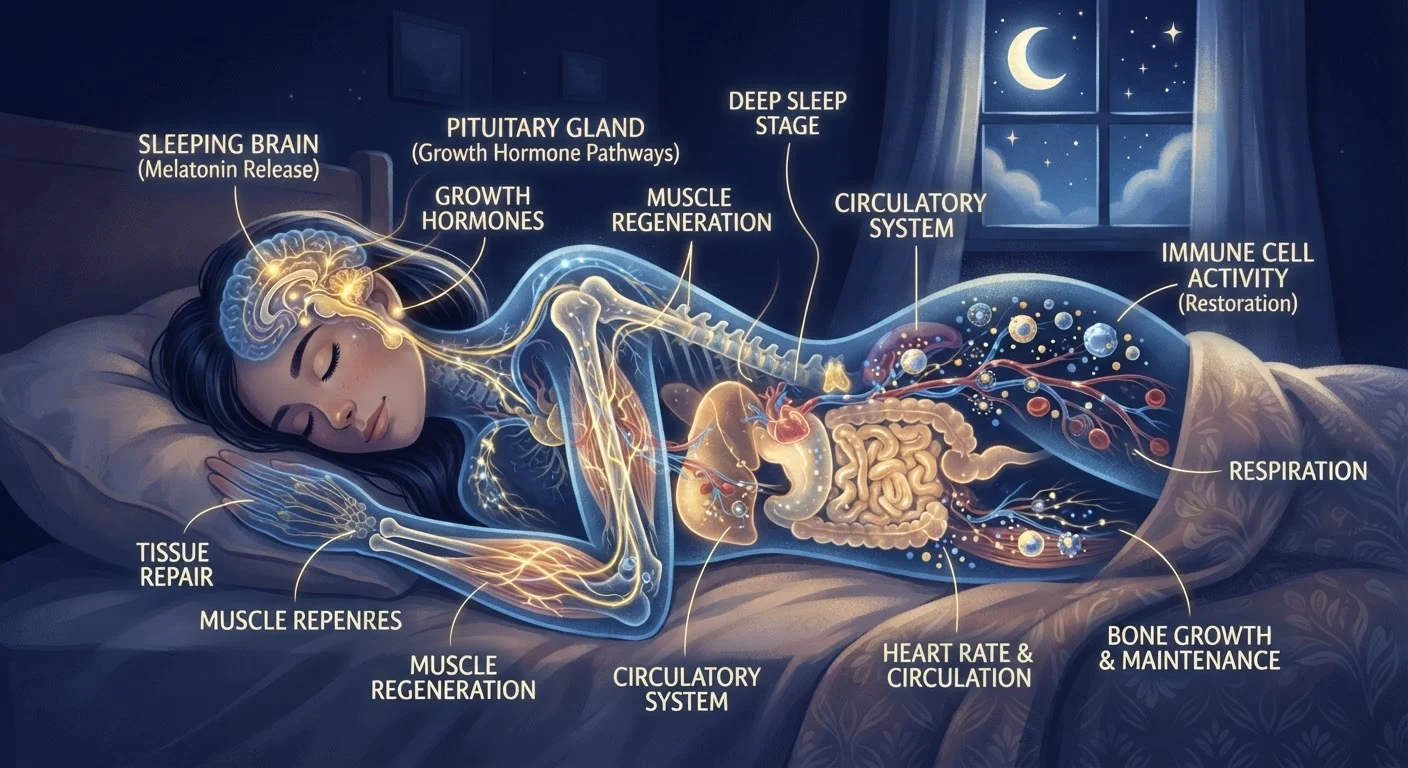
Slow-wave sleep — also called deep sleep or N3 — is the deepest stage of non-REM sleep, characterized by large, synchronized brain waves called delta waves. It is the phase during which the body carries out its most intensive physical repair and restoration work. Growth hormone is released, immune activity ramps up, and tissues are rebuilt. Unlike lighter sleep stages, slow-wave sleep is genuinely difficult to disrupt, and waking from it often leaves a person feeling groggy.
SWS is defined by delta wave activity (0.5–4 Hz) occupying at least 20% of an epoch on a polysomnogram. It predominantly occurs in the first half of the night and decreases significantly with age.
What Makes Deep Sleep Different
Sleep is not a uniform state. Each night, the brain cycles through several distinct stages — light sleep, deep sleep, and REM — each with its own physiological signature and purpose. Slow-wave sleep sits at the bottom of that hierarchy, where brain activity slows dramatically into long, rolling delta waves and the body shifts into its most intensive repair mode.
During this stage, heart rate and breathing slow, muscles relax deeply, and the brain becomes far less responsive to external stimuli. It takes a strong signal to pull someone out of slow-wave sleep — and when it happens, the disorientation known as sleep inertia is the brain's protest at being yanked from its deepest recovery work.
For a deeper look at how these processes connect to physical restoration more broadly, see what the science says about sleep and physical recovery.
Growth Hormone and the Body's Repair Chemistry
One of the most well-established functions of slow-wave sleep is its role in growth hormone (GH) secretion. The pituitary gland releases the largest pulse of GH during the first major slow-wave sleep episode of the night — a timing that is not coincidental. GH drives protein synthesis, supports the repair of muscle and connective tissue, and regulates fat metabolism.
This is why sleep quality matters so profoundly to athletes and active individuals. Without adequate slow-wave sleep, the hormonal environment that enables tissue repair is compromised. As explored in how sleep drives muscle repair overnight, the overnight hormonal cascade triggered by deep sleep is one of the body's primary recovery mechanisms — and it cannot be fully replicated during waking hours.
~70%
Daily growth hormone released during sleep
Research suggests the majority of daily growth hormone secretion occurs during slow-wave sleep, primarily in the first sleep cycle of the night.
13–23%
Proportion of sleep that is slow-wave in healthy adults
According to sleep stage research, healthy adults typically spend roughly 13–23% of their total nightly sleep in slow-wave (N3) sleep.
Significant
Decline in slow-wave sleep from young adulthood to older age
Studies consistently show that time spent in slow-wave sleep decreases meaningfully across the lifespan, contributing to slower physical recovery in older adults.
It is worth noting that GH release during sleep declines with age, which partly explains why recovery from physical exertion tends to take longer as people get older.
Immune Activity During Deep Sleep
The immune system uses slow-wave sleep as a window for intensive maintenance. Research indicates that certain immune cells — including T cells and natural killer cells — show heightened activity during deep sleep. Pro-inflammatory cytokines, proteins that help coordinate immune responses, are also released in greater concentrations during this stage.
This relationship runs in both directions. When the immune system is actively fighting an infection, it signals the brain to increase slow-wave sleep — which is why illness often brings an intense urge to rest. The body is, in a real sense, prescribing its own recovery protocol.
For a thorough, evidence-grounded breakdown of the sleep-immunity connection, what the science actually shows about sleep and the immune system is worth reading alongside this piece.
What Disrupts Deep Sleep — and What Supports It
Several common behaviors reliably suppress slow-wave sleep. Alcohol is among the most studied: even modest consumption close to bedtime fragments sleep architecture, reducing time spent in deeper stages. Irregular sleep schedules, late exposure to blue-spectrum light, and high core body temperature at bedtime all make it harder for the brain to descend into slow-wave sleep efficiently.
Conversely, behavioral practices associated with better sleep quality tend to support deeper sleep. A consistent wake time anchors the circadian rhythm. A cooler bedroom aligns with the natural drop in core body temperature that precedes deep sleep. Physical activity during the day has been shown in research to increase slow-wave sleep pressure — though intense exercise too close to bedtime can have the opposite effect for some people.
Support Deep Sleep with Consistent Timing
Going to bed and waking at the same time every day — including weekends — reinforces your circadian rhythm and helps maximize slow-wave sleep pressure at night. Even a single night of irregular sleep can shift when and how deeply slow-wave sleep occurs. Consistency is one of the most evidence-supported levers for improving sleep architecture over time.
As discussed in sleep's underrated role in healthy aging, protecting deep sleep over the long term is increasingly recognized as a meaningful factor in healthspan. The habits that support slow-wave sleep today have compounding benefits over decades.
This article is for general informational purposes only and is not a substitute for professional medical advice. If you have concerns about your sleep health, consult a qualified healthcare provider.