

Key Takeaways
- Total daily protein intake matters more than the exact timing of any single meal.
- The post-workout 'anabolic window' is real but much wider than 30 minutes — likely several hours.
- Spreading protein across meals supports muscle protein synthesis more effectively than front- or back-loading.
- Individual factors like age, training status, and goals influence how much timing actually matters.
- No single protein timing strategy guarantees results — consistency and total intake remain the priority.
Why Protein Timing Became Such a Hot Topic
Walk into any gym and you'll hear confident claims about protein timing — eat within 30 minutes of training or your workout is wasted, front-load protein at breakfast, never eat protein at night. These ideas spread fast because they're simple and actionable. But how much of this advice holds up under scrutiny?
The science on protein timing has evolved considerably over the past two decades. Early research suggested a narrow post-exercise window was critical for muscle repair. More recent, larger studies have complicated that picture. Understanding what the evidence actually shows can help everyday eaters make smarter, less stressful decisions about when — and how much — protein to eat.
For a broader look at how protein fits into daily eating patterns, see how meal timing fits into a daily wellness routine.
Common Myths — and What the Evidence Actually Shows
Several widely repeated protein timing rules don't hold up as firmly as their popularity suggests. Below, we work through the most common myths and explain what current research supports instead.
Myth
You must eat protein within 30 minutes of a workout or you'll miss the muscle-building window.
Fact
The post-exercise anabolic window is real, but research suggests it spans several hours — not a narrow 30-minute slot.
This myth originated from early studies on trained, fasted athletes. In those contexts, rapid post-exercise protein consumption did show benefits. But a landmark 2013 meta-analysis by Alan Aragon and Brad Schoenfeld, published in the Journal of the International Society of Sports Nutrition, found that when total daily protein intake was controlled, the timing advantage largely disappeared. For most people who eat a meal before training, the anabolic window extends well into the post-workout period — likely three to five hours or more.
Myth
Eating protein before bed causes fat gain because your body can't use it while you sleep.
Fact
The body continues to digest and utilize protein during sleep; nighttime protein consumption does not inherently cause fat storage.
Metabolism doesn't switch off during sleep. Research has shown that consuming protein before sleep — particularly casein, a slow-digesting dairy protein — can support overnight muscle protein synthesis and recovery without promoting fat gain in the context of a balanced daily diet. A 2012 study in Medicine & Science in Sports & Exercise found that pre-sleep protein improved overnight protein balance in active individuals. Fat gain is driven by sustained caloric surplus, not by the timing of protein specifically.
Myth
The body can only absorb about 30 grams of protein per meal, so eating more is wasteful.
Fact
The body absorbs virtually all the protein you consume; what varies is the rate of absorption and how efficiently it's used for muscle protein synthesis.
Digestion is a continuous process — there is no physiological 'cutoff' at which the gut stops absorbing amino acids. Larger protein doses simply take longer to digest. However, muscle protein synthesis does appear to have a ceiling per meal, meaning that very large servings may not stimulate additional muscle building beyond a certain threshold. The excess amino acids are oxidized for energy or used for other bodily functions — not simply excreted or converted to fat by default. Distribution across meals still makes practical sense, but the '30-gram rule' overstates the case.
Myth
Protein timing only matters if you're a serious athlete — it's irrelevant for everyday people.
Fact
While timing effects are smaller for non-athletes, consistent protein distribution across meals is a practical strategy that supports general health goals for most adults.
Research on protein timing has historically focused on trained individuals, which has led some to assume it's irrelevant for general health. But the principle of spreading protein intake — rather than consuming most of it in one meal — applies broadly. Older adults in particular may benefit from meeting a consistent per-meal protein threshold to counteract age-related declines in muscle protein synthesis efficiency. For everyday eaters, the practical upshot is simple: try not to skip protein at breakfast and lunch while loading it all at dinner.
What Timing Still Gets Right
Dismissing timing entirely would also be an overcorrection. Emerging research does suggest that distributing protein across meals — rather than eating most of it at dinner — tends to support muscle protein synthesis more reliably. A 2014 study published in The Journal of Nutrition found that spreading protein intake evenly across three meals produced a greater muscle-building response than skewing it toward one meal, even when total intake was identical.
For older adults especially, per-meal protein distribution may matter more. Research suggests that muscle protein synthesis becomes less efficient with age, making it harder to maximize the anabolic response from a single large serving. Consistently meeting a meaningful protein threshold at each meal may help offset this.
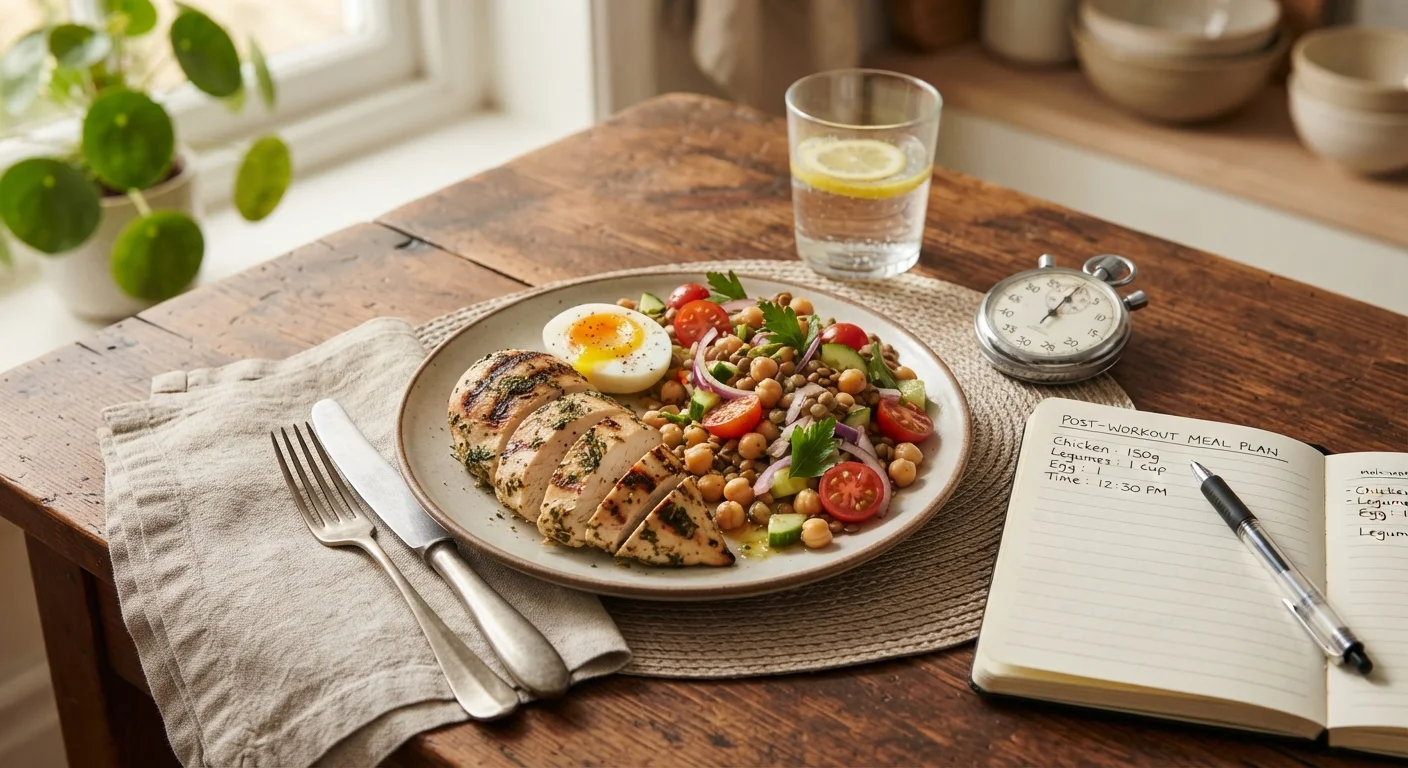
Post-exercise nutrition also remains relevant, though not in the rigid way often described. Consuming protein after training — particularly alongside carbohydrates — supports tissue repair and glycogen replenishment. You can read more about this in our overview of how protein, carbs, and hydration shape recovery.
~3–5 hrs
Estimated post-exercise anabolic window
Research suggests the window for beneficial post-workout protein consumption is several hours, not the commonly cited 30 minutes, particularly when a pre-workout meal was consumed.
~0.7–1g/lb
General daily protein target for active adults
Many sports nutrition organizations suggest active adults aim for roughly 0.7 to 1 gram of protein per pound of body weight daily, though individual needs vary.
A Practical Framework for Everyday Eaters
The clearest takeaway from the research is this: total daily protein intake is the strongest predictor of outcomes, and timing is a secondary variable that matters most when total intake is already adequate. For most active adults, this means focusing first on consistently hitting a reasonable protein target across the day before fine-tuning when each serving falls.
Protein's roles in the body extend well beyond muscle — from immune function to enzyme production. Understanding the full picture helps put timing in perspective. See protein's job in the body goes far beyond muscle for a plain-language overview.
For those who want practical post-workout guidance, recovery nutrition after exercise offers a realistic breakdown of macronutrient choices. And if you're curious how the broader meal-timing debate fits in, why meal timing is more nuanced than you've been told adds useful context.
This article is for general informational and educational purposes only and is not a substitute for personalized medical or nutritional advice. Consult a registered dietitian or qualified healthcare professional for guidance specific to your health needs.