

Key Takeaways
- Social jet lag occurs when weekend sleep timing shifts significantly from weekday sleep timing.
- Even a one- to two-hour shift in sleep schedule on weekends can disrupt circadian rhythms.
- Irregular meal timing on weekends compounds the disruption beyond sleep alone.
- Limiting weekend sleep shifts to under one hour helps protect energy and metabolic health.
- Morning light exposure and consistent meal anchors are practical tools to reduce social jet lag.
Option A
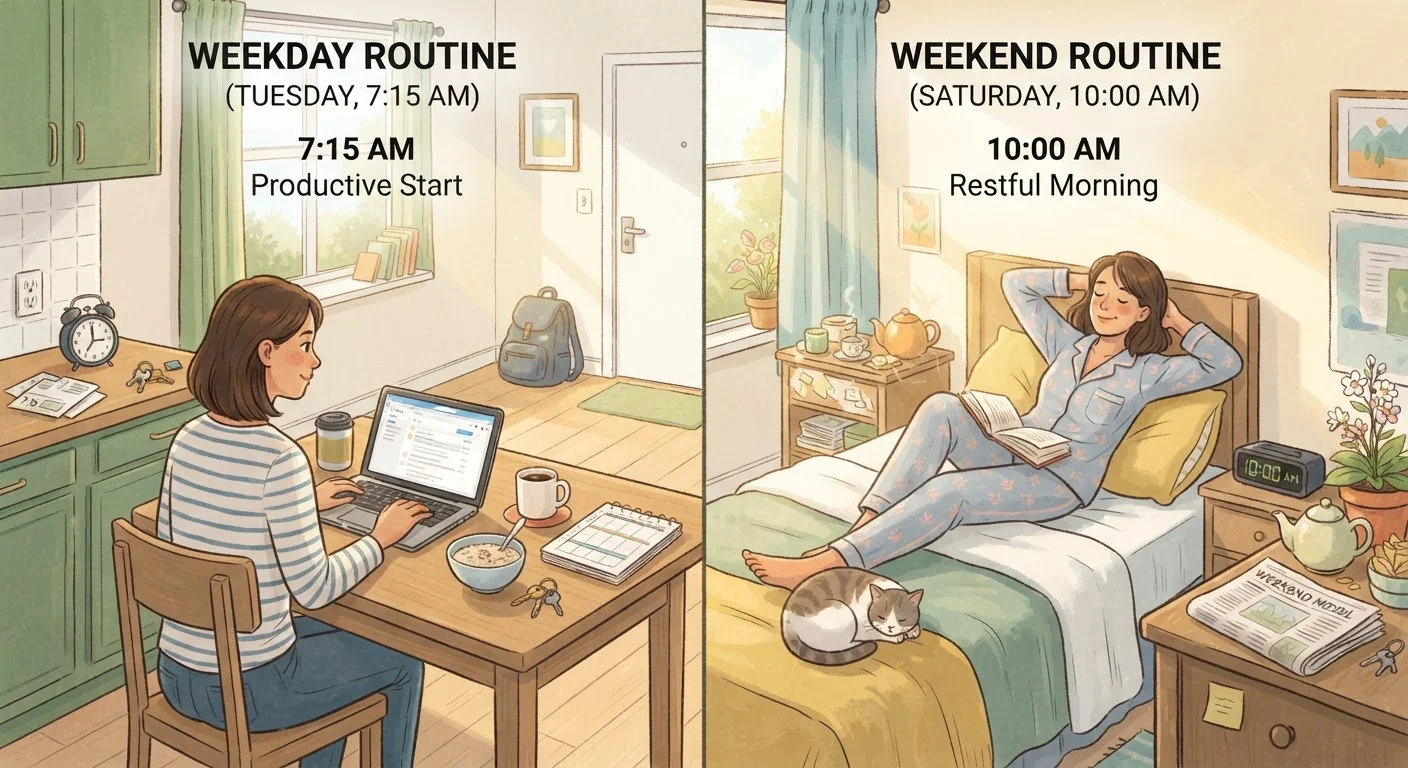
Weekday Routine
The consistent, clock-anchored schedule.
Best for: People who thrive on predictability and want steady energy, focus, and sleep quality throughout the work week.
Option B
Weekend Routine
The flexible, socially driven schedule.
Best for: People prioritizing social connection, rest, and leisure — but who risk shifting their internal clock in ways that hurt Monday's performance.
If you struggle with Monday fatigue and afternoon energy crashes
Weekday Routine
Keeping a consistent schedule seven days a week removes the Sunday-night reset your body has to fight through every Monday morning.
If you value social flexibility but want to minimize the biological cost
Weekend Routine
A slightly adjusted weekend schedule is fine — just keep the shift under 60 minutes and use morning light to realign your clock.
If your work requires peak cognitive performance early in the week
Weekday Routine
Research links larger social jet lag gaps with reduced alertness and reaction time, making consistency especially valuable for cognitively demanding roles.
What Is Social Jet Lag — and Why Does It Matter?
Most Americans live on two clocks simultaneously: the biological clock (the circadian rhythm governing sleep, hormones, and metabolism) and the social clock (work schedules, family obligations, and leisure). During the week these two clocks tend to align. On weekends, they drift apart — and that drift has a name.
Social jet lag is the term chronobiologists use for the mismatch between your body's preferred sleep timing and the schedule society imposes. Coined by researcher Till Roenneberg, the concept describes what happens when someone who naturally sleeps later stays on an early alarm all week, then shifts two or three hours later on Saturday and Sunday. The body experiences a version of crossing time zones — without the flight.
Unlike vacation jet lag, which resolves after a few days, social jet lag cycles weekly. Research published in peer-reviewed journals has associated larger social jet lag gaps with increased fatigue, poorer metabolic markers, and lower reported well-being. It is not a minor inconvenience — it is a recurring physiological stress. For more on the biological underpinnings of consistent scheduling, see the science behind why morning routines actually work.
Weekday vs. Weekend Routines: A Side-by-Side Look
The contrast between how Americans structure their weekdays and weekends goes well beyond sleep time. Meal timing, light exposure, physical activity, and alcohol intake all shift — often compounding each other's effects on the circadian system.
| Criterion | Weekday Routine | Weekend Routine |
|---|---|---|
| Wake time | Fixed, alarm-driven | Delayed, often 1–3 hrs later |
| Bedtime | Consistent, earlier | Later, socially influenced |
| Meal timing | Regular intervals | Shifted later, less structured |
| Morning light exposure | Earlier, more consistent | Later or skipped indoors |
| Alcohol intake | Typically lower | Often higher, later at night |
| Circadian alignment | Higher alignment | Lower alignment, clock drift |
| Monday energy level | Generally more stable | Often lower due to re-adjustment |
The compounding element is important. A later wake time means later breakfast, which signals a later metabolic cycle. Add social drinking Saturday night and the internal clock's anchors — light, food, activity — all shift in the same direction, amplifying the mismatch. Habits that silently erode sleep quality often operate through exactly this kind of accumulation rather than any single obvious cause.
The Hidden Health Costs of a Shifting Schedule
Social jet lag's effects reach further than Monday grogginess. Circadian disruption influences glucose regulation, appetite-signaling hormones like leptin and ghrelin, and inflammatory markers. Studies have found associations between higher social jet lag and increased likelihood of being overweight, though researchers note these are observational links — not simple cause and effect — and individual variation is significant.
~69%
Adults experiencing some social jet lag
Research by Roenneberg and colleagues estimates the majority of the population experiences at least some weekly circadian misalignment due to social schedules.
1–2 hrs
Average weekend sleep midpoint shift
Studies of large population samples find most adults shift their sleep timing by one to two hours on weekends compared to weekdays.
33%
Higher obesity odds with greater social jet lag
A study published in Current Biology found each hour of social jet lag was associated with approximately 33% higher odds of obesity, though the relationship is observational.
Cognitive performance is another area of concern. Alertness, working memory, and reaction time all depend on circadian timing. When your brain expects to be in its sleep phase but you're asking it to focus — as happens Monday morning after a late-weekend shift — performance predictably suffers. This matters whether you're driving a commute, presenting in a meeting, or caring for young children.
It is also worth noting that not everyone is equally vulnerable. People with a naturally late chronotype (night owls) tend to carry more social jet lag burden under standard 9-to-5 schedules and may find it harder to close the gap. If this describes you, common daily routine myths explores the evidence around rigid early-rising expectations.
This article provides general health information and is not a substitute for personalized medical advice. Consult a qualified healthcare professional about sleep or health concerns specific to your situation.
Practical Strategies to Reduce Social Jet Lag
The goal is not to eliminate weekend flexibility — it's to shrink the gap between your weekday and weekend clocks to a manageable size. Most sleep researchers suggest keeping the difference in sleep midpoint (the midpoint between when you fall asleep and wake up) under 60 minutes as a practical target.
- Anchor your wake time: Even on weekends, rising within about an hour of your weekday alarm gives your circadian clock a consistent light-exposure cue. You don't have to jump out of bed — just get eyes on natural light.
- Use morning light deliberately: Bright outdoor light in the first 30–60 minutes after waking is one of the most powerful circadian anchors available. A short walk outside serves this purpose well.
- Keep meal timing consistent: Try to eat your first meal within a similar window on both weekdays and weekends. Irregular meal timing sends conflicting signals to peripheral clocks in the liver and gut. Designing a health routine for a busy work week offers guidance on anchoring nutrition habits across varying schedules.
- Moderate alcohol timing: Alcohol consumed close to bedtime suppresses REM sleep even when total sleep hours look adequate. If social drinking is part of your weekend, earlier timing reduces the sleep-architecture impact.
- Plan a Sunday wind-down: Treat Sunday evening as a pre-work preparation phase. Dimming lights, limiting screens, and setting a consistent bedtime help ease the transition back to weekday timing. If Sundays still feel draining, why weekends don't always feel restful examines additional patterns that undermine weekend recovery.
For readers who find the tension between structure and flexibility frustrating, rigid schedules vs. flexible routines provides a balanced framework for navigating both.