

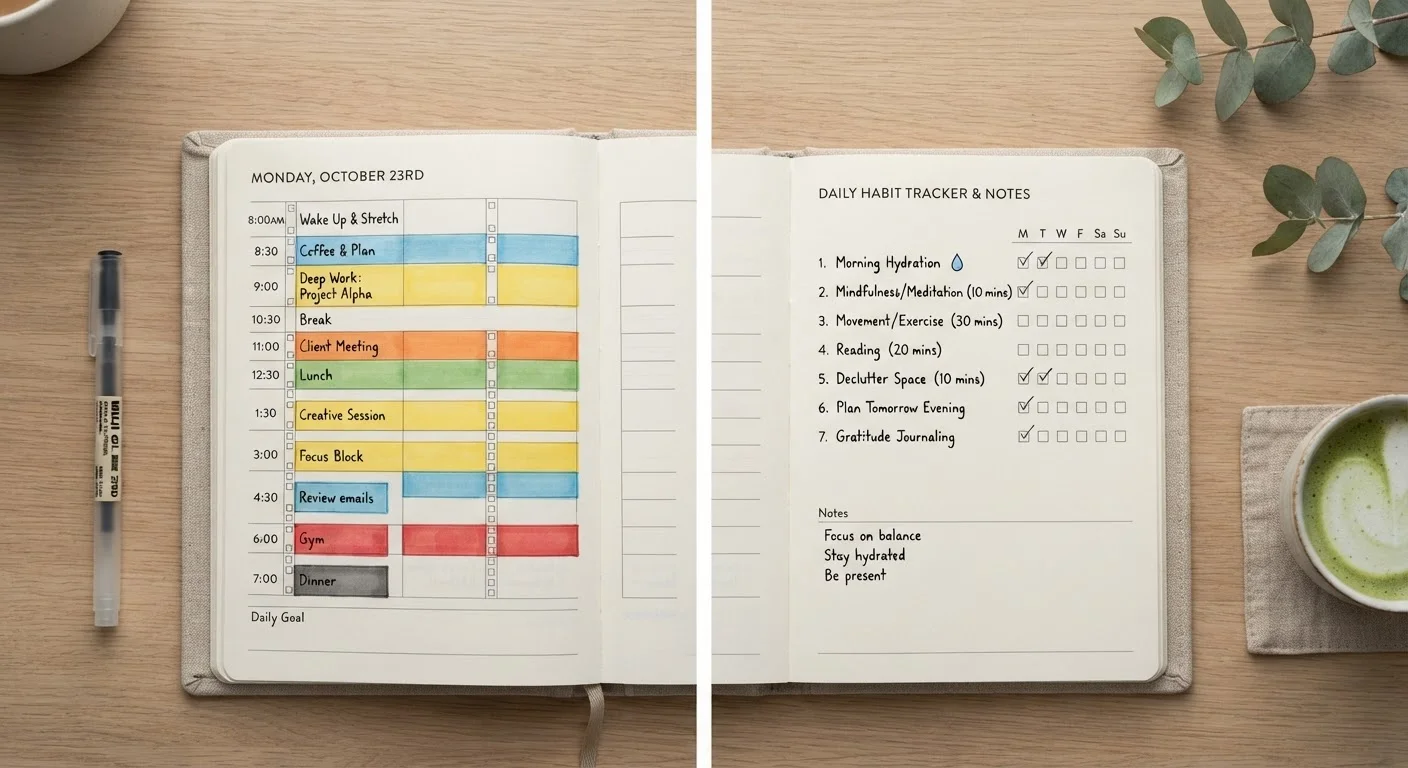
Key Takeaways
- Rigid schedules reduce decision fatigue and create consistent circadian anchoring.
- Flexible routines are more resilient to disruption and easier to sustain long-term.
- Research suggests consistency of behavior — not strict timing — drives most health benefits.
- A hybrid approach, using fixed anchors with flexible fill-in habits, works for many people.
- Your work demands, chronotype, and life stage should inform which structure you lean on.
Reduces decision fatigue around when to act
Assigning habits to fixed times means the decision is already made, conserving mental energy for higher-stakes choices throughout the day.
Strengthens circadian rhythm through behavioral consistency
Eating, sleeping, and exercising at the same times each day reinforces the body's internal clock, supporting better sleep quality and metabolic regulation.
Creates clear accountability and progress tracking
A timed schedule makes it easy to notice when something was skipped, allowing for deliberate course-correction rather than gradual drift.
Builds automaticity faster in stable environments
Habits performed at the same time and place each day become automatic more quickly because the context itself becomes a reliable cue.
Fragile when disrupted by real-life variability
A single schedule break — travel, illness, or an overrunning meeting — can derail the entire structure, sometimes causing people to abandon the routine altogether.
Can generate shame and all-or-nothing thinking
When a timed task is missed, rigid frameworks sometimes trigger a perception of complete failure, which behavioral research links to higher rates of habit abandonment.
Poor fit for variable work schedules or caregiving demands
Shift workers, parents of young children, and those with unpredictable professional demands often find strict time-based schedules structurally incompatible with their daily reality.
May not account for chronotype differences
Individual biological differences in sleep-wake preference — chronotype — mean that a schedule built around early-morning habits may actively work against some people's physiology.
Our Verdict
Neither rigid schedules nor flexible routines are universally superior — each serves different people in different seasons of life. A rigid structure offers unmatched consistency and reduced mental load when life is stable, while a flexible routine proves more durable when demands shift unpredictably. Most people benefit most from a hybrid: a handful of fixed daily anchors surrounded by adaptable habits.
Rigid schedules suit people with predictable workdays and strong motivation for structure; flexible routines are better for shift workers, parents, or anyone whose daily demands vary significantly.
What We Mean by Rigid Schedules and Flexible Routines
A rigid schedule assigns specific tasks to specific times — wake at 6:00 a.m., exercise at 6:30, eat breakfast at 7:15, and so on. Every action is timed and ordered. A flexible routine, by contrast, defines what you want to do each day without locking in when — you aim to exercise, prepare a healthy meal, and wind down before bed, but the exact timing bends with the day.
Both approaches are legitimate frameworks. The distinction matters because how you structure daily habits affects whether they stick, how you feel when they're disrupted, and how well they align with your biology. Neither label is an insult — the real question is which architecture serves your actual life.
The Case for Rigid Schedules
Reduces decision fatigue around when to act
Assigning habits to fixed times means the decision is already made, conserving mental energy for higher-stakes choices throughout the day.
Strengthens circadian rhythm through behavioral consistency
Eating, sleeping, and exercising at the same times each day reinforces the body's internal clock, supporting better sleep quality and metabolic regulation.
Creates clear accountability and progress tracking
A timed schedule makes it easy to notice when something was skipped, allowing for deliberate course-correction rather than gradual drift.
Builds automaticity faster in stable environments
Habits performed at the same time and place each day become automatic more quickly because the context itself becomes a reliable cue.
Time-fixed schedules eliminate the daily negotiation of when something gets done. That reduction in decision fatigue is meaningful — research in behavioral science consistently shows that willpower and decision quality erode across the day. By automating the timing, you conserve mental energy for other choices.
Rigid schedules also support your circadian rhythm. The body's internal clock — which regulates sleep, digestion, cortisol, and body temperature — operates on approximately 24-hour cycles and is sensitive to behavioral timing cues. Eating, sleeping, and exercising at consistent times each day reinforces these cues. For more on how timing inconsistencies affect your body clock, see our piece on weekend vs. weekday routine differences.
The Case for Flexible Routines
Fragile when disrupted by real-life variability
A single schedule break — travel, illness, or an overrunning meeting — can derail the entire structure, sometimes causing people to abandon the routine altogether.
Can generate shame and all-or-nothing thinking
When a timed task is missed, rigid frameworks sometimes trigger a perception of complete failure, which behavioral research links to higher rates of habit abandonment.
Poor fit for variable work schedules or caregiving demands
Shift workers, parents of young children, and those with unpredictable professional demands often find strict time-based schedules structurally incompatible with their daily reality.
May not account for chronotype differences
Individual biological differences in sleep-wake preference — chronotype — mean that a schedule built around early-morning habits may actively work against some people's physiology.
Flexibility's greatest advantage is resilience. When a rigid schedule breaks — a meeting runs long, a child gets sick, travel disrupts your sleep — the entire structure can collapse, and with it, the habit. A flexible routine survives those disruptions because the commitment is to the behavior, not the clock.
Behavioral research also supports the idea that consistency of behavior, rather than strict timing, is the primary driver of habit formation. A workout that happens at different times each day still produces physical adaptations. A meal prepared at home at 7 p.m. or 8 p.m. still beats skipping it. Flexible routines tend to generate less guilt and shame around imperfect days, which supports longer-term adherence. If you're curious about the structural reasons routines fall apart, why routines collapse by week three explores the behavioral patterns in depth.
Building a Hybrid Approach That Works
66 days
Average time for a habit to become automatic
A study published in the European Journal of Social Psychology found it took an average of 66 days for a new behavior to become automatic, with a range of 18 to 254 days depending on the person and habit complexity.
~35%
Americans with irregular daily routines
Survey data from the American Time Use Survey suggests a substantial share of U.S. adults have significant day-to-day variability in sleep timing and meal patterns, highlighting the practical limits of rigid schedules.
Most people benefit from a middle path: a small number of fixed anchor habits — consistent wake time, a designated meal window, a regular sleep target — surrounded by more loosely timed daily habits. The anchors provide circadian stability and structural predictability. The flexible habits adapt to real-world variability without feeling like failures when they shift.
Practical steps to build this hybrid:
- Choose two or three non-negotiable time anchors that genuinely matter for your health (sleep timing and a regular eating window are strong candidates).
- Define your flexible habits by category, not by time — movement, vegetables, stress relief — and consider tying them to natural transition points in your day using habit stacking. See our comparison of habit stacking vs. scheduled routines for a side-by-side breakdown.
- Build in a minimum viable version of each habit for difficult days — a 10-minute walk instead of a full workout preserves the behavior pattern even when time is short.
For a fuller framework on embedding these principles into a working week, our guide on designing a daily health routine that survives a busy work week offers step-by-step guidance. Life stage also matters — the right structure for a new parent differs from that of a retiree, a reality explored in daily routines for every life stage.
This article is for general informational and educational purposes only and is not a substitute for professional medical advice. Consult a qualified healthcare provider before making significant changes to your diet, exercise, or sleep habits.