

Key Takeaways
- Household chores contribute to the weekly movement totals recommended by major health authorities.
- Activities like mopping, gardening, and stair climbing engage real muscle groups and raise heart rate.
- Accumulating movement in short bouts throughout the day carries measurable cardiovascular and metabolic benefits.
- Reframing chores as intentional movement can help close the gap for people who struggle to find structured exercise time.
- Intensity matters - moving with purpose during chores makes the activity more physiologically meaningful.
Why Chores Deserve a Spot in Your Activity Log
Most people think of physical activity as something that happens in a gym, on a trail, or in a yoga class. But exercise science has long recognized a broader category: non-exercise activity thermogenesis, or NEAT - the energy your body burns through all the movement that isn't formal exercise or sleep. Chores are a major NEAT contributor, and the evidence suggests they're worth taking seriously.
The U.S. Department of Health and Human Services defines moderate-intensity physical activity as movement that noticeably raises your heart rate and breathing. Many household tasks - particularly those done with effort and continuity - meet that threshold. If you're already doing chores, you may already be accumulating meaningful activity without realizing it. The movement habit audit is a useful tool for seeing exactly where your day's activity is coming from.
Below are some of the most common household tasks, explained through the lens of what they actually do for your body.
Vacuuming
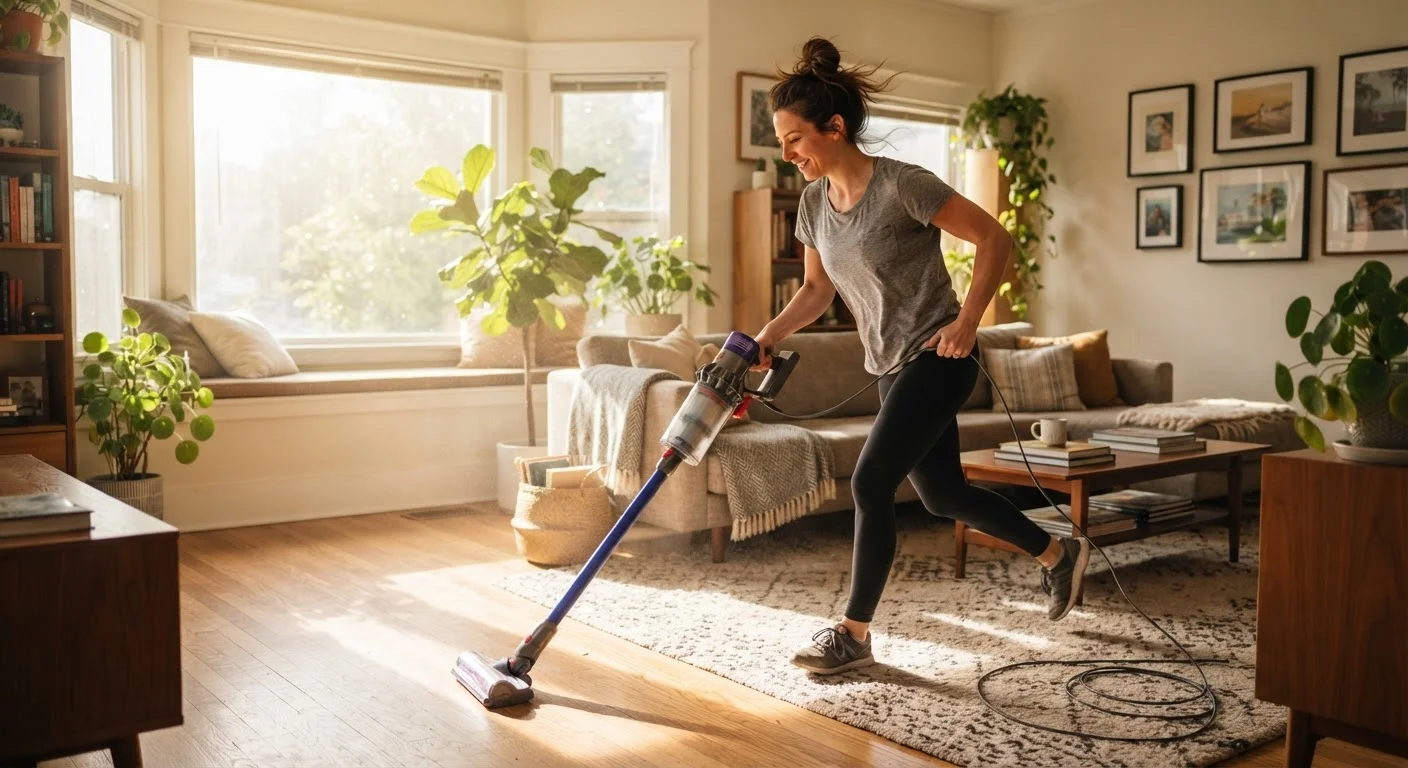
Vacuuming requires continuous pushing and pulling motion that engages your core, arms, and legs simultaneously. Done at a brisk pace across a full home, it can elevate your heart rate into a light-to-moderate intensity zone. The repeated direction changes and reaching also challenge balance and coordination in ways that are genuinely functional - meaning they translate to real-world movement quality.
To get more out of it, try engaging your core deliberately, using full arm extensions, and moving at a pace that makes conversation slightly effortful.
Brisk vacuuming across a full home can push your heart rate into a genuine moderate-intensity zone.
Carrying Groceries
Loaded grocery bags are essentially farmer's carries - a staple loaded-carry exercise in strength training programs. Carrying bags from the car to the kitchen challenges your grip strength, forearm muscles, shoulder stabilizers, and core. The heavier and farther the carry, the more muscular demand it places on your body.
Rather than making multiple light trips, deliberately loading both arms (within comfort) increases the training stimulus. Just be mindful of your posture - keep your shoulders back and avoid leaning to one side.
Loaded grocery carries are functionally identical to farmer's carries, a proven strength-building exercise.
Mopping and Scrubbing Floors
Floor-level scrubbing and mopping demand more from your body than they get credit for. The lateral movement, hip hinge patterns, and sustained upper-body effort involved in mopping a kitchen or scrubbing a bathroom floor are genuine physical challenges. Holding a low position while moving side-to-side activates hip and glute muscles in ways most people rarely train intentionally.
Working at a steady, deliberate pace for 15 to 20 minutes can produce a meaningful cardiovascular response, particularly for people whose baseline activity is low.
Sustained mopping activates hip and glute muscles while raising heart rate - both markers of useful physical work.
Gardening and Yard Work
Gardening is one of the most physically diverse activities on this list. Digging, weeding, raking, hauling soil or mulch, and pushing a mower each recruit different muscle groups and energy systems. Research published in exercise science literature has categorized gardening as moderate-intensity physical activity - comparable to walking at a brisk pace.
The combination of squatting, kneeling, lifting, and carrying also makes it valuable for functional strength and joint mobility, particularly for older adults. Anyone with existing joint or back concerns should consult a healthcare provider before starting more demanding yard work.
Gardening is classified as moderate-intensity activity and delivers both cardiovascular and functional strength benefits.
Climbing Stairs During Household Tasks
Every trip up and down the stairs during laundry runs, tidying, or errand-running counts as genuine stair-climbing activity. Stair climbing is consistently shown to elevate heart rate, strengthen lower-body muscles, and improve cardiovascular fitness over time. Unlike flat walking, it involves a significant eccentric load on descent and concentric leg drive on ascent.
Rather than batching everything into one trip to minimize stair use, consider the reverse: split tasks deliberately to take more trips. It's a low-effort way to stack short bouts of elevated activity across the day.
Deliberately taking extra stair trips during chores stacks meaningful cardiovascular bouts throughout the day.
Washing Windows and Wiping Down Surfaces
Overhead and lateral wiping movements - cleaning windows, wiping counters, scrubbing stovetops - engage the shoulder girdle, triceps, and upper back in sustained isometric and dynamic contractions. When done with full arm extension and continuous effort, these tasks can produce notable muscular fatigue over time.
Standing on your toes to reach high surfaces adds a calf-raise element. Moving quickly between surfaces adds a cardiovascular component. Treating window-washing day as an upper-body activity session reframes the effort in a useful way.
Extended overhead wiping and surface cleaning produce real shoulder and upper-back muscular demand.
Making the Most of the Movement You Already Do
Recognizing chores as activity is only the first step. The second is being intentional about how you do them. Slow, distracted scrubbing yields different results than brisk, engaged mopping. Carrying one grocery bag at a time is different from deliberately loading both arms. Small choices compound across a week.
Raise the Intensity Without Adding Time
You don't need to do chores longer to get more out of them - you need to do them with more deliberate effort. Try setting a brisk, consistent pace, taking fewer breaks, and engaging your core throughout. Wearing a heart rate monitor even once can show you just how much these tasks are doing for your cardiovascular system.
For people whose schedules make structured workouts difficult, this approach - sometimes called lifestyle activity - is a practical bridge. Research consistently shows that activity accumulated in shorter bouts throughout the day can produce similar cardiovascular and metabolic benefits to equivalent activity done in one continuous session. You can explore how this compares to formal exercise in our overview of daily movement vs. structured exercise.
If you want to build on this momentum, adding more steps to your day is a natural complement - no extra equipment or schedule changes required. And for a fuller picture of staying active without a gym membership, see our comprehensive guide to everyday activity.
This article is for general informational purposes only and is not a substitute for professional medical advice. Consult a qualified healthcare provider before starting or changing any physical activity routine, especially if you have an existing health condition.