

Key Takeaways
- The glycemic index ranks carbohydrate foods by how quickly they raise blood sugar on a standardized scale.
- GI scores are measured in isolation, so real-world meals behave differently than the numbers suggest.
- Glycemic load adds portion size to the equation, making it a more practical companion metric.
- Individual blood sugar responses to the same food can vary significantly from person to person.
- GI is one useful lens — not a complete nutrition system on its own.
Evidence-based tool with decades of research support
The GI framework has been studied extensively since the 1980s and is used in clinical nutrition research worldwide, giving it a strong scientific foundation compared to many popular diet metrics.
Helpful for blood sugar management
For people with type 2 diabetes or prediabetes, choosing predominantly low-GI foods is associated with improved glycemic control, according to multiple systematic reviews and the American Diabetes Association's nutrition guidance.
Encourages focus on carbohydrate quality
GI shifts the conversation from simply counting carbohydrates to considering how different carbohydrates behave metabolically — a more nuanced and useful way to think about food choices.
Useful for comparing similar foods objectively
GI provides a structured, reproducible way to compare carbohydrate-rich foods within the same category — for example, distinguishing between the metabolic effects of steel-cut oats versus instant oats.
Ignores how foods combine in real meals
GI scores are measured for single foods eaten alone. Adding fat, protein, fiber, or acid (like vinegar) to a meal significantly slows glucose absorption, often making a high-GI food behave like a lower-GI one in practice.
Doesn't account for portion size
A food with a high GI score consumed in a small amount may raise blood sugar less than a low-GI food eaten in large quantities. GI alone cannot capture this, which is why glycemic load was developed as a companion metric.
Individual responses vary considerably
Research, including a widely-cited 2015 study published in Cell, has demonstrated that two people can have dramatically different blood glucose responses to the exact same food, driven by gut microbiome composition, genetics, and other personal factors.
Cooking methods and ripeness affect scores
Al dente pasta has a lower GI than well-cooked pasta; a ripe banana has a higher GI than an unripe one. These variables make published GI tables an approximation, not a precise individual prediction.
Can mislead about overall nutritional value
Some nutritious whole foods (like carrots) have moderate-to-high GI scores, while some processed foods engineered to be lower-GI are not necessarily healthier overall. GI reflects one variable — not nutrient density, fiber content, or overall diet quality.
Our Verdict
The glycemic index is a genuinely useful research and planning tool, particularly for people managing blood sugar. Its limitations — ignoring portion size, food combinations, and individual variation — mean it works best as one input among several, not a standalone dietary rulebook.
People managing blood sugar conditions or those wanting a research-backed framework for comparing carbohydrate quality will find GI most valuable when combined with glycemic load and broader dietary context.
What the Glycemic Index Actually Measures
The glycemic index (GI) is a numerical scale that ranks carbohydrate-containing foods by how rapidly they raise blood glucose after eating. Pure glucose is used as the reference point, assigned a score of 100. Foods are then categorized as low (55 or below), medium (56–69), or high (70 and above).
The measurement process is highly controlled: participants fast overnight, consume a specific amount of a test food containing 50 grams of available carbohydrate, and researchers track their blood glucose response over two hours. Those response curves are averaged and compared to the glucose baseline.
This makes GI a standardized, reproducible metric — which is why it's been widely used in nutrition research for decades. But standardized conditions are not the same as real-life eating conditions, and that gap is where most of GI's limitations emerge.
Where the Glycemic Index Genuinely Helps
Evidence-based tool with decades of research support
The GI framework has been studied extensively since the 1980s and is used in clinical nutrition research worldwide, giving it a strong scientific foundation compared to many popular diet metrics.
Helpful for blood sugar management
For people with type 2 diabetes or prediabetes, choosing predominantly low-GI foods is associated with improved glycemic control, according to multiple systematic reviews and the American Diabetes Association's nutrition guidance.
Encourages focus on carbohydrate quality
GI shifts the conversation from simply counting carbohydrates to considering how different carbohydrates behave metabolically — a more nuanced and useful way to think about food choices.
Useful for comparing similar foods objectively
GI provides a structured, reproducible way to compare carbohydrate-rich foods within the same category — for example, distinguishing between the metabolic effects of steel-cut oats versus instant oats.
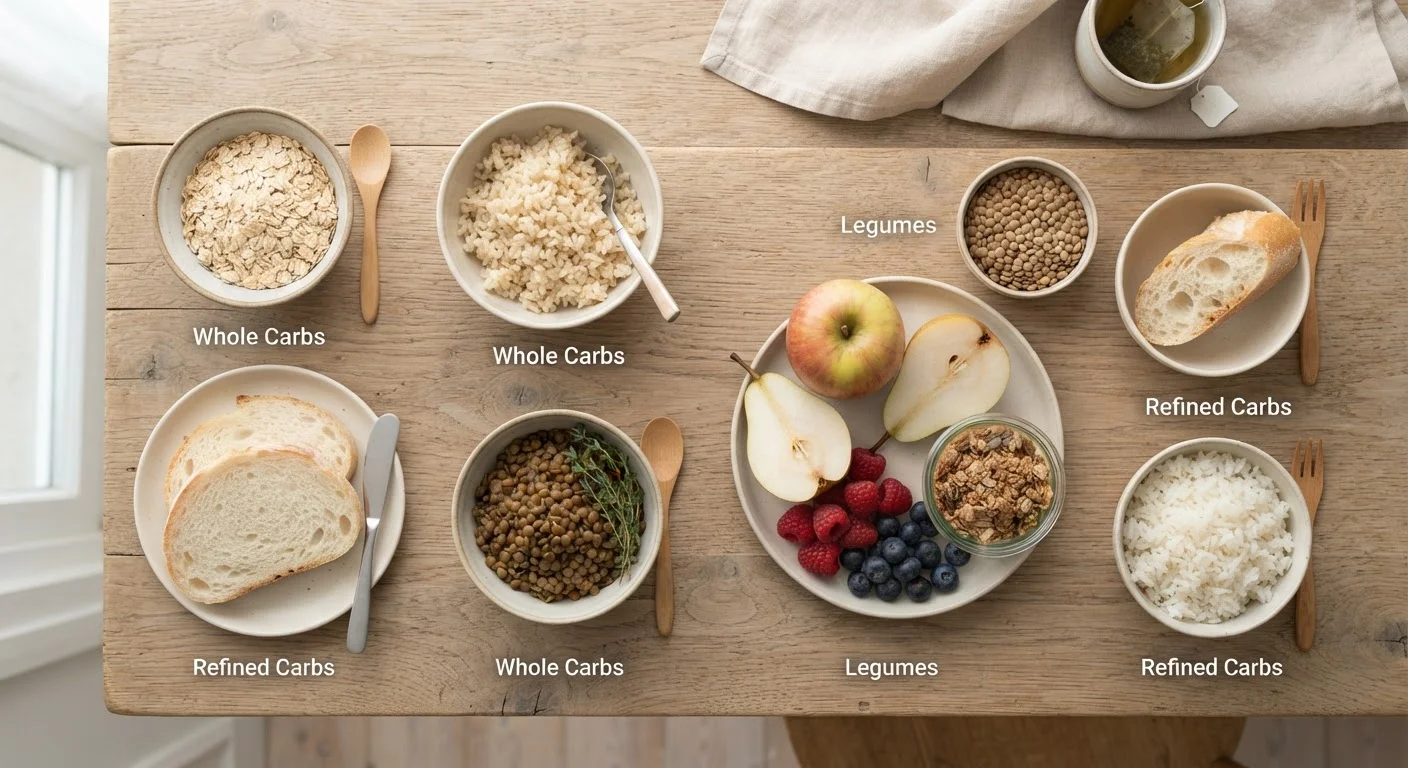
For people with type 2 diabetes or prediabetes, choosing lower-GI carbohydrates more consistently is associated with better glycemic control in several systematic reviews. It also gives everyday eaters a useful shorthand for comparing carbohydrate quality — for instance, understanding why legumes and intact whole grains generally cause a slower glucose rise than refined white flour products.
~50%
Variation in individual blood glucose responses
Research published in Cell (Zeevi et al., 2015) found that glycemic responses to identical foods varied dramatically between individuals, highlighting the limits of population-averaged GI scores.
Low GI
Dietary pattern associated with better glycemic control
A Cochrane review of dietary interventions found that low-GI diets were associated with modest improvements in HbA1c levels among people with type 2 diabetes compared to higher-GI diets.
The Real Limitations You Should Know
Ignores how foods combine in real meals
GI scores are measured for single foods eaten alone. Adding fat, protein, fiber, or acid (like vinegar) to a meal significantly slows glucose absorption, often making a high-GI food behave like a lower-GI one in practice.
Doesn't account for portion size
A food with a high GI score consumed in a small amount may raise blood sugar less than a low-GI food eaten in large quantities. GI alone cannot capture this, which is why glycemic load was developed as a companion metric.
Individual responses vary considerably
Research, including a widely-cited 2015 study published in Cell, has demonstrated that two people can have dramatically different blood glucose responses to the exact same food, driven by gut microbiome composition, genetics, and other personal factors.
Cooking methods and ripeness affect scores
Al dente pasta has a lower GI than well-cooked pasta; a ripe banana has a higher GI than an unripe one. These variables make published GI tables an approximation, not a precise individual prediction.
Can mislead about overall nutritional value
Some nutritious whole foods (like carrots) have moderate-to-high GI scores, while some processed foods engineered to be lower-GI are not necessarily healthier overall. GI reflects one variable — not nutrient density, fiber content, or overall diet quality.
Cooking Method Changes the Number
The same food prepared differently can have a meaningfully different GI. Pasta cooked al dente (firm) has a lower GI than the same pasta cooked until soft, because the starch structure remains less accessible to rapid digestion. Similarly, cooling cooked starchy foods like potatoes or rice increases their resistant starch content, which can lower the effective glycemic response. Published GI tables reflect averages and may not match how you actually prepare a food.
These limitations don't invalidate GI as a concept, but they do mean treating GI scores as precise, universal predictions is a mistake. Nutrition science consistently shows that single-metric approaches rarely capture the full picture of how food affects the body.
Glycemic Load: The More Practical Partner
Glycemic load (GL) addresses one of GI's biggest blind spots: portion size. GL is calculated by multiplying the GI of a food by the grams of carbohydrate in an actual serving, then dividing by 100. This brings the real-world amount consumed into the equation.
Watermelon illustrates the difference well. Its GI is relatively high (around 72), suggesting a rapid glucose spike. But a typical serving contains so little carbohydrate by weight that its glycemic load is low — meaning the practical blood sugar impact is modest. Relying on GI alone would lead to unnecessarily avoiding watermelon.
Using GI and GL together gives a more complete and realistic picture of a food's likely effect on blood sugar than either metric alone.
This article is for general informational purposes only and is not a substitute for personalized medical or dietary advice. If you have diabetes, prediabetes, or any metabolic condition, consult a qualified healthcare provider or registered dietitian before making significant dietary changes.